Guards chief says Israel must leave Lebanon or 'flee in defeat'
Iran’s Quds Force commander Esmail Qaani said on Thursday that Israel must leave Lebanon or face a forced withdrawal in defeat.
“You must leave all of Lebanon,” Qaani said in remarks carried by state media. “This land is a field of steadfastness and resistance, not a playground for occupiers.”
“If you do not withdraw of your own accord today, tomorrow you will be forced to flee in humiliation and defeat,” he said.
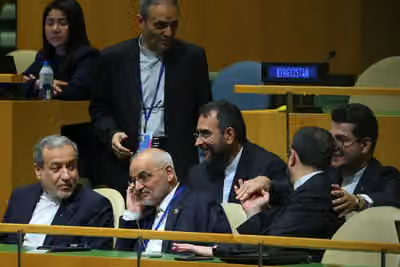
Oman said future arrangements for the Strait of Hormuz would not include transit fees, as it backed a memorandum of understanding between the United States and Iran.
Oman’s foreign minister made the remarks at a joint ministerial meeting between the Gulf Cooperation Council and the United States in Bahrain, Oman News Agency said.
He said Oman, as a state bordering the Strait of Hormuz, had a special responsibility to support international efforts to secure maritime navigation under international law and the UN Convention on the Law of the Sea.
Oman also called for the restoration of freedom of navigation and safe shipping through the strait, and said the US-Iran MoU should achieve its objectives to help deliver peace.
AI-generated illustration depicting CoinEx's role in cryptocurrency flows linked to Iran.
Iranian entities moved more than $3.84 billion in cryptocurrency through the Seychelles-based exchange CoinEx over the past six years, helping connect Iran's crypto ecosystem to global markets despite US sanctions, The Wall Street Journal reported on Wednesday.
CoinEx, the report said, has emerged as the largest foreign counterparty to Iran's biggest cryptocurrency exchange, Nobitex, replacing Binance after the latter tightened sanctions compliance.
The Journal said its reporting drew on blockchain data compiled by blockchain intelligence firm TRM Labs, which traced transactions involving more than 60 Iranian-linked entities.
Wallets with identifiable links to Iran, according to the analysis, transferred more than $3.84 billion through CoinEx since 2019. More than $763 million moved between CoinEx and Nobitex in 2025 alone, making CoinEx Nobitex's largest international counterparty.
The report also traced part of the proceeds from the $1.5 billion Bybit cryptocurrency theft earlier this year to digital wallets attributed to Iran's Central Bank.
Investigators said the funds were routed through multiple blockchains, decentralized finance protocols and unhosted wallets before reaching Nobitex. Ultimately, approximately $67 million was transferred into CoinEx deposit accounts, where it was mixed with other customer funds, making further tracing impossible.
The transactions, the Journal said, illustrate the challenges authorities face in enforcing sanctions through blockchain-based financial systems, where funds can move across multiple networks before reaching centralized exchanges.
CoinEx founder Haipo Yang acknowledged to the newspaper that the exchange had been widely used by Iranian customers but said it had no relationship with the Iranian government.
In a statement issued after publication of the report, CoinEx rejected suggestions that it had knowingly facilitated sanctions evasion or maintained ties with Iranian government institutions.
"CoinEx has never established any commercial relationship with Iranian government-related entities or Iranian domestic exchanges," the company said, adding that it had "never knowingly provided any form of facilitation" to sanctioned individuals or organizations.
The exchange also said it was blacklisted by Iranian authorities in 2021, had never maintained an office in Iran and disputed TRM's methodology for calculating transaction volumes, arguing that blockchain analytics vary between providers.
CoinEx said the transactions involving Alireza Derakhshan, an Iranian accused by the United States of helping run a network that sold Iranian oil, and Zedcex, a London-registered cryptocurrency exchange linked by US authorities to Iranian tycoon Babak Zanjani, occurred before US sanctions were imposed on those entities. Zanjani has described himself as a strategist for the Islamic Revolutionary Guards Corps' sanctions-evasion operations.
CoinEx also said it had helped freeze accounts linked to the Bybit hack and would conduct an internal review of the transactions highlighted by the newspaper.
Compliance tightened
Yang told the Journal that CoinEx recently stopped accepting new users from Iran and began removing existing Iranian accounts after US sanctions earlier this month targeted Nobitex.
The exchange said it has strengthened sanctions screening, introduced geographic restrictions for Iranian users, enhanced transaction monitoring and expanded customer identification procedures as part of a broader effort to reduce sanctions-related risks.
The Journal said cryptocurrency remains popular among ordinary Iranians seeking to protect savings from the weakening rial, with researchers estimating that about 13% of Iran's population owns digital assets in a market valued at between $8 billion and $10 billion in 2025.
The same infrastructure, the report said, has also become an important channel through which Iranian-linked entities can access the broader global cryptocurrency ecosystem.
Canadian security agencies flagged an Iranian doctoral student at Carleton University as a threat to national security, saying his aerospace research could help advance Iran’s weapons programs, Global News reported on Wednesday.
The report said Mohammadreza Pakatchian, 41, was pursuing a PhD in aerospace engineering at the Ottawa university after beginning studies online in 2023.
The Canadian Security Intelligence Service said Pakatchian worked for MAPNA, an Iranian company sanctioned by Canada over weapons of mass destruction concerns, and planned to return to the company after completing his studies, according to Global News.
“[He] represents a danger to the security of Canada,” the report quoted Canadian security records as saying.
Iranian Oil Minister Mohsen Paknejad met India’s Minister of Petroleum and Natural Gas Hardeep Singh Puri on Thursday on the sidelines of a BRICS energy meeting in Gurugram, Iran’s oil ministry said.
The ministers discussed energy cooperation, oil and gas ties, and the Chabahar port, the ministry said.
Paknejad also said lasting stability and security in West Asia required foreign forces to leave the region and US military bases to be dismantled.
“The only way to achieve stability and security in West Asia, which supplies a large share of the world’s energy, is for foreigners to leave the region,” he said.
He said regional countries should be responsible for their own security.
“Security in this strategic region must be entrusted to the countries of the region,” Paknejad said.
Aformer North Korean diplomat said Pyongyang received about $25 million for providing Iran with tunnel technology that he understood was used extensively at underground nuclear facilities near Natanz and Isfahan.
Ryu Hyun-woo, a former acting ambassador at North Korea’s embassy in Kuwait, made the remarks in an interview published this month by the Korea Development Institute, a prominent South Korean think tank.
“North Korea provided Iran with tunnel design and technology in the early 2000s, receiving about $25 million,” Ryu said.
“I understand that North Korean tunnel technology was applied to a considerable extent at underground nuclear facilities in areas such as Natanz and Isfahan,” he added.