Cargo ship hit by unknown projectile off Oman, UKMTO says
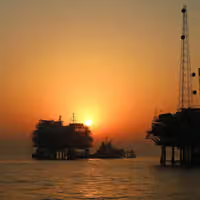
A cargo vessel was struck by an unknown projectile off the coast of Oman on Thursday, causing damage to its bridge but leaving no reported casualties or environmental impact, the UK Maritime Trade Operations said.
The British maritime security agency said the incident occurred at 2:10 PM UTC about 7.5 nautical miles southeast of Dahit, Oman. “A cargo vessel has been hit on the starboard side by an unknown projectile, causing damage to the bridge,” UKMTO said.
The ship’s master reported that all crew were safe and that there was no environmental damage.
The attack came after Iran’s IRGC Navy warned ships not to use any route through the Strait of Hormuz except those authorized by Iran
Ship & Bunker reported that vessel-tracking data showed traffic on routes close to Oman was continuing Thursday despite the warning.
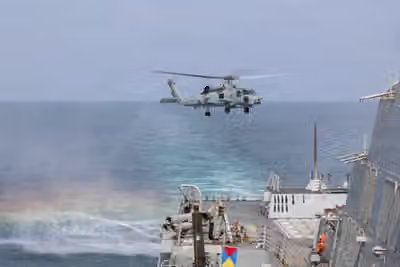
A hardline Iranian lawmaker said the new Hormuz route defined by Oman in coordination with the United States and the International Maritime Organization challenges Tehran's dominance over the strategic waterway and sets a "dangerous precedent".
He claimed the new route, along with what he described as repeated violations of the recent memorandum of understanding, required an immediate military response.
“Given the repeated violations of the memorandum in this short period, an immediate military reaction is the only way to prevent the consolidation of this dangerous precedent in the Strait of Hormuz,” Rasaei said.
He said the move came one day after Parliament Speaker Mohammad Bagher Ghalibaf visited Muscat.
US Vice President JD Vance said one of the biggest breakthroughs of the Switzerland talks with Iran was an agreement in principle to establish a direct military communication channel between the Revolutionary Guard and CENTCOM in Doha to help prevent future escalation.
Speaking to UnHerd aboard Air Force Two after the Lake Lucerne summit, Vance said Washington had sought “a channel on the Iranian side” for reducing conflict.
“They were like, ‘OK, fine, we’ll send somebody from the IRGC to go hang out in Doha with somebody from CENTCOM, and that’s how we’re going to settle a lot of these disputes,’” he said.
The talks, mediated by Pakistan and Qatar, brought US and Iranian officials together after the recent war and amid efforts to turn a preliminary memorandum of understanding into a broader settlement.
Vance described the MOU as a “foundational document” rather than a final nuclear deal, saying its basic logic was: “Let’s open the Strait, let’s stop shooting at each other, and let’s see if we can make a nuclear deal.”
He said Iran was offering terms “radically different” from the 2015 JCPOA, including a tougher inspection regime and the “elimination” of its existing enriched uranium stockpile, while also seeking a transformed relationship with the United States and the world.
The vice president also linked the emerging arrangement to wider regional de-escalation, including Lebanon. At the end of the summit, he said progress on Lebanon was “very good” and pointed to a deconfliction mechanism discussed in Switzerland.
Vance said Israel and “every other nation in the region” had the right to self-defense, but added that Washington wanted that right exercised in a context of de-escalation.
He acknowledged that the process remains uncertain, saying Iran is “talking differently than they have in the past,” but that the question is whether Tehran’s actions will follow its words.
A combo showing the aftermath of the 1990 quake in Iran's Manjil (left) and the Venezuelan people resting as they receive treatment in a field hospital in the aftermath of earthquakes, in La Guaira, Venezuela, June 24, 2026.
A World Cup fixture etched in Iran’s memory since the 1990 Rudbar-Manjil earthquake gained a grim new echo after twin quakes struck Venezuela as Brazil and Scotland met again 36 years later.
For most football fans, Brazil vs Scotland is just a World Cup pairing. For many Iranians and now Venezuelans, it has never been that simple.
The match recalls the early hours of June 21, 1990, when millions in Iran were awake for Italy 90 and Brazil’s 1-0 win over Scotland in Turin. Minutes later, northern Iran was shattered by the 7.4-magnitude Rudbar-Manjil earthquake, one of the deadliest disasters in the country’s modern history.
Now, 36 years later, the same fixture has coincided with another national tragedy, this time in Venezuela.
As Brazil beat Scotland 3-0 in Miami on Wednesday, two powerful earthquakes struck west of Caracas, sending buildings crashing down, forcing terrified residents into the streets and triggering a major rescue operation. US seismologists said the first quake measured magnitude 7.2 and was followed less than a minute later by a stronger 7.5 tremor.
Venezuelan authorities said at least 164 people had been killed and nearly 1,000 injured, with the toll expected to rise as rescue teams searched through collapsed buildings in Caracas, La Guaira and other damaged areas for over 14,000 missing people.
The US Geological Survey warned the eventual death toll could run into the thousands.
Interim President Delcy Rodriguez declared a state of emergency and said rescue crews were racing to reach those trapped beneath the rubble. Power outages, damaged roads and continuing aftershocks complicated the response. International offers of aid quickly followed.
For Venezuelans, the images were immediate and devastating: dust rising from apartment blocks, airports and hospitals under strain, families searching through debris, and people too frightened to return home.
For Iranians watching from afar, the timing reopened a wound buried deep in national memory.
40,000 people killed
The Rudbar-Manjil earthquake struck shortly after midnight local time in 1990, destroying towns and villages across Gilan and Zanjan provinces. Around 40,000 people were killed, tens of thousands were injured, and hundreds of thousands were left homeless.
Many survivors later told the same story: they were awake because of the Brazil-Scotland match. Some said football saved their lives, giving them the seconds they needed to run outside or protect their families when the walls began to shake.
There has never been an official study proving that the match reduced casualties, but the story became part of Iran’s collective memory.
That is why this week’s coincidence feels so jarring.
There is, of course, no scientific link between a football match and an earthquake. Seismology has no room for curses, omens or fixtures written into the earth’s plates. Venezuela sits in a seismically active zone, just as northern Iran lies along dangerous fault lines. The two disasters were geological events, not cosmic messages.
But memory does not always obey science.
For Brazil, Wednesday’s match was a clean passage into the World Cup knockout stage, with Vinicius Junior scoring twice and Matheus Cunha adding a third. For Scotland, it was a damaging defeat that left its hopes hanging by other results.
For Iran and Venezuela, however, Brazil vs Scotland now carries a darker meaning.
In Iran, it will always evoke the night Rudbar and Manjil collapsed. In Venezuela, it may now recall the evening when two quakes, 39 seconds apart, turned a World Cup night into a national disaster.
The Islamic Republic’s judiciary denied reports that chanting slogans against the United States or burning the US flag at gatherings had been banned, calling the claim “fake” and “false.”
The judiciary’s media center said no law or criminal provision exists banning such acts. It described the report as part of a media “psychological operation,” without giving further details.
The denial came after claims circulated that authorities had prohibited anti-US slogans and the burning of the American flag at public gatherings following the memorandum of understanding signed between Tehran and Washington.
File photo shows residents queue with containers to collect water from a public distribution point in the central Iranian city of Yazd amid water cuts.
Daily electricity and water outages disrupted life across Iran as summer began, with residents blaming years of underinvestment and deteriorating infrastructure despite officials citing rising demand and shrinking water supplies.
Messages sent to Iran International from residents in Khuzestan, Ilam, Lorestan, East Azarbaijan, Alborz, Tehran and other provinces described hours-long daily power cuts and recurring water shortages that began with the onset of summer.
The reports come as much of Iran experiences extreme heat, placing additional strain on the country's aging electricity and water networks.
A resident of Khuzestan, one of Iran's main electricity-producing provinces, said scheduled power cuts had resumed despite the province generating far more electricity than it consumes.
"On the first day of summer, with temperatures above 50 degrees Celsius, they started cutting electricity again in a province that produces twice its own needs."
Residents in Ilam province also reported electricity outages lasting up to four hours as temperatures reached 46 degrees Celsius. One warned that if the blackouts continue, authorities would face "angry and protesting people."
In Pardis, east of Tehran, a resident of a 14-story apartment building said electricity was cut for four hours during the day, leaving elevators out of service.
"How are we supposed to climb all these stairs?"
Others said the loss of elevator access posed particular difficulties for elderly residents and families with young children.
Water shortages deepen disruption
Citizens also reported prolonged water outages, which they said often coincided with electricity cuts because pumping stations stopped operating.
Mehdi Masaeli, secretary of Iran's Electricity Industry Syndicate, said last year that water supplies are interrupted when electricity fails because pumps stop working.
Residents in Boumehen near Tehran said they had access to running water on only two days during the previous week, and then only for a few hours.
"We have a sick person at home. We no longer know who to turn to."
People from Shahriar and Qods, west of Tehran, also described prolonged water cuts, with some saying supplies were unavailable from mid-afternoon until early the following morning. Several said repeated calls to the local water utility produced only tracking numbers and recorded messages.
"Water is a basic necessity, not a luxury service."
Officials have cited falling reservoir levels, declining rainfall and rising consumption as the main causes of the shortages. Many people, however, said authorities were blaming consumers instead of addressing years of underinvestment and poor management.
File photo shows residents lining up with containers to collect water from a tanker truck during water shortages in Iran.
One message from Ilam province said the city of Shabab had gone without running water for three consecutive days.
Some also compared the shortages with recent warnings about attacks on infrastructure.
"There was no need for anyone to attack the energy infrastructure," one citizen wrote. "Government inefficiency has taken our water away and pushed us back to the Stone Age. We carry water home in containers."
Higher bills, aging infrastructure
People also complained that utility bills had increased even as services deteriorated.
A resident in Zanjan said electricity and water tariffs had quietly risen just as power cuts resumed. In Ahvaz, people reported sharply higher water bills, with one saying many families could no longer afford to pay them and that local authorities were unwilling to offer installment plans.
Energy experts have long warned that Iran's electricity and water systems suffer from years of inadequate investment in power generation, transmission networks and water infrastructure.
They say authorities have repeatedly relied on rotating blackouts and water restrictions to manage seasonal shortages rather than addressing the underlying causes, leaving households increasingly vulnerable during periods of extreme heat.