Over recent days, at least four MPs—Hamid Rasai, Amir Hossein Sabeti, Abolfazl Aboutorabi and Kamran Ghazanfari—have publicly challenged Ghalibaf, accusing him of violating Supreme Leader Mojtaba Khamenei's red lines and keeping parliament closed to shield the government and negotiators from criticism.
Despite the attacks, Ghalibaf's position appears secure. A recent internal vote showed his supporters retain a comfortable majority, with fewer than 30 of the Majles' 290 members opposing his speakership.
All four leading critics belong to the ultraconservative Paydari (Steadfastness) Party, which has consistently opposed negotiations with the United States.
Even so, Ghazanfari has threatened that if parliament does not reopen before June 28, he and like-minded MPs will stage a sit-in outside the Majles. He argues the closure was never authorized by the Supreme National Security Council (SNSC), as Ghalibaf has maintained, and claims one man has effectively been making decisions on behalf of all 290 lawmakers.
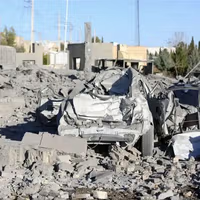
Parliament was originally closed after the outbreak of the 40-day war with Israel and the United States because of security concerns.
Ghazanfari's assertion that "all MPs" want parliament reopened is not borne out by events. Over the past four months, only Rasai has publicly demanded its reopening. Ghazanfari nevertheless accuses Ghalibaf of unlawfully keeping the Majles shut because he fears lawmakers would oppose negotiations with Washington.
Ghalibaf has rejected the allegation, saying parliament remains operational and that sessions are being held online because of continuing security risks. He has also called on the Judiciary to investigate the claims against him.
According to ILNA, Ghazanfari has further accused Ghalibaf of violating the constitution and falsely claiming the SNSC ordered parliament's closure.
He also alleges Ghalibaf refused to show MPs the purported SNSC authorization and ignored what he described as a request from Mojtaba Khamenei to reopen parliament.
Hardline MP Abolfazl Aboutorabi told the Didban Iran website that Ghalibaf was preventing parliament from legislating on Iran's sovereignty over the Strait of Hormuz. He accused the speaker of "playing with words" by presenting the accord with the United States as an MoU rather than a binding agreement.
Aboutorabi said several MPs were preparing a legal complaint against Ghalibaf, arguing that any memorandum or agreement should require parliamentary approval.
Asked whether MPs planned to impeach President Masoud Pezeshkian over the MoU, he replied that impeachment was not currently under consideration, adding: "Maybe God helps and makes him a martyr."
The remark is among the most serious death-tinged comments directed at the president since a prominent eulogist earlier suggested Pezeshkian could be beheaded before later insisting the remark had been intended as an "internal discussion."
Aboutorabi also accused Ghalibaf of violating Khamenei's red lines on the Strait of Hormuz and nuclear negotiations.
Similar allegations have been made by other Paydari figures, including Mahmoud Nabavian and Amir Hossein Sabeti, who argue the agreement with Washington is being pursued against the Supreme Leader's wishes.
For now, however, there is little indication the campaign is gaining traction beyond a small faction. Ghalibaf's support within parliament remains strong, while his longstanding ties to the Revolutionary Guards and Khamenei's inner circle leave him well placed to withstand attacks from rivals with far less institutional backing.