• العربية
  • فارسی
Brand
  • Iran Insight
  • Politics
  • Economy
  • Analysis
  • Special Report
  • Opinion
  • Podcast
  • Iran Insight
  • Politics
  • Economy
  • Analysis
  • Special Report
  • Opinion
  • Podcast
  • Theme
  • Language
    • العربية
    • فارسی
  • Iran Insight
  • Politics
  • Economy
  • Analysis
  • Special Report
  • Opinion
  • Podcast
All rights reserved for Volant Media UK Limited
volant media logo

US downed Iranian drones targeting commercial shipping in Strait of Hormuz

Jun 13, 2026, 02:36 GMT+1

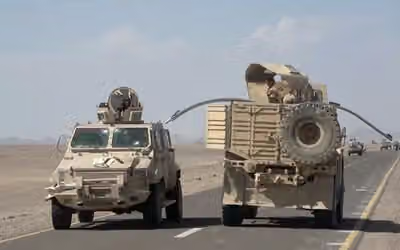
Iran launched multiple one-way attack drones in an attempt to strike commercial ships transiting the Strait of Hormuz, US Central Command said on Friday.

"Iran launched multiple one-way attack drones in an attempt to strike commercial ships transiting the Strait of Hormuz. U.S. forces have downed all of them in recent hours as traffic flow through the strait continues unimpeded. The international trade corridor remains open for transit," CENTCOM posted on X.
Most Viewed

Tit-for-tat under ceasefire: Experts warn of new normal in Mideast conflict
1

Tit-for-tat under ceasefire: Experts warn of new normal in Mideast conflict

2

Iran officials threaten Hormuz escalation as Trump says deal is near

3

Iran says US MoU may be signed in days as hardliners warn of retreat

4
ANALYSIS

The uneasy mix of diplomacy and pressure in Canada’s Iran policy

Banner
Banner

Spotlight

  • Iran officials threaten Hormuz escalation as Trump says deal is near

    Iran officials threaten Hormuz escalation as Trump says deal is near

  • How Nourabad Mamasani became an early flashpoint of Iran’s January bloodshed

    How Nourabad Mamasani became an early flashpoint of Iran’s January bloodshed

  • As prices soar, Iranian diets shrink to survival level
    VOICES FROM IRAN

    As prices soar, Iranian diets shrink to survival level

  • Iranian teens say rising costs turn simple wishes into distant dreams
    VOICES FROM IRAN

    Iranian teens say rising costs turn simple wishes into distant dreams

  • Faith in diplomacy further dented by Iran-Israel exchange
    INSIGHT

    Faith in diplomacy further dented by Iran-Israel exchange

  • 'Nothing is over':  Iran-Israel conflict enters a new phase
    ANALYSIS

    'Nothing is over': Iran-Israel conflict enters a new phase

•
•
•

More Stories

The uneasy mix of diplomacy and pressure in Canada’s Iran policy

Jun 13, 2026, 02:21 GMT+1
•
Mahsa Mortazavi
The uneasy mix of diplomacy and pressure in Canada’s Iran policy
100%

Canada’s response to the latest Iran crisis reflects the contradiction at the heart of Western policy toward Tehran: a continued call for diplomacy with a government it simultaneously treats as a source of terrorism, repression and regional instability.

In a written response to Iran International, the Canadian government said all parties involved in the latest exchanges between Iran, Israel and the United States must comply with international humanitarian law, including the protection of civilians and civilian infrastructure.

Ottawa also stressed the need for diplomacy and dialogue to resolve the crisis. But in Canada’s case, that language does not signal a softer approach toward Tehran. It sits alongside one of the most restrictive Iran policies among Western governments, built around sanctions, terrorist designations and a long-standing diplomatic rupture.

That tension is especially visible in Canada’s concern over the Strait of Hormuz.

Global Affairs Canada said Ottawa remains worried about disruptions in the strategic waterway and emphasized that respect for international navigation rights under international law is essential. It said the free flow of maritime traffic through the corridor is critical to global energy stability and supply chains.

For Canada, the crisis is therefore not only about preventing a wider war or limiting civilian harm. It is also about protecting the rules and routes that underpin global trade, energy flows and maritime security.

That is where Ottawa’s call for diplomacy begins to narrow. Canada supports de-escalation, but not in a way that separates the current crisis from Tehran’s broader conduct in the region.

Global Affairs Canada said Ottawa will continue working with allies and partners, both bilaterally and multilaterally, to support a diplomatic solution while countering what it describes as destabilizing activities by the Islamic Republic.

Those activities include Iran’s support for terrorist organizations, its ballistic missile program, nuclear activities and systematic human rights violations.

In other words, Canada’s message is not simply that the fighting should stop. It is that any diplomatic path must exist alongside continued pressure on the structures Ottawa believes drive Iran’s regional behavior.

That pressure is not only rhetorical.

Canada lists Hamas, Hezbollah and Yemen’s Houthi movement, also known as Ansarallah, as terrorist organizations. Ottawa has accused Iran of providing political, financial or military support to such groups.

In June 2024, Canada also listed the Islamic Revolutionary Guard Corps as a terrorist organization, following years of pressure from victims’ families of Flight PS752, human rights advocates and the Iranian-Canadian community.

Since 2012, Canada has designated Iran as a foreign state supporter of terrorism under the State Immunity Act, a legal framework that allows victims of terrorism to pursue civil action against the Iranian state in Canadian courts.

Together, those measures make Canada’s diplomatic language more constrained than it may first appear. Ottawa can call for dialogue, but it is doing so with a state it has legally and politically framed as a sponsor of terrorism and a source of transnational threats.

The sanctions record points in the same direction.

In March 2026, Canada sanctioned five individuals and four entities involved in procurement networks supplying technology used in IRGC weapons production, including drone-related systems. Canada said some Iranian arms, drones and technology have been transferred to Russia for use in the war against Ukraine.

A month earlier, Ottawa sanctioned seven individuals linked to Iranian state bodies responsible for intimidation, violence and transnational repression targeting dissidents and human rights defenders.

These measures show why Canada’s Iran policy cannot be read only through its latest call for restraint. The government is trying to prevent escalation in the short term while preserving the tools it has built over years to isolate and pressure Tehran.

The relationship has been moving in that direction for more than a decade.

Canada severed diplomatic relations with Iran in September 2012, closed its embassy in Tehran and declared Iranian diplomats in Canada persona non grata. Relations have not been restored since.

The gap widened further after the downing of Flight PS752, crackdowns on protests in Iran, allegations of transnational repression, Tehran’s regional activities, and concerns over its missile and nuclear programs.

Against that backdrop, Canada’s latest response is less a change in policy than a reminder of its limits. Ottawa wants diplomacy to contain the crisis, but it has little trust in the government with which diplomacy would have to be conducted.

That is the uneasy mix shaping Canada’s approach: avoid direct military involvement, keep channels for de-escalation open, and continue working with allies to restrict Iran’s room for maneuver.

The unresolved question is whether diplomacy can contain the crisis if Tehran is unwilling to make lasting changes, or whether negotiations will again become a way to delay pressure while preserving the policies that brought the region to this point.

Iranian MP criticizes parliament media over leaked draft on Iran-US talks

Jun 13, 2026, 00:42 GMT+1

Meisam Zohurian, an Iranian lawmaker, said on Friday a text published by the official media outlet of Iran’s parliament on a reported Iran-US agreement draft was “irresponsible” on multiple grounds.

"First, the text includes incorrect claims, such as the recognition of enrichment or the payment of Iran's funds at the outset of the agreement, which are not present in the actual text and effectively create a public perception of the text that will lead to dissatisfaction once the main text is released," he posted on X.

"Second, its publication prompted objections from the opposing side, resulting in the denial by Iran's Foreign Minister, which Trump interpreted as an apology from Iran," Zohurian added.

Service fee collection for Hormuz is part of negotiations, Iran says

Jun 13, 2026, 00:07 GMT+1

Iranian Foreign Minister Abbas Araghchi said Iran’s “pressure” over the Strait of Hormuz will remain in place indefinitely and that Iranian armed forces will intervene whenever necessary.

Araghchi added that under international law, imposing transit tolls on the Strait of Hormuz is not possible, but said that Iran is taking “service fees” and that the matter is part of ongoing negotiations, IRGC affiliated Tasnim reported.

UAE denies media reports alleging transfer of funds to Iran

Jun 12, 2026, 22:49 GMT+1

The United Arab Emirates on Friday denied media reports on the transfer of funds from the UAE to Iran, including claims involving $3 billion.

In a statement, the Ministry of Foreign Affairs said the allegations were “entirely false and unfounded,” adding that no frozen Iranian funds have been released, transferred, or facilitated through the UAE.

Iran says US MoU may be signed in days as hardliners warn of retreat

Jun 12, 2026, 22:22 GMT+1
Iran says US MoU may be signed in days as hardliners warn of retreat
100%

Iran’s foreign minister said a Memorandum of Understanding with the United States could be signed remotely in the coming days, even as Tehran said the text was not final and hardliners attacked both the emerging deal and his handling of its public messaging.

Foreign Minister Abbas Araghchi told state television Friday that the memorandum could be signed once the final stages of negotiations are completed.

“Probably in the coming days, the memorandum of understanding between us and the United States will be signed,” Araghchi said.

He added that the signing would take place digitally and remotely after the final negotiating stages are passed, saying the process would be announced and could happen “in the coming days.”

But Araghchi also cautioned that the memorandum had not yet been signed and could still change. Foreign Ministry spokesman Esmail Baghaei said separately that the text was in the final stages of internal review and that no final decision had been made.

“Regarding the text of the understanding, we are in the final internal review stages. A meeting of the relevant bodies is currently underway,” Baghaei said.

Interim deal before nuclear talks

Araghchi sought to present the memorandum not as a final nuclear settlement, but as an interim political and security arrangement that would have to be implemented before any nuclear negotiations begin.

He said nuclear talks with the United States would take place only at a later stage and would not proceed unless the proposed interim deal was implemented first.

According to Araghchi, the interim arrangement would include reopening the Strait of Hormuz and ending conflicts on multiple fronts. He said management of the strait would not return to the pre-war era, adding that sovereignty over the waterway belonged to Iran and Oman and that Iran would secure safe passage for ships through it.

Araghchi also said the draft memorandum contains 14 articles and that nuclear issues had been moved to a second phase of negotiations lasting 60 days. He said the first phase included ending the war in Iran and on other fronts, as well as mutual commitments by Tehran and Washington not to interfere in each other’s internal affairs.

The comments came after Araghchi wrote on X that the “Islamabad Memorandum of Understanding” had never been closer to finalization, while urging media outlets not to speculate about its contents before the process is complete.

Hardliners target Araghchi

Araghchi’s public messaging quickly drew criticism from hardline circles, especially after President Donald Trump reposted his message and described it as “very positive.”

Fars News Agency, which is affiliated with the Revolutionary Guards, criticized Araghchi for what it called an “ambiguous” response to Trump’s rejection of Iranian media reports about the terms of a possible agreement.

The outlet said Araghchi’s English-language post failed to directly rebut Trump’s claim that leaked Iranian accounts of the agreement were false. Fars said his call for media restraint could be interpreted as an indirect confirmation that some of the published Iranian reports were inaccurate.

Fars also noted that Trump reposted Araghchi’s message shortly after it was published, portraying the Iranian foreign minister’s remarks as support for his own version of the negotiations.

Trump had earlier rejected Iranian media reports about the possible terms of the MoU, saying leaked details published in Iran had “NOTHING” to do with the written terms and bore “no relation to the truth.” He later told Axios that Iran had privately “apologized for putting out false information,” while saying he still believed a deal could be signed over the weekend or on Monday.

Hardline lawmaker Mahmoud Nabavian also criticized the latest version of the draft, saying it was more damaging than two earlier versions and involved greater Iranian concessions.

“After seeing the text of the agreement, I must say that compared with the two previous versions, it is more damaging and Iran’s retreats have also increased,” Nabavian said.

He posted a screenshot of Trump reposting Araghchi’s remarks and used it to attack Iranian officials involved in the talks.

“An agreement cooked up by the architects of the disgraceful JCPOA is certainly pure loss,” Nabavian wrote, using a phrase long used by hardliners to criticize the 2015 nuclear deal.

Several Friday prayer leaders also warned against compromise with Washington. Ahmad Alamolhoda, the Friday prayer leader in Mashhad, said no understanding would be acceptable without the approval of Supreme Leader Mojtaba Khamenei.

Mohammad Nabi Mousavifard, the Friday prayer leader in Ahvaz, said any retreat before what he called the “US and Israeli front” was “forbidden and unacceptable,” while Mohammad Mehdi Hosseini Hamedani in Karaj warned that countries assisting Iran’s enemies could become targets.

Conflicting reports over terms

The political pressure has been sharpened by sharply different accounts from Tehran and Washington over what the memorandum actually contains.

Iranian state media published details of what it called a 14-point draft understanding with the United States, including a ceasefire on all fronts, the lifting of the naval blockade and oil sanctions, the release of blocked funds, and future talks limited to nuclear and sanctions issues while excluding Iran’s missile program and support for regional allies.

Mehr News Agency said the draft included reconstruction projects worth at least $300 billion and the release of billions of dollars in frozen Iranian assets. It said final talks would not start until some oil sanctions were suspended, part of the frozen assets were released and the naval blockade was lifted.

US officials have described the emerging deal very differently.

A senior US official told Reuters the MoU would require the dismantling of Iran’s nuclear program, the on-site destruction and subsequent removal of its highly enriched uranium from Iran, and a long-term inspection regime to enforce compliance.

The official said the deal would be “performance-based,” meaning Iran would receive no access to frozen assets until it had fulfilled its obligations.

Fox News, citing a White House official, reported that those obligations would include dismantling Iran’s nuclear program, removing nuclear material and ending support for proxy groups before sanctions relief is granted.

Vice President J.D. Vance also said Iranian authorities would receive no money simply for signing an agreement or attending a meeting.

“There is a lot of misinformation being circulated about a possible agreement to reopen the Strait of Hormuz and end the Islamic Republic’s nuclear weapons program,” Vance said.

Close, but contested

The hardline backlash has contrasted with signals from some senior officials that Iran is preparing for possible implementation.

Parliament Speaker Mohammad Bagher Ghalibaf, who heads Iran’s negotiating delegation, said commitments made under a looming deal with the United States must be upheld, warning there would be “no ifs, no buts, no excuses.”

Fars has denied reports that an agreement would be signed in Geneva on Sunday, saying Iran’s review and decision-making process had not been finalized and that claims about both the timing and location were “completely false.”

The denial effectively overtook earlier speculation in Iranian media over a public signing ceremony and who might represent Tehran if one took place.

For now, Iranian officials are presenting the memorandum as close to completion but still unsigned, while Washington is insisting that any benefits for Tehran will depend on concrete performance.

That gap has left both sides trying to shape the public narrative before any document is signed.

In Tehran, the dispute has already moved beyond the content of the memorandum itself to a broader question: whether the leadership can sell an interim understanding with Washington to a political base that still views direct compromise with the United States as a humiliation.

Historian and analyst Abdollah Shahbazi said any document signed at this stage would likely be a memorandum of understanding rather than a legally binding agreement, warning that any such text could at best provide a temporary pause before tensions return.