Trump says open to meeting Khamenei despite not being his ‘favorite person’
President Donald Trump said on Thursday he would be open to meeting Iran's new Supreme Leader Mojtaba Khamenei if it helped secure a deal with Iran, adding that he would be “honored” and “respectful” despite admitting he is “not his favorite person.”
"I don't want to meet, but if I did meet, I'd be honored to meet him. I'd like to see if we make a deal, but if we make a deal, it's possible that I would meet him. I'd be okay with it," he told reporters at the White House.
"I haven't really heard too much about it. I didn't suggest it (a meeting), but some people have suggested it. If it happened, it would be happening. I'd be respectful. I would say I'm not his favorite person, but with that being said, he's probably a professional. In some circles he has a very good reputation, actually.

President Donald Trump said he considered sending US special operations forces to retrieve Iran’s highly enriched uranium stockpile, but rejected the idea because the mission would require weeks inside a war zone and risk becoming a “Jimmy Carter” moment.
"I didn't want to be Jimmy Carter. I didn't feel like being Jimmy Carter, so that topic we did. Well, we thought about it right at the very beginning, before you saw, before we did what we did, what before we destroyed their entire military. We thought about it, and I didn't want to be in a position where you had been here to get there," he told reporters at the White House.
"It's not like it's not like Venezuela, like you go in, you're there for a matter of minutes and you're out and everybody's waving goodbye as you, and you brought the cargo to be there for two weeks, you need massive equipment to airlift the equipment, and you're in a war zone."
"There was a time at the very beginning when we thought about doing that, because they would have not been watching, but they would have found out."
Five Kurdish Iranian opposition groups formed a coalition against the regime in Iran, Feb 22, 2026.
Three Iranian Kurdish opposition groups denied Israeli media reports that the Mossad and CIA had armed Kurdish fighters as part of a plan to help bring down Iran’s government.
Israeli outlet Ynet reported on Thursday that the Mossad armed Kurdish militias with weapons seized from Hamas in Gaza and Hezbollah in Lebanon as part of a plan to facilitate regime change in Iran.
The report said the CIA was also involved in the plan, but that US President Donald Trump ultimately canceled it under pressure from Turkish President Recep Tayyip Erdogan. It said the Kurds received money and vehicles and were armed with light weapons, anti-tank missiles, grenades and mortar shells.
However, Abdullah Mohtadi, secretary-general of the Komala Party of Iranian Kurdistan, told Iran International that his party had not received any weapons from Israel or the United States.
Khalid Azizi, spokesman for the Democratic Party of Iranian Kurdistan, also told Iran International that his party had received no weapons from Israel or the United States, calling the reports “completely untrue.”
Reza Kaabi, secretary-general of the Komala Party of Toilers of Kurdistan, also denied receiving any weapons from Israel or the United States and said other Iranian Kurdish parties had not received any weapons from the two countries either.
The three parties are among Iranian Kurdish opposition groups that have long opposed the Islamic Republic.
Kurdish ground invasion plan
The Jerusalem Post separately reported on Thursday that, according to sources close to outgoing Mossad chief David Barnea, the United States was in many ways the originator of the idea of using Kurdish forces to open an internal ground front against Iran’s government.
The report said Israel had hoped to activate Kurdish forces with previous combat experience, including groups involved in US-backed operations against Saddam Hussein in Iraq in 2003.
It said Israeli officials believed such a plan could allow Washington to avoid deploying its own ground forces, while Israel would provide air cover and firepower against Iranian forces trying to block a Kurdish advance.
In April, when asked about reported plans to have Kurdish forces launch a ground operation against Iran, Trump said, “I'd rather have them stay away because I think they bring with them some problems and some difficulties. They bring death, I mean to themselves."
The Jerusalem Post said the plan was ultimately halted amid disagreements in Washington over whether it could succeed, as well as pressure from Erdogan, who opposed any Kurdish military operation that could strengthen Kurdish groups near Turkey.
The report said some Israeli officials were skeptical of the operation, while Mossad officials and sources close to Barnea argued that the agency had already prepared the ground for it.
The report also said Israel had begun striking Iranian government and Basij targets in Kurdish areas during the war, but that only ten percent of the targets intended to support a Kurdish ground operation were hit before that stage of the campaign was halted.
According to the Jerusalem Post, Barnea told Trump in a video call on February 12 that Iran’s government was unlikely to fall immediately, but that a war combined with Kurdish ground pressure and continued US financial, maritime, diplomatic and military pressure could create the conditions for regime change within a year or more.
The report said Barnea believed those plans would become far less relevant if Trump lifted economic sanctions or ended the US counter-blockade against Iran in the Strait of Hormuz before a final agreement on key disputes.
In that scenario, the report said, Iran’s government could regain access to funds, strengthen its position and reduce the internal pressure needed for any renewed regime-change effort.
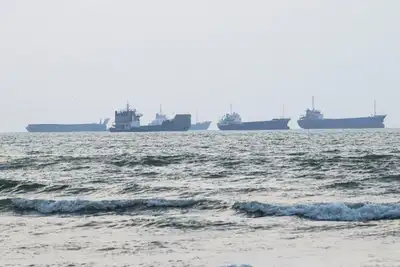
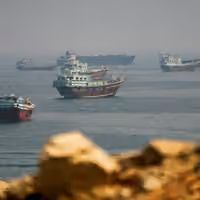
Four Iranian-flagged oil tankers passed through the Strait of Hormuz on Monday for the first time since April 15 and the US blockade of Iranian ports, AFP reported, citing maritime tracking firm Kpler.
The tankers Hilda I, Amber, Silvia 1 and Happiness I were carrying a total of seven million barrels of oil, the report said.
The ships loaded their cargo in mid-April on Kharg Island, Iran’s main oil terminal, and crossed the strait on Monday with their AIS transponders turned off, the report said.
As Iran grapples with its most severe crisis since 1979, a new book by journalists Yeganeh Torbati and Bozorgmehr Sharafedin is revisiting how a revolution built on promises of justice and equality turned into what the authors describe as a mafia state.
Published this week, Stolen Revolution: Betrayal and Hope in Modern Iran has drawn attention at policy forums in Washington and New York, where its authors discussed Iran’s modern history, the resilience of the Islamic Republic and the country’s uncertain future after war, economic collapse and the succession of Mojtaba Khamenei.
The New York Times Book Review described Stolen Revolution as “one of the most perceptive books on modern Iran in years, capturing not only the machinery of repression but the fragile forms of hope that survive beneath it.”
The Center for Middle East Policy at Brookings hosted Torbati, the New York Times Iran correspondent, and Sharafedin, the Head of Digital at Iran International and a former Reuters Iran correspondent, on Wednesday.
The discussion was moderated by Suzanne Maloney, an Iran scholar and vice president and director of the Foreign Policy program at Brookings.
“One theme that runs throughout the book is the constant push and pull between the nation and the state,” Sharafedin said at the event.
“The Islamic Republic tries to project an image of continuity, to show it is business as usual and they are in full control. Much of the people’s struggle against the system has been an effort to break that continuity. Yet the system has proved quite resilient. Even foreign intervention was unable to create a rupture or break that continuity,” he said.
Sharafedin said the succession of Mojtaba Khamenei after his father was a sign of that continuity.
Authors Yeganeh Torbati and Bozorgmehr Sharafedin speak at the Brookings Institution in Washington, DC, on June 3, 2026, in a discussion moderated by Suzanne Maloney.
The assassination of Iran's Supreme Leader Ali Khamenei in late February plunged the country into its most perilous crisis since the 1979 revolution, leaving the Islamic Republic struggling with the aftermath of war, a collapsing economy and the military's expanding role in state affairs.
“I think what we've learned over the last 10 or 12 weeks—and what also became clearer to us while writing the book—is that individuals play a very important role in shaping the trajectory of events,” Torbati said.
“At the same time, the system is bigger than any one person—whether a supreme leader, a general, or a national security adviser. It is a system deeply committed to its own survival and self-preservation.”
Torbati said Iran is projected to face around 70 percent inflation this year. Food prices have soared, and layoffs have followed the war. Yet the system and its leadership appear willing to absorb those costs, and have ordinary Iranians bear much of the burden, in order to survive and avoid capitulating to the United States and Israel.
Yeganeh Torbati
“By contrast, American leaders must contend with public opinion. President Trump has to worry about public support, and his party has to worry about the midterm elections,” she said.
“As a result, the Iranian government can often tolerate far more pain and pursue tactics for much longer than its American counterparts. I think that helps explain its survival up to this point.”
At a separate discussion hosted by the 92nd Street Y in New York on Wednesday night, journalist Scott Anderson, the author of King of Kings, joined Torbati and Sharafedin to assess Iran's modern history and the fallout from the US-Israeli war.
“Iranians have expressed [they want democracy] many, many times, and they've been machine-gunned for it,” Anderson said, referring to the January massacre in Iran that killed tens of thousands.
“Iran is not a closed society like North Korea. Iranians have a very good concept of what's happening in the outside world. Yet it's just this massive monolithic structure that has the guns,” he said.
Bozorgmehr Sharafedin
The book traces how a revolution that promised to build an egalitarian society gradually transformed into what the authors describe as a mafia state. It tells that story through the lives of six Iranians whose experiences span the arc of modern Iranian history and who undergo profound transformations themselves.
One of them is Mehdi Karroubi, a devoted follower of Ayatollah Ruhollah Khomeini who rose to the highest ranks of power. Over time, however, he became a vocal critic of the Islamic Republic after seeing corruption, especially the growing role of the Revolutionary Guards in the economy. He paid a heavy price for his criticism and ultimately spent years under house arrest.
Another is Said Rahmani, who returned to Iran hoping to spark a startup boom in his country. Instead, he encountered a ruthless security state that seized much of his business empire and eventually forced him into exile.
“In my opinion, this is a book that will be of great interest both to those who have never read anything about Iran but are watching the news and want to better understand the country, and to those of us who already have large libraries of books on Iran,” Maloney said.
Former UK Foreign Secretary Jack Straw called the book “extraordinarily powerful,” while Jonathan Blitzer, an American journalist and writer, described it as “a masterwork of reporting.”
David Hoffman, author of The Billion Dollar Spy, called it “a brilliant investigative history of modern Iran,” and the BBC’s Lyse Doucet said it was “a rare and riveting chronicle of a major political story of our time.”
Iran and Hezbollah are trying to undermine hopes for security and peace following a US-brokered ceasefire between Israel and Lebanon, Israel's ambassador to the United States said on X.
Yechiel Leiter said the agreement was based on Hezbollah stopping fire, withdrawing from southern Lebanon and being disarmed.
"There was real hope at the negotiating table for a new chapter of security and peace. Hezbollah and Iran are trying to destroy that hope. They must not succeed," he said.