Araghchi says he was in Khamenei’s office when he was killed
Iranian Foreign Minister Abbas Araghchi said he was in Ali Khamenei’s office when the former supreme leader was killed in US-Israeli strikes on February 28.
"When I came out from under the rubble, I was only thinking about whether he had been targeted or not," Araghchi told Hezbollah-affiliated Al Mayadeen.
"After returning from the Geneva negotiations on Friday, I went to his office at 9 a.m. on Saturday to present my report," Araghchi said.
"My report was about the negotiations and the atmosphere that emerged on Friday, which made the possibility of war much greater," he said.
"The building where we were sitting was targeted, but the wing we were in remained intact," Araghchi said.
"I felt that, based on the normal course of work, the leader would definitely be in his office," he added.
"Although the possibility of war was high, the martyred leader's spirit prevented him from going to shelters," Araghchi said.
The office of Iran’s exiled Prince Reza Pahlavi called on Iranians abroad to hold gatherings around June 16 to mark the birthday of Majidreza Rahnavard, a protester executed after Iran’s 2022 nationwide protests, and to use World Cup matches to display the lion-and-sun flag and images of protesters killed by the Islamic Republic.
The call comes as Iran’s team is due to be based in Tijuana, Mexico, for the World Cup, while playing its group-stage matches in Los Angeles and Seattle. Several outlets have reported that FIFA plans to ban Iran’s pre-revolutionary Lion and Sun flag at the tournament.
The statement said the World Cup provided a rare opportunity to bring the voice of the Iranian people to the world.
"Now is the time to show up; the time for even greater unity under Iran’s national flag," Pahlavi's office said.
It called on Iranians in North America to gather in large numbers inside and outside stadiums and show what it described as "the will and determination of a united nation to reclaim its homeland."
Footage showing an Iranian drone striking Kuwait airport was fabricated by Iran's adversaries, a military source told Tasnim News Agency, which is affiliated with the Revolutionary Guards.
The source said drones launched by the IRGC Aerospace Force toward US targets in Kuwait struck during overnight operations, whereas the widely circulated videos and images showed daylight conditions, suggesting they were unrelated to the attack.
The comments appeared to contradict earlier remarks by IRGC spokesman Hossein Mohebbi, who said damage to Kuwait airport's passenger terminal had been caused by errors in US Patriot air defense systems.
Supporters of the ultra-hardline Paydari Front were removed earlier this week from nightly state-organized rallies backing the Islamic Republic, in an apparent effort to contain hardline pressure as talks with the United States continue, Iran International has learned.
Supporters of the ultra-hardline Paydari Front were removed earlier this week from nightly pro-government rallies held in support of the Islamic Republic, Iran International has learned.
According to the information obtained by Iran International, the order to keep Paydari supporters away from the gatherings was issued after requests by President Masoud Pezeshkian and Parliament Speaker Mohammad Bagher Ghalibaf, who also heads Tehran’s negotiating team.
Protesters carrying placards opposing concessions on the nuclear issue have also been removed from the state-backed rallies, according to the same information.
File photo of men resting in a dormitory at an addiction treatment camp in Iran.
Shortages and rising prices of addiction treatment medicines are disrupting care for many people with substance dependence in Iran, raising concerns that patients could relapse or turn to more dangerous drugs, a former addiction treatment official said on Thursday.
"The shortage of opium tincture has become one of the most serious challenges facing addiction treatment centers," Saeed Safatian, a former treatment director at Iran's Drug Control Headquarters, told ILNA.
Supplies of opium tincture, one of the three main medicines used in Iran's addiction treatment system alongside methadone and buprenorphine, have fallen sharply in recent months.
Safatian linked the shortages to reduced availability of raw opium following the Taliban's ban on poppy cultivation in Afghanistan and said authorities had failed to prepare adequately despite years of warnings about potential supply disruptions.
Proposals to cultivate opium domestically for pharmaceutical purposes and efforts to secure imports from countries including India and Turkey failed to materialize, leaving treatment providers with few options, according to Safatian.
File photo of residents sitting on bunk beds inside an addiction treatment and rehabilitation camp in Iran.
The shortages have fueled concerns among addiction specialists that patients unable to obtain prescribed medicines could return to the illicit drug market.
"Nearly one million patients depend on maintenance treatment with opium tincture across the country, but treatment centers in more than 15 provinces have faced shortages or suspension of their medicine allocations," Ali Ahmadi, deputy head of Tehran province's addiction treatment providers association, said earlier during a protest by treatment providers outside the Health Ministry.
A worker at an addiction treatment center told Iran International in January that he had received no support from the State Welfare Organization despite a decade of operating a treatment facility. The revocation of licenses for some centers had also pushed many patients toward methadone treatment, he said.
The effects of the shortages became apparent in 2023 and intensified in 2025, when some treatment centers were able to provide opium tincture to only a fraction of patients seeking it, Safatian said.
He warned that some users could shift to methamphetamine or combine multiple substances, making treatment more difficult and increasing health, social and economic harms.
Shortages of opium tincture, methadone and other addiction medicines, he said, could continue in the coming months if problems securing raw materials and foreign currency persist, adding to pressure on Iran's addiction treatment system.
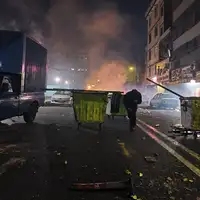
A scene of nightly state-organized rallies in Tehran
Supporters of the ultra-hardline Paydari Front were removed earlier this week from nightly state-organized rallies backing the Islamic Republic, in an apparent effort to contain hardline pressure as talks with the United States continue, Iran International has learned.
According to the information obtained by Iran International, the order to keep Paydari supporters away from the gatherings was issued after requests by President Masoud Pezeshkian and Parliament Speaker Mohammad Bagher Ghalibaf, who also heads Tehran’s negotiating team.
Protesters carrying placards opposing concessions on the nuclear issue have also been removed from the state-backed rallies, according to the same information.
The move points to an effort by senior figures in the Islamic Republic to contain ultra-hardline pressure at a sensitive moment, as Tehran and Washington continue talks over a possible understanding involving the ceasefire, the Strait of Hormuz, frozen Iranian assets and nuclear-related terms.
The Paydari Front and its allies have been among the most vocal opponents of negotiations with the United States. In recent days, figures close to the camp have criticized Ghalibaf and the negotiating team, warning against concessions and arguing that talks with Washington amount to a mistake.
The reported removals came as the Islamic Republic held the first anniversary ceremony for Ruhollah Khomeini since the killing of Ali Khamenei, without the former supreme leader’s presence.
During the ceremony on Thursday, Mojtaba Khamenei issued a message warning against what he called doubt, despair, fear and suspicion.
The message, read by Mohammad-Javad Haj-Ali-Akbari, Tehran’s interim Friday prayer leader, said any action that causes public pessimism or disillusionment amounts to helping the enemy.