Putin says he hopes Iran conflict ends soon
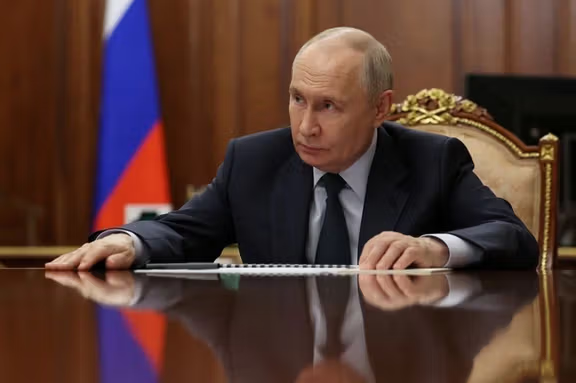
Russian President Vladimir Putin said he hopes the Iran conflict ends as soon as possible, warning that everyone would lose if the war continues, Reuters reported.
Russian President Vladimir Putin said he hopes the Iran conflict ends as soon as possible, warning that everyone would lose if the war continues, Reuters reported.




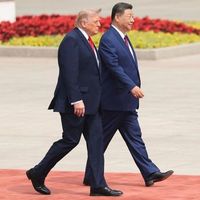
The United States sanctioned three Chinese companies accused of helping Iran’s military carry out strikes on US forces in the Middle East, escalating tensions with Beijing days before President Donald Trump is due to meet Chinese President Xi Jinping.
The US State Department said Meentropy Technology (Hangzhou) Co., Earth Eye and Chang Guang Satellite Technology Co. provided satellite imagery that enabled Iranian military strikes against US forces in the region.
“The targeting of US service members and partners will not go unanswered,” the State Department said, according to Politico.
Washington said it would continue to hold China-based entities accountable for supporting Iran and to prevent Tehran from rebuilding what it called “proliferation-sensitive programs” after Operation Epic Fury.
Politico said the sanctions are likely to give Trump additional leverage before his talks with Xi, where he is expected to push Beijing to pressure Tehran toward a deal that would reopen the Strait of Hormuz to normal shipping.
The administration also sanctioned 10 other entities and individuals in countries including Belarus, Iran and the United Arab Emirates, accusing them of helping Iran’s military secure weapons.
The new sanctions come less than a week before Trump is expected to travel to Beijing with a delegation of US CEOs seeking deals with China, even as US defense officials worry the draining conflict with Iran could give Xi more leverage in talks with Washington.
The latest measures add to a growing trade and sanctions dispute between the world’s two largest economies. Last week, China’s Commerce Ministry banned enforcement of, or compliance with, separate US sanctions on five Chinese oil refineries accused of buying Iranian oil.
Despite the tensions, Trump has suggested he believes Xi can be helpful on the Iran crisis.
“That’ll be one subject,” Trump said at an Oval Office press conference last week, referring to Iran. “But he’s been very nice about this. In all fairness, he gets like 60 percent of his oil from Hormuz. I think he’s been very respectful. We haven’t been challenged by China.”
The Iran war is disrupting fuel and fertilizer supplies from the Middle East, pushing Asian farmers to cut planting or reduce fertilizer use at the start of key growing seasons, The Washington Post reported.
The disruption stems from damage to Persian Gulf gas infrastructure and the rival US-Iran efforts to restrict movement through the Strait of Hormuz, which have prevented key supplies of fuel and urea fertilizer from leaving the Middle East, according to the report.
Urea, a nitrogen-rich fertilizer used to boost crop yields, has been especially affected. The report cited market analysts saying about 30% of the world’s urea supply has effectively been wiped out, with spot prices up 40% since February.
The impact is being felt first in countries entering major planting periods, including Thailand, the Philippines, Bangladesh and Australia, where farmers are cutting planting areas or using less fertilizer, steps that could reduce harvests later this year.
The report said India and Brazil, two of the world’s largest agricultural producers, are expected to ramp up urea orders in June, raising the risk of wider pressure on global food supplies if shipping through the Persian Gulf does not recover.
UN Food and Agriculture Organization officials warned the war had become a disruption at the center of the global food system, with possible effects on commodity prices, inflation and growth if the crisis continues.
The report said the fallout could worsen if a major El Niño climate pattern brings extreme heat and drought this year, adding another threat to harvests already hit by higher fuel and fertilizer costs.
An adviser to Iran’s Foreign Ministry spokesperson said Tehran is reviewing a US proposal despite deep mistrust of Washington and what he called American “provocations” in the Strait of Hormuz.
Ali Safari told Al Mayadeen that Tehran had responded to all US actions in the strait and now described the process as one of “rebuilding trust” with Washington.
“We are reviewing their proposal,” Safari said, adding that Iran had received messages through different channels saying the US does not want a military escalation.
He said Iran did not want to use the Strait of Hormuz as leverage, but said Washington had attacked Iran and Tehran had responded.
“The attacks can no longer be ignored,” he said, adding that the US “cannot again use the Strait of Hormuz to attack Iran and the countries of the region.”
Safari said Tehran’s priority is to stop the war, reopen the Strait of Hormuz and prevent what he called US “piracy.”
“When we say ending the war, we mean all fronts, especially Lebanon,” he added.
Safari also said Iran is in contact with official parties in Lebanon, and criticized regional countries backing a UN Security Council draft resolution against Iran, saying they had opened their territory to US “aggression.”
He said the United Arab Emirates was among the countries that had participated in the war against Iran.
A member of Iran’s parliament urged people to save electricity, water and fuel, describing conservation as part of the country’s response to what he called an “economic war.”
Majid Doustali, a member of parliament’s Planning and Budget Committee, said people had an important duty to conserve resources, adding that saving was “not only an economic recommendation” but rooted in religious and moral teachings.
He said the enemy wanted to use problems such as shortages of electricity, water and fuel to pressure people and create public dissatisfaction.
“Every amount of saving by the people is in fact a direct confrontation with this economic conspiracy by the enemy,” Doustali said.
Republican Senator Lindsey Graham said any negotiated settlement with Iran must include an end to Tehran’s state sponsorship of terrorism through support for Hezbollah and other groups, warning that continued backing for proxies should bring “the severest of consequences.”
“Without that Lebanon and Syria will never be stabilized and Israel will never know peace.”
Graham made the comments while reposting a video of President Donald Trump telling reporters that Washington could return to “Project Freedom” if negotiations do not produce a deal.
“We’ll go a different route if everything doesn’t get signed up, buttoned up,” Trump said. “We may go back to Project Freedom if things don’t happen – but it’ll be Project Freedom Plus, meaning Project Freedom plus other things.”
Graham called the idea of “Project Freedom Plus” “very intriguing” and said it could bear fruit, describing safe passage for international shipping in the Strait of Hormuz “in the face of Iranian resistance as a game changer.”
He said the “plus” part, in his view, would involve more international partners and “limited kinetic activity.”