• العربية
  • فارسی
Brand
  • Iran Insight
  • Politics
  • Economy
  • Analysis
  • Special Report
  • Opinion
  • Podcast
  • Iran Insight
  • Politics
  • Economy
  • Analysis
  • Special Report
  • Opinion
  • Podcast
  • Theme
  • Language
    • العربية
    • فارسی
  • Iran Insight
  • Politics
  • Economy
  • Analysis
  • Special Report
  • Opinion
  • Podcast
All rights reserved for Volant Media UK Limited
volant media logo

Satellite images show oil slick off Iran’s Kharg Island - AP

May 8, 2026, 21:55 GMT+1

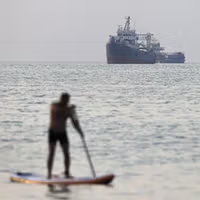
Satellite images reviewed by the Associated Press show what appears to be an oil slick in the Persian Gulf emanating from the western side of Iran’s Kharg Island, the country’s main crude export terminal.

The images, taken on Friday, show a slick covering about 27 square miles, with signs of possible ongoing leakage from the terminal, according to Ami Daniel, CEO of maritime intelligence firm Windward AI.

Daniel estimated around 80,000 barrels of oil may have spilled since the slick was first detected on Tuesday, though the cause remains unclear.

“This is the risk of fighting in an oil-rich area,” he said, adding that cleanup efforts are unlikely in what he described as an active war zone.

He said the slick appears to be moving southwest and could reach the UAE, Qatar or Saudi Arabia within two weeks.

Most Viewed

Iranians vent frustration as Trump revives talk of Tehran deal
1
VOICES FROM IRAN

Iranians vent frustration as Trump revives talk of Tehran deal

2
VOICES FROM IRAN

Internet shutdown pushes Iranians onto distrusted domestic apps

3

Iranian threat in Germany more urgent than publicly announced - NYT

4
INSIGHT

Tehran hails China’s support, but Beijing’s limits are showing

5

Wage crisis hits 27,000 workers as Iran's top steel plant remains crippled

Banner
Banner

Spotlight

  • Iran-UAE breakdown leaves Iranian expats in limbo
    INSIGHT

    Iran-UAE breakdown leaves Iranian expats in limbo

  • Canada’s Middle East role: From Pearson’s legacy to passive diplomacy
    ANALYSIS

    Canada’s Middle East role: From Pearson’s legacy to passive diplomacy

  • Iran runs dry as Islamic Republic funds ideology and foreign proxies
    ANALYSIS

    Iran runs dry as Islamic Republic funds ideology and foreign proxies

  • Ghalibaf pushes for the role many thought he already had
    INSIGHT

    Ghalibaf pushes for the role many thought he already had

  • Internet shutdown pushes Iranians onto distrusted domestic apps
    VOICES FROM IRAN

    Internet shutdown pushes Iranians onto distrusted domestic apps

  • Iranians vent frustration as Trump revives talk of Tehran deal
    VOICES FROM IRAN

    Iranians vent frustration as Trump revives talk of Tehran deal

•
•
•

More Stories

Iran could hold out four months under US blockade - CIA assessment

May 8, 2026, 21:43 GMT+1

Efforts to end the war between the United States and Iran appeared to stall on Friday as fighting intensified in the Persian Gulf, while a US intelligence assessment concluded Iran could withstand a naval blockade for up to four months, Reuters reported.

The CIA assessment also concluded that the US bombing campaign of Iran, hailed as a success by US President Donald Trump, has failed to force Iran’s leadership to capitulate, according to a US official familiar with the analysis, which was first reported by the Washington Post.

The analysis suggested the conflict may not end soon, despite Trump’s efforts to bring it to a close, which has faced political pressure at home.

Iran foreign ministry cites Kubrick’s Dr Strangelove in nuclear jab

May 8, 2026, 21:33 GMT+1

Iranian foreign ministry spokesperson Esmaeil Baghaei on Friday mocked what he called contradictory claims about seeking peace while warning of a nuclear crisis, describing them as a “grotesque absurdity” and referencing a “one big glow” scenario.

"It is a grotesque absurdity that they claim to seek peace and prevent a nuclear crisis, yet their proposed solution is “one big glow.” HOWEVER... (just watch Stanley Kubrick’s Dr. Strangelove or: How I Learned to Stop Worrying and Love the Bomb, 1964)," Baghaei posted on X.

Qatar, US discuss Pakistan mediation efforts on Iran conflict

May 8, 2026, 21:24 GMT+1

Qatar’s Prime Minister and Foreign Minister Sheikh Mohammed bin Abdulrahman Al-Thani met US Vice President JD Vance in Washington on Friday to discuss regional developments and mediation efforts aimed at de-escalating tensions linked to the Iran conflict, Qatar’s foreign ministry said.

"Sheikh Mohammed stressed the need for all parties to engage with ongoing mediation efforts to address the root causes of the crisis through dialogue and peaceful means," according to the statement. "Such efforts should pave the way for a comprehensive agreement capable of achieving lasting peace in the region."

Iran runs dry as Islamic Republic funds ideology and foreign proxies

May 8, 2026, 19:26 GMT+1
•
Mohammad Nayeb Yazdi, Mehdi Ketabchy, Saeed Ghasseminejad

Iran’s water crisis is not only about scarcity or drought. It is also about where the Islamic Republic chooses to spend the country’s money, and what it leaves unfunded at home.

In a system where political and ideological objectives consistently outweigh environmental sustainability and public welfare, even severe and widely recognized crises fail to trigger meaningful correction.

In this sense, Iran’s water crisis is not a failure of resources, it is a consequence of deliberate choices. The impact of decades of misguided water engineering and policy decisions is already visible across Iran’s water systems.

Major lakes and wetlands such as Urmia Lake have shrunk. Groundwater has been depleted across more than half of the country’s plains, land subsidence is accelerating, and per capita water availability has fallen to near or below 1,000 cubic meters.

At the same time, access to reliable drinking water has become increasingly uncertain. Water quality is declining because of inadequate wastewater treatment and aging infrastructure, while policy still emphasizes large-scale agricultural self-sufficiency despite mounting environmental constraints.

It would be easy to assume that these failures could stem partially from financial limitations. But this is not a story of absolute constraint. Even under sanctions, Iran has continued to generate substantial revenues, particularly from oil exports, over the past decade.

The water crisis is not necessarily due to a lack of resources, but how those resources are allocated. Based on Iran’s FY1404 (2025-2026) public budget, significant funding is still directed toward religious and ideological institutions, amounting to roughly $750 to $860 million annually, depending on exchange rates.

At the same time, Iran’s regional activities, including support for groups such as Hezbollah, Hamas, Palestinian Islamic Jihad, the Houthis, and allied militias, are widely estimated, based on publicly reported figures, to cost an additional $1.1 to $1.5 billion each year.

These estimates reflect direct financial transfers and likely understate total support, which also includes substantial non-cash assistance such as weapons, equipment, and logistical backing.

In total, nearly $1.8 to $2.4 billion per year is allocated to priorities that do little to address Iran’s most urgent domestic challenges. Even redirecting a portion of these resources toward water management and infrastructure could support large-scale, practical solutions. Over a five-year period, such a shift would mobilize roughly $10 billion, enough to move beyond short-term fixes and begin addressing some of the structural drivers of Iran’s water crisis.

Based on order-of-magnitude cost benchmarks for standard water infrastructure projects, a reallocation of roughly $10 billion over five years could finance a coherent national water program. This would include a full-scale effort to reduce water losses in Tehran’s aging distribution network, where non-revenue water (NRW), water lost before it reaches consumers due to leaks, aging infrastructure, and inefficiencies is estimated at roughly 25 to 30 percent.

It could also support the deployment of potable reuse facilities across major urban centers such as Tehran, Mashhad, Isfahan, Shiraz, Yazd, and Ahvaz, helping relieve pressure on overstretched freshwater supplies.

In parallel, a targeted desalination and conveyance package could be implemented for Sistan and Baluchestan province, designed specifically to secure drinking water in a region facing chronic shortages, rather than to support inland agriculture.

Such an investment could also enable the construction of dozens of wastewater treatment plants nationwide, depending on facility size and treatment level, addressing both water quality degradation and reuse potential in regions struggling with untreated discharge.

Beyond urban infrastructure, even limited investments in agriculture could deliver measurable benefits. For example, modernizing irrigation in a single province such as Isfahan, where more efficient systems can reduce water use by roughly 30 to 60 percent, could significantly lower demand in one of Iran’s most water-stressed regions.

Even at the current economic development and growth, over a five-year period, roughly $10 billion directed toward ideological priorities could instead finance a nationwide water recovery program: upgrading Tehran’s water distribution system to reduce losses, building 10 potable reuse facilities for major cities, developing seven coastal desalination plants for southern Iran, and constructing a strategic water transfer system to Zahedan in Sistan and Baluchestan.

It could also fund eight large wastewater treatment plants, dozens of mid-size facilities across the country, and modernize irrigation in Isfahan. Instead, those resources are being directed elsewhere. Now imagine how the country’s water infrastructure can be overhauled if the regime is gone and Iran is back on the path to growth and prosperity, with access to the latest technologies the world has to offer, to tackle this issue.

These figures are illustrative, not precise. They highlight both Iran’s potential capacity to invest in water infrastructure and the scale of resources currently misallocated, without even accounting for additional spending on missile programs, and nuclear development, which further underscores the magnitude of available resources.

Ultimately, the constraint is neither technical nor financial: it is political. As long as the current regime remains in power, resources that could stabilize and modernize Iran’s water systems will continue to be diverted toward non-productive ideological ends.


Ghalibaf pushes for the role many thought he already had

May 8, 2026, 18:00 GMT+1
•
Behrouz Turani

Parliament Speaker Mohammad Bagher Ghalibaf appears to be trying to solidify his position inside Iran’s fractured post-war leadership after recent weeks exposed the limits of assumptions that he had effectively emerged as the country’s de facto ruler.

In an audio message published on May 6, Ghalibaf laid out five requests directed at Iranians at home and abroad, framing austerity, solidarity and public mobilization as essential to surviving what he described as one of the most critical periods in Iran’s contemporary history.

The intervention marked Ghalibaf’s clearest political re-emergence after a period in which hardline factions appeared to sideline him despite his elevated wartime profile.

Ghalibaf rose to prominence during the 12-day war with Israel and the United States in 2025, when he was widely seen as one of slain supreme leader Ali Khamenei’s most trusted political figures.

After Khamenei’s death, he headed Iran’s delegation in the Islamabad talks with the United States — perhaps the clearest sign yet of his standing within the new order.

Repeated remarks by President Donald Trump hinting at regime change in Iran and suggesting that a figure from inside the system could ultimately emerge reinforced speculation abroad that Ghalibaf might become the face of a post-Khamenei transition.

But his position soon appeared less secure. Hardline critics accused him of weakness in negotiations and insufficient resistance to Western pressure, and for a period he largely retreated from public view before gradually re-emerging.

In the May 6 message, Ghalibaf urged Iranians to recognize that the country was engaged in “one of the biggest wars in Iran’s contemporary history,” arguing that enduring hardship was necessary to secure a strategic victory.

His central appeal focused on austerity, with Ghalibaf calling saving and reduced consumption “the missile the people can fire at the heart of the enemy.”

He also called for reviving mutual-aid networks similar to those formed during the COVID-19 pandemic and urged the Basij militia to return to what he described as its historic role as a neighborhood-based problem-solving force helping citizens navigate daily hardships.

The appeal contrasted sharply with the Basij’s prominent role in suppressing protests during the 2022 Women, Life, Freedom movement and the unrest of January 2026.

Ghalibaf’s final request targeted Iranians professionals and experts abroad, whom he urged to contribute ideas and resources to help manage wartime economic pressures. He encouraged expatriates not to wait for official outreach but to “force officials” to use their capabilities.

The appeal quickly drew criticism from some Iranians overseas, with users on social media arguing authorities could not simultaneously seek help from expatriates while hardliners continued threatening confiscation of assets and punitive measures against critics abroad.

Ghalibaf’s remarks came amid broader calls from establishment figures for the government to repair its relationship with the public after months of unrest, war and economic pressure.

Former government spokesman Ali Rabiei and centrist politician Mohammad Atrianfar, both former intelligence officials, have argued in recent days that the state must first reconcile with its own citizens before it can stabilize the country externally.

In an interview with Khabar Online, Atrianfar warned that failing to respond seriously to public demands risked further erosion of public trust and legitimacy, pointing specifically to internet restrictions and communication controls as symbols of the widening gap between the state and society.

The comments reflect growing concern within parts of Iran’s political establishment that war, economic hardship and repeated crackdowns have deepened public alienation, forcing even longtime insiders to speak increasingly openly about the system’s legitimacy crisis.