• العربية
  • فارسی
Brand
  • Iran Insight
  • Politics
  • Economy
  • Analysis
  • Special Report
  • Opinion
  • Podcast
  • Iran Insight
  • Politics
  • Economy
  • Analysis
  • Special Report
  • Opinion
  • Podcast
  • Theme
  • Language
    • العربية
    • فارسی
  • Iran Insight
  • Politics
  • Economy
  • Analysis
  • Special Report
  • Opinion
  • Podcast
All rights reserved for Volant Media UK Limited
volant media logo

US forces have turned back 38 ships under Iran blockade - CENTCOM

Apr 27, 2026, 02:57 GMT+1

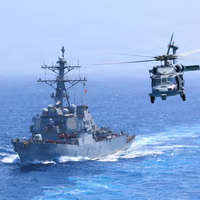
US Central Command said American forces have now directed 38 ships to turn around or return to port since the start of Washington’s naval blockade against Iran.

In a post on X, CENTCOM said US forces continue to enforce sanctions and implement the blockade against vessels entering or departing Iranian ports.

Most Viewed

The hidden target in US war on Iran may be China
1
PODCAST

The hidden target in US war on Iran may be China

2
PODCAST

US should use Iran talks leverage to help Iranian people, veteran journalist says

3

UK releases man jailed for spying on Iran International in 2023 terror plot

4
INSIGHT

Unity or fracture? Tehran battles Trump’s narrative of disarray

5

Three Baha’i women jailed in southeast Iran, one of them pregnant

Banner
Banner

Spotlight

  • Is Ghalibaf becoming Iran’s Khrushchev?
    INSIGHT

    Is Ghalibaf becoming Iran’s Khrushchev?

  • Iran’s new military-led order may mean greater dangers abroad
    ANALYSIS

    Iran’s new military-led order may mean greater dangers abroad

  • The hidden target in US war on Iran may be China
    PODCAST

    The hidden target in US war on Iran may be China

  • Unity or fracture? Tehran battles Trump’s narrative of disarray
    INSIGHT

    Unity or fracture? Tehran battles Trump’s narrative of disarray

  • Iran’s economy after the March war: how bad can it get?
    ANALYSIS

    Iran’s economy after the March war: how bad can it get?

  • Behind Tehran’s unity show: The secret letter to the shadow king
    INSIGHT

    Behind Tehran’s unity show: The secret letter to the shadow king

•
•
•

More Stories

Iran’s new military-led order may mean greater dangers abroad

Apr 27, 2026, 02:40 GMT+1
•
Shervin Shahrestani

The Islamic Republic that has emerged from the killing of Iran's Supreme Leader Ali Khamenei may prove more operationally aggressive than the one it replaces, analysts say.

Dominated by the Revolutionary Guards, the leadership in Tehran may be less constrained by theology and more driven by revenge.

This is an assessment by analysts tracking the post-war power shift in Tehran, as a string of attacks on Jewish and Israeli targets have taken place since the Feb. 28 US-Israeli strikes. 

Across Europe, an Iran-linked group calling itself Harakat Ashab al-Yamin al-Islamia has claimed several attacks, including the targeting of Jewish volunteer ambulances in London, a synagogue in Belgium and a synagogue and Jewish school in the Netherlands. 

In Azerbaijan, an alleged Iranian plot targeting the Israeli embassy in Baku and Jewish community sites was foiled by authorities. 

Danny Citrinowicz, a senior researcher at the Institute for National Security Studies in Tel Aviv, says the post-Ali Khamenei Islamic Republic is likely to become more operationally aggressive, with sleeper cells and lone-wolf attacks posing a growing threat to Tehran’s adversaries.

"Lone wolves are a bigger threat," Citrinowicz told Iran International, referring to the act of an individual committing a violent act alone without a direct order.

"You just need to create the atmosphere," Citrinowicz said. "It will lead to someone saying, I'm going to do something." 

Citrinowicz describes the Islamic Republic in 2026 as "Iranian Revolution 3.0" — its third iteration since 1979 — in which a military junta has taken control of the founding doctrine of clerical rule, Velayat-e Faqih, with the IRGC dominating all meaningful decisions.

It is a regime that has demonstrated, through the foreign fighters it brought in to suppress its own population during the January 2026 uprising, that it harbors sizable loyal support outside its borders. 

"The regime will try to present itself as a continuation of Ali Khamenei's regime," Citrinowicz said.

Yet the IRGC-dominated leadership still faces a limitation in its power, inheriting a government whose revolutionary appeal has long outlasted its domestic popularity. 

Iran International reported that around 800 members of Iraqi militia groups — including Kataib Hezbollah and Harakat al-Nujaba — entered Iran days before the January 2026 crackdown that killed tens of thousands of protesters.

Proxy Shia forces from Turkey, Afghanistan and Pakistan have also been reported inside Iran. 

The Pakistani contingent — the Zainabiyoun Brigade — is an armed wing rooted in Tehran's ideological network, drawn from South Asia's Shia communities. But one militia is only part of the picture.

Simon Wolfgang Fuchs, an associate professor at the Hebrew University of Jerusalem, describes Lahore-based cleric Jawad Naqvi as running a sprawling and sophisticated Shia seminary operation in Lahore, Pakistan. 

The seminary produces Qom-trained scholars, high-quality social media content, and an explicit political model.

"He's really someone who says we have to implement the Iranian model in Pakistan," Fuchs told Iran International. Naqvi's political model draws inspiration from Hezbollah, Fuchs argues — a Shia minority that embraced Velayat-e Faqih and came to dominate Lebanon's political field.

"The vision and the boldness to simply claim that you could also dominate the state is definitely there," Fuchs said, though he cautioned the comparison has limits — Pakistan's Shia community has no history of armed resistance. 

"Iran's efforts to gain a following as the legitimate leader of the Shia (community) has paid off somewhat in South Asia," said Cliff Smith, a fellow at the Middle East Forum who visited Indian-administered Kashmir and documented Iranian influence on the ground.

"The idea of Iran is stronger outside its borders than it is inside." 

India, home to between 20 and 40 million Shia — the second-largest such population after Iran — has received less scrutiny than its neighbour. 

Smith observed during time spent in Kashmir that New Delhi had effectively tolerated Iranian influence among the Shia community, calculating it served as a useful counterweight to Sunni radicalism from Pakistan.

The wave of protests and unrest that was seen in India following Khamenei's killing has prompted a reassessment, according to Smith. 

"I had one of those people tell me, when they had seen the riots and demonstrations after Khamenei’s death, that I was right. We should have paid attention to this sooner," he said, recalling a contact at an Indian think tank. 

Abhinav Pandya of India's Usanas Foundation argues the blind spot runs deeper than Kashmir, as Iran's influence among Indian Muslims is not confined to Shia communities.

India is home to around 200 million Muslims — the world's third-largest — and Pandya argues the Indian security establishment has been too focused on the Sunni threat to register how deeply the Islamic Republic's influence has taken root among the country's Shia groups. 

"The biggest misunderstanding is that most of the jihadist problem comes from the Sunni Muslims, and the Shias — they don't need to bother about them, Shias are completely loyal," Pandya said.

"So far Shia Muslims have not majorly participated in any terrorist activity... But partly this understanding is problematic." 

For Citrinowicz, the killing of Khamenei —a figure seen as much as a religious leader as a political one — risks transforming Iran's conflict with the US and Israel into something far harder to contain. 

“The killing of him is potentially opening some sort of religious war that I think that we have to make sure it won't expand between the Shias and the state of Israel," he said.

Citrinowicz also warned of an increase in Iranian terror activity abroad. "While they have this kind of capabilities and shared communities all over the world, especially in places like India, definitely we'll see an uptick."

Iran offers US deal to reopen Hormuz, delay nuclear talks - Axios

Apr 27, 2026, 02:12 GMT+1

Iran has offered the United States a deal to reopen the Strait of Hormuz and help end the war while postponing talks on its nuclear program to a later stage, Axios reported.

According to the report, the proposal was conveyed to Washington through Pakistani mediators following the collapse of talks in Islamabad.

The reported offer would prioritize reopening the strategic waterway and de-escalating the conflict, while deferring the more contentious nuclear issue to later negotiations.

Iranian Foreign Minister Abbas Araghchi visited Pakistan over the weekend as part of the diplomatic effort, though no breakthrough was announced.

Is the US blockade working? It depends who you ask

Apr 27, 2026, 01:25 GMT+1

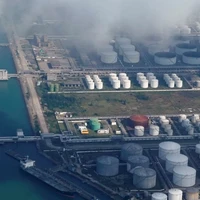
Recent tracking data suggesting Iran is still moving millions of barrels of crude despite a US naval blockade has raised fresh questions about the effectiveness of Washington’s effort to choke off Tehran’s oil exports.

TankerTrackers.com on Sunday cited satellite images that it said showed Iran loaded at least 4.6 million barrels of crude at export terminals in recent days, with another four million barrels appearing to have crossed the US blockade line.

The figures suggest Tehran retains at least some ability to keep oil flowing despite a US naval blockade launched nearly two weeks ago and repeated claims from Washington that the operation is crippling Iran’s maritime trade.

How effective has the blockade been?

US Central Command has portrayed the blockade as increasingly effective.

In its latest update on April 25, CENTCOM said US forces had “redirected” 37 vessels since the blockade began against ships entering or departing Iranian ports on April 13.

US forces have also expanded enforcement beyond the Persian Gulf, intercepting or seizing tankers in the Indian Ocean and Arabian Sea suspected of carrying Iranian crude.

Washington has framed the operation less as a hermetic seal than an economic squeeze. US officials argue the blockade’s effectiveness should be measured by whether Iran’s revenues are being cut.

Independent maritime trackers, however, paint a more complicated picture.

How is Iran still moving oil?

Shipping intelligence firm Lloyd’s List Intelligence reported this week that at least 26 vessels linked to Iran, including 11 oil and gas tankers and two very large crude carriers, have sailed in and out of Iranian ports since the blockade began.

The Financial Times, citing cargo tracking firm Vortexa, reported the figure could be as high as 34 Iran-linked tankers bypassing the blockade line in the Strait of Hormuz, including six outbound tankers carrying around 10.7 million barrels of crude.

Vortexa has also identified multiple fully laden tankers slipping past US warships. Bloomberg reported that a wider flotilla may have moved roughly nine million barrels around the blockade in recent days.

Iran’s so-called shadow fleet has long relied on tactics such as switching off AIS transponders, spoofing vessel locations, conducting ship-to-ship transfers, relabeling cargoes and using front companies to disguise ownership and destinations.

Since the blockade began, shipping analysts have observed vessels “going dark” near Iranian terminals before reappearing beyond the enforcement line.

Others have hugged coastal routes or moved through narrow shipping lanes where interception becomes more politically and operationally difficult.

What impact is the blockade having?

Even so, the blockade appears to be having an impact.

Traffic through the Strait of Hormuz has dropped sharply from normal levels, insurers have raised premiums, and some buyers have reportedly delayed or canceled purchases amid legal and logistical uncertainty.

Higher freight rates and longer voyages are also increasing costs for Iranian exports and for customers, chiefly in China.

The longer the blockade persists, the greater the chance Iran faces storage bottlenecks at export terminals or is forced to shut in production.

For now, the blockade appears to be functioning less as an impenetrable wall than as a bottleneck: slowing, complicating and raising the cost of Iran’s oil trade without stopping it entirely.

That may be enough for Washington to claim success and enough for Tehran to claim survival.

Oil rises as US-Iran talks stall

Apr 27, 2026, 01:19 GMT+1

Oil prices extended gains on Monday, rising nearly 2% as peace talks between the United States and Iran stalled and shipments through the Strait of Hormuz remained limited, keeping global supplies tight.

Brent crude futures rose $2.16 to $107.49 a barrel before midnight London time, the highest since April 7, while West Texas Intermediate rose $1.77 to $96.17.

Last week, Brent and WTI gained nearly 17% and 13%, respectively, their biggest weekly gains since the start of the war.

The hidden target in US war on Iran may be China

Apr 27, 2026, 01:07 GMT+1

As Washington and Tehran navigate a fragile ceasefire, one of the biggest questions looming over the conflict may not be about Iran at all—but China.

Zineb Zineb Riboua, a research fellow at the Hudson Institute who specializes in Chinese influence in the Middle East and North Africa, told Eye for Iran that the broader significance of Operation Epic Fury may lie in weakening China’s strategic position through its deep ties to the Islamic Republic.

“I am in the group of those who think it is about weakening China,” Riboua said. “I don't think the administration says it this way… but I think it's a very important one.”

Read the full article here.