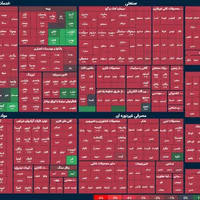
Trading has been suspended for two months. Ticker symbols remain closed, and millions of retail investors have been unable to move their assets.
The head of the Securities and Exchange Organization said the market would reopen within ten to twelve days in phases. In the first stage, only companies not directly damaged by the war will resume trading, while steel and petrochemical firms that suffered losses will remain closed.
Reopening a damaged petrochemical company whose production has halted and whose recovery costs and timeline are unclear would likely trigger a sharp price drop and create a volatile market signal. Yet the current approach of prolonged closure presents deeper structural concerns.
There are three conceivable scenarios for reopening the Tehran Stock Market.
Scenario one: Comprehensive deal with US
The first scenario envisions a comprehensive agreement and broad sanctions relief. In an optimistic case, Iran reconnects to the global financial system, oil and petrochemical exports face fewer restrictions, and foreign investment gradually returns. Market reopening could then mark the beginning of long-delayed reforms: transition from price controls to market pricing, reduced financial repression in banking, and transparent government balance sheets.
Export-oriented sectors such as steel, petrochemicals, and copper would benefit from renewed access to global markets. Banks could reassess their balance sheets and shift toward genuine credit evaluation. Foreign investors, absent for nearly two decades, might gradually return.
However, without internal coordination and structural reform, even sanctions relief would not rescue the TEDPIX.
Scenario two: Limited military and regional agreement
A more likely scenario involves a limited agreement focused on military and regional tensions. Hostilities ease, but sanctions remain largely intact and foreign investment prospects stay uncertain.
Under these conditions, reopening may trigger a new crisis. Major export-driven firms would initially remain untradeable. Downstream industries would face raw material shortages and price spikes. The automotive sector, already loss-making before the war, would struggle with supply chain disruptions and accumulated losses.
Meanwhile, limited foreign currency inflows could push the government toward inflationary financing to fund reconstruction and subsidies, either through money creation or borrowing from banks already dependent on regulatory forbearance. With high inflation ahead, questions arise about how listed firms can generate sufficient value to remain profitable, especially amid infrastructure damage and seasonal energy shortages.
Investors, having endured months of uncertainty without clear disclosure of portfolio losses, may view reopening as an exit opportunity. Investment funds facing redemption waves would be forced into selling queues, amplifying downward pressure. The market could reopen with a heavy backlog of sell orders, and each negative headline could trigger further declines.
Scenario three: Continued conflict and further escalation
If negotiations fail and conflict intensifies, prolonged closure would likely continue. In such a scenario, Tehran Stock Exchange, under its current management and policy framework, could effectively cease to function as a credible capital market.
Policymakers may believe closure prevents price collapse, but in practice, investor confidence collapses instead. Alternative investment channels gain prominence: foreign currency, gold, real estate, consumer goods, or capital flight to neighboring countries.
Iran’s economy before and after the war
Even before the recent conflict, Iran’s economy faced a structural crisis. Industrial capacity was constrained by aging machinery, energy imbalances, and sanctions. Institutional trust was at its lowest level in four decades. Key industries — steel, petrochemicals, automotive, and banking — were either loss-making or dependent on hidden subsidies. War in such an environment acts as a crisis accelerator, pushing uncertainty beyond policymakers’ management capacity.
Tools available for reopening — tighter price limits, sales restrictions, targeted liquidity injections, and market-maker intervention — can at best distribute the shock and manage short-term risk. They cannot substitute for honest disclosure of losses, independent audit assessments, and credible reconstruction plans.
Reopening the Tehran Stock Exchange alone will not resolve broader economic challenges. In the best-case scenario, it could form part of a larger reform package aligned with political agreement and foreign capital inflows. In the other two scenarios, reopening may merely accelerate the crisis cycle.
The core question facing policymakers is political rather than technical: are they willing to accept the real market value of shareholders’ assets, or will they postpone the cost through opacity and suspension, only to face a larger reckoning later.