On Wednesday, US President Donald Trump suggested renewed talks with Tehran could take place as soon as Friday, though Iranian officials and state media quickly pushed back, saying no official position had yet been announced.
For ordinary Iranians, the diplomatic uncertainty comes atop an economy already battered before the March war.
Domestic news agencies, including the Labor News Agency ILNA, report that more than one million jobs have been lost since the start of the war, while the government is reportedly struggling to meet pension obligations.
ILNA said in recent weeks between three and four million workers, including insured employees as well as informal and uninsured laborers, may have lost their jobs. That would leave 12 to 15 million people with no source of income.
ILNA said the government’s only support for many of those affected by wartime job losses has been a monthly cash subsidy and a food voucher that “barely covers the cost of a single 10-kilogram bag of rice.”
The agency’s Wednesday front page painted a bleak picture: widespread business closures, workers protesting inadequate wages, thousands displaced by US-Israeli strikes still living in hotels, and even a 40% increase in funeral costs.
For many Iranians, economic hardship now feels more immediate than diplomacy.
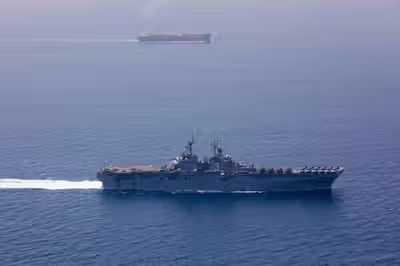
On Tuesday, Trump claimed on Truth Social that Iran was “collapsing financially” and losing $500 million a day because of the closure of the Strait of Hormuz.
US Treasury Secretary Scott Bessent said this month Washington would not renew temporary sanctions waivers that had allowed some Iranian and Russian oil already at sea to reach global markets, tightening pressure on energy supplies.
Oil prices rose on Wednesday despite Trump’s ceasefire extension, reflecting market doubts over whether the truce would hold and whether shipping through the Strait would fully resume.
Iranian politicians and media outlets have increasingly highlighted the global economic repercussions of the conflict, a narrative some analysts see as an attempt to increase pressure on Washington.
The reform-leaning Asr Iran wrote this week that although the second round of negotiations remains uncertain, “geopolitical necessities and crushing economic pressures may push both sides toward accepting an emergency agreement.”
On Tuesday night, after Trump announced a continued ceasefire without a formal deal, many Iranians on social media and in messages to Persian-language outlets abroad accused him of abandoning them to hardline commanders in Tehran.
Others argued that economic strain and internal political divisions may ultimately force Iran’s leadership back to the table.
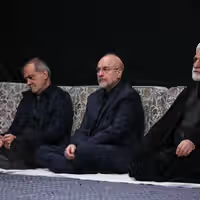
What remains unclear is whether Tehran’s leaders know what they want from the talks—or whether some are still prepared to risk a prolonged war of attrition.
For ordinary Iranians, any notion of “victory” may increasingly depend less on geopolitics than on whether they can endure the economic collapse unfolding around them.