President Donald Trump is not inclined to extend the Iran ceasefire beyond Wednesday evening when it expires, the Wall Street Journal reported, citing a White House official.
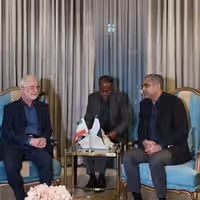
According to the report, the United States and Iran are planning to hold peace talks in Islamabad this week as the deadline approaches.
While Tehran has not publicly confirmed it will participate in the meetings in Pakistan, it has told regional mediators that it intends to send a negotiating team, according to people familiar with the matter.
The head of the company overseeing construction of the northern Karaj freeway said rebuilding a major bridge damaged in US attacks could cost about 3.5 trillion tomans (roughly $23 million).
“We are trying to proceed with reconstruction under the current conditions by demolishing parts of the structure and redesigning it so it can be preserved as a symbol in the country,” said Abolfazl Rahmani, chief executive of the North Karaj Freeway Construction Company
Rahmani added that the B1 bridge had been built “without foreign involvement” and reconstruction cost could end up higher than the initial estimate.
Pink missiles, pink drones and pink firearms. Women with uncovered hair—braids, ponytails, short bobs—stood beside weapons, waved flags and smiled for cameras in scenes broadcast across Iranian media. Tehran appears willing to try almost anything to preserve power.
Critics say the imagery forms part of a new Islamic Republic campaign that pairs missiles with fashion, war with pop culture and force with softness.
Liora Hendelman-Baavur, author of Creating the Modern Iranian Woman, told Iran International the visuals resemble Japan’s “kawaii” culture — imagery built around cuteness — but applied here to rockets and war.
“I think it is trying to make violence look cute,” Hendelman-Baavur said. “It is trying to appeal to the youth, to Gen Z.”
The United States will extend the life of the A-10 “Warthog” attack aircraft until 2030, delaying the aging but widely used close air support plane’s planned retirement.
Air Force Secretary Troy Meink announced the decision on social media, saying the move would maintain combat capability while the defense industry increases aircraft production.
The A-10, which first flew in 1976, has faced repeated retirement attempts for more than two decades as the Pentagon sought to replace it with newer aircraft.
The plane has been used in the current conflict with Iran, according to US Central Command.
A pink military-style vehicle moves through a street rally in Iran, carrying several women dressed in black chadors and hijabs.
Pink missiles, pink drones and pink firearms. Women with uncovered hair—braids, ponytails, short bobs—stood beside weapons, waved flags and smiled for cameras in scenes broadcast across Iranian media. Tehran appears willing to try almost anything to preserve power.
Critics say the imagery forms part of a new Islamic Republic campaign that pairs missiles with fashion, war with pop culture and force with softness.
Liora Hendelman-Baavur, author of Creating the Modern Iranian Woman, told Iran International the visuals resemble Japan’s “kawaii” culture — imagery built around cuteness — but applied here to rockets and war.
“I think it is trying to make violence look cute,” Hendelman-Baavur said. “It is trying to appeal to the youth, to Gen Z.”
She said the campaign appears aimed at a generation that has filled streets, campuses and online spaces during years of unrest.
“We hear a lot of very aggressive and violent language coming from officials,” she said.
“And we also see it in many of the posters and murals being displayed in Iran. Violence and missiles — with red as the central color — are meant to show they are invincible and victorious. And on the other hand, we have this very light, pinkish, idyllic way of presenting a different reality … to demonstrate a whole different picture of what is really going on.”
A pink-painted missile bearing Persian script sits on display, turning a weapon of war into a piece of stylized propaganda.
The result, she said, is two messages at once: murals, rockets and threats for one audience; pink colors, uncovered hair and festival scenes for another — a duality.
The campaign comes just over 100 days after one of the deadliest crackdowns in modern history, when at least 36,500 people were killed during the bloodiest days of the uprising on January 8 and 9 alone. The Islamic Republic continues to execute political dissidents linked to the January protests.
Any publicity — even negative — is good
For Iranian pop culture expert Siavash Rokni, the scenes are less about change than circulation.
He called the imagery a public relations stunt meant to fill feeds, group chats, broadcasts and headlines with new pictures after months of funeral processions, executions, arrests and mourning.
“With PR stunts, it doesn’t matter if it’s good or bad — what matters is that it circulates,” Rokni said.
He said many Iranians know the difference between staged images and daily life, but viewers abroad may not.
“What worries me isn’t Iranians — it’s people outside Iran who might see this and think everything is normal. That’s where it becomes dangerous.”
Others say the campaign also keeps state control over women at the center of public life. Even without hijab, women’s faces, hair and bodies remain tools in official messaging.
Retreat — for now — on Islamist ideology
It may also point to pressure inside the system itself.
Arash Azizi, author of What Iranians Want: Women, Life, Freedom, told Iran International the Islamic Republic was founded on the goal of building a uniformly Islamist society. If it now loosens one of its core social codes, he said, that carries meaning beyond style.
“They understand that they have to give up on this Islamist ideology,” Azizi said.
He also rejected claims that the war has produced a broad wave of new support for the state.
“There’s no evidence that tons of people were anti-regime before the war and are pro-regime now,” he said.
For now, the pink paint may soften the image, but it does not erase the prisons, the executions, the graves or the anger that still runs beneath the surface of Iran.
Senate Democrats will force another vote on legislation seeking to limit US involvement in the war with Iran, Senate Minority Leader Chuck Schumer said.
“Tomorrow, Senate Democrats will force a fifth vote on our War Powers Resolution,” Schumer wrote on X.
“Senate Republicans cannot sit on the sidelines while our servicemembers are risking their lives on the frontlines. We will continue putting them on the record until the war ends or until enough of them find the courage to vote with us to end this war.”