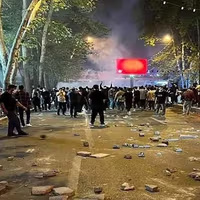
The protests that started in the Grand Bazaar of Tehran in late December and quickly spread across the country were followed by what has been described as the deadliest crackdown on protesters in Iran’s contemporary history in January.
Shortly thereafter, a war involving the United States and Israel began, compounding the country’s economic distress.
The service sector was hit hard during the protests. Advertising agencies, technical consulting firms, digital service providers, and hospitality and tourism businesses have since suffered further, and in many cases irreparable, damage because of the war.
Three weeks of internet disruptions during the protests, and over 1,100 hours since the beginning of the war on February 28, have effectively paralyzed large parts of the digital economy.
"According to official estimates released by Iranian authorities, more than 10 million people in Iran earn their income directly through the internet. As a result, any disruption or shutdown of internet services poses a serious threat to their livelihoods," Dadban, a legal advisory and training center for activists, said in a report.
"With the continuation of this situation, millions have faced a sharp drop in income or unemployment," Dadban added.
More significantly, the conflict has inflicted severe damage on critical economic infrastructure, including key petrochemical industries and steel production across multiple cities. These sectors, considered the backbone of Iran’s industrial economy, have suffered extensive losses.
The destruction of major industries has disrupted the supply of raw materials, triggering cascading effects across manufacturing and related sectors.
Widespread layoffs have followed, affecting not only workers in these industries but also those employed in dependent businesses.
At the same time, exports have declined sharply, further constraining an already limited flow of foreign revenue.
The scale of the economic shock is underscored by official estimates. A government spokesperson has put total war damages at around $270 billion—roughly 57 percent of Iran’s gross domestic product and several times larger than the country’s annual oil revenues.
The figure is estimated to be nearly three times the government’s general budget, highlighting the unprecedented fiscal strain facing the state.
Stagflation and rising risk of renewed unrest
Iran’s economy has now entered a period of stagflation, combining high inflation with economic stagnation and rising unemployment.
Even if the conflict were to end in the near term, economists warn that recovery will be protracted and uneven.
These worsening conditions have heightened the risk of renewed social unrest.
Without a political resolution—particularly an agreement with the United States—analysts suggest that further protests, potentially larger than those seen in December, are increasingly likely.
Public anger boils over online
Public sentiment, particularly on social media, reflects growing frustration and despair.
One user highlighted the desperation faced by unemployed citizens: “I live in Tehran, I’m married and renting. Since January I was working reduced hours, and I was officially laid off on March 25.”
Another user described the collapse of freelance work: “In this situation, most jobs have shut down, especially for people like us who worked freelance. Our income has dropped to zero, and we don’t know what we can do if the war and internet outages continue.”
A third user wrote: “Given the brutality of the clerical regime and its supporters, the skyrocketing prices of basic necessities, and the bizarre inflation that keeps getting worse… I think people are just waiting for a spark to come back to the streets. Death is no longer the issue—this situation is worse than death and must end.”
Inflation surges to historic highs
Inflation has risen dramatically over the past 100 days. Official data show point-to-point inflation, already above 50 percent at the end of December, climbed to over 70 percent by late February—before the war—reaching its highest level in decades.
In essential goods such as meat, dairy, oil, rice, fruits, and vegetables, inflation has exceeded 110 percent. Prices of critical medications, including some types of insulin, have multiplied several times—when they are available at all.
Although updated overall inflation figures have not been released, some experts believe the rate may already have entered triple digits, with further increases expected.
Survival economy takes hold
Some Iranians say the absence of severe shortages during the war reflects collapsing demand rather than stable or sufficient supply. With incomes sharply reduced, many households can no longer afford basic goods.
To cope, families are increasingly relying on savings, rental deposits, or loans from banks and relatives—placing them at risk of losing their homes. In some cases, household are selling personal belongings just to afford food.
Business owners are also under pressure. Many have begun selling equipment, with online marketplaces now flooded with listings for café and restaurant supplies and electronic devices—often with little or no buyer interest.
Meanwhile, the government faces mounting fiscal constraints. Even before the war, it struggled to meet budgetary obligations. Now, with millions feared to be unemployed, the government lacks the capacity to provide adequate unemployment benefits, and some workers report being unable to access them at all.