• العربية
  • فارسی
Brand
  • Iran Insight
  • Politics
  • Economy
  • Analysis
  • Special Report
  • Opinion
  • Podcast
  • Iran Insight
  • Politics
  • Economy
  • Analysis
  • Special Report
  • Opinion
  • Podcast
  • Theme
  • Language
    • العربية
    • فارسی
  • Iran Insight
  • Politics
  • Economy
  • Analysis
  • Special Report
  • Opinion
  • Podcast
All rights reserved for Volant Media UK Limited
volant media logo

Iranian delegation led by Qa'ani in Baghdad to mediate Shiite rift

Apr 18, 2026, 20:59 GMT+1Updated: 22:25 GMT+1

An Iranian delegation headed by IRGC Quds Force commander Esmail Qa'ani has arrived in Baghdad to mediate between Iraqi Shiite leaders, as disputes continue to stall the formation of a new government.

Abdul Rahman Al-Jazaeri, a commander in the Popular Mobilization Forces, told Kurdistan24 the mission aims to resolve internal disagreements and accelerate the selection of a prime minister.

Qaani held four meetings with leaders of Shiite political and armed factions before leaving Baghdad, after which Trump’s special envoy Tom Barrack arrived in the city, according to Kurdistan24.

Both sides are focused on selecting a prime minister and forming a government.

Most Viewed

100 days after carnage: Iran economy reels from war, inflation, unemployment
1
INSIGHT

100 days after carnage: Iran economy reels from war, inflation, unemployment

2
OPINION

The Hormuz get out of jail card turned to a grave

3

State media slam Araghchi's Hormuz tweet, say it let Trump claim victory

4
PODCAST

Too early to tell who is winning Iran war, experts say

5
EXCLUSIVE

Iranian assaulted in London amid concern over threats to regime critics

Banner
Banner

Spotlight

  • A nation in limbo: 100 days after the massacre, has the world moved on?
    INSIGHT

    A nation in limbo: 100 days after the massacre, has the world moved on?

  • 100 days after carnage: Iran economy reels from war, inflation, unemployment
    INSIGHT

    100 days after carnage: Iran economy reels from war, inflation, unemployment

  • The Hormuz get out of jail card turned to a grave
    OPINION

    The Hormuz get out of jail card turned to a grave

  • How Tehran bends its own red lines to boost state rallies
    INSIGHT

    How Tehran bends its own red lines to boost state rallies

  • Iran blackout cripples freelancer, small business incomes
    VOICES FROM IRAN

    Iran blackout cripples freelancer, small business incomes

•
•
•

More Stories

Ghalibaf calls US mine-clearing in Hormuz a ‘ceasefire violation’

Apr 18, 2026, 20:38 GMT+1

Iran’s parliament speaker said in a televised interview on Saturday that the Strait of Hormuz is under the control of the Islamic Republic, and transit through the waterway will remain restricted unless the US ends the blockade of Iranian ports.

Mohammad-Bagher Ghalibaf said efforts by the United States to conduct mine-clearing operations in the waterway constitute a “violation of the ceasefire.”

He said Iran had warned the US delegation in Islamabad that if their mine-sweeper “moves even slightly forward,” it would be targeted.

Iran’s IRGC navy says Hormuz Strait to stay closed until US lifts blockade

Apr 18, 2026, 19:21 GMT+1

Iran’s Islamic Revolutionary Guard Corps (IRGC) Navy said the Strait of Hormuz has been closed from Saturday afternoon, citing what it described as a US failure to lift its naval blockade despite ceasefire conditions.

The IRGC navy’s public relations office said that prior to the announcement, several civilian vessels had been allowed to pass through the strait via the Larak corridor under its supervision and coordination.

However, it said, the Islamic Republic shut the strategic waterway after a violation of ceasefire commitments, accusing the United States of maintaining its maritime restrictions on Iranian vessels and ports.

“The Strait of Hormuz is closed from this evening until the naval blockade is lifted,” the statement said.

The force warned that any vessel moving from its anchorage in the Persian Gulf or the Sea of Oman toward the strait would be considered as cooperating with the enemy and could be targeted.

It also instructed ship operators to follow updates exclusively through official IRGC navy channels on maritime communication channel 16, dismissing statements by the US president as lacking credibility.

Trump convenes Situation Room meeting to discuss Hormuz, Iran talks - Axios

Apr 18, 2026, 18:33 GMT+1

US President Donald Trump convened a White House Situation Room meeting on Saturday morning to discuss the renewed crisis around the Strait of Hormuz and negotiations with Tehran, Axios reported citing two US officials.

Vice President JD Vance, Secretary of State Marco Rubio, Defense Secretary Pete Hegseth, Treasury Secretary Scott Bessent, White House Chief of Staff Susie Wiles, White House envoy Steve Witkoff, CIA Director John Ratliffe and Joint Chiefs chairman Dan Caine attended the meeting, the report said.

The meeting comes three days before a two-week ceasefire in the US-led war on Iran expires, with no date set for a new round of talks.

If there is no breakthrough soon, the war could resume in the coming days, Axios reported citing a senior US official.

100 days after carnage: Iran economy reels from war, inflation, unemployment

Apr 18, 2026, 18:10 GMT+1
•
Maryam Sinaiee

One hundred days after thousands of protesters were massacred on January 8 and 9, Iran's already fragile economy has sharply deteriorated, with millions feared to be unemployed as a devastating war compounds the crisis and accelerates economic collapse.

The protests that started in the Grand Bazaar of Tehran in late December and quickly spread across the country were followed by what has been described as the deadliest crackdown on protesters in Iran’s contemporary history in January.

Shortly thereafter, a war involving the United States and Israel began, compounding the country’s economic distress.

The service sector was hit hard during the protests. Advertising agencies, technical consulting firms, digital service providers, and hospitality and tourism businesses have since suffered further, and in many cases irreparable, damage because of the war.

Three weeks of internet disruptions during the protests, and over 1,100 hours since the beginning of the war on February 28, have effectively paralyzed large parts of the digital economy.

"According to official estimates released by Iranian authorities, more than 10 million people in Iran earn their income directly through the internet. As a result, any disruption or shutdown of internet services poses a serious threat to their livelihoods," Dadban, a legal advisory and training center for activists, said in a report.

"With the continuation of this situation, millions have faced a sharp drop in income or unemployment," Dadban added.

More significantly, the conflict has inflicted severe damage on critical economic infrastructure, including key petrochemical industries and steel production across multiple cities. These sectors, considered the backbone of Iran’s industrial economy, have suffered extensive losses.

The destruction of major industries has disrupted the supply of raw materials, triggering cascading effects across manufacturing and related sectors.

Widespread layoffs have followed, affecting not only workers in these industries but also those employed in dependent businesses.

At the same time, exports have declined sharply, further constraining an already limited flow of foreign revenue.

The scale of the economic shock is underscored by official estimates. A government spokesperson has put total war damages at around $270 billion—roughly 57 percent of Iran’s gross domestic product and several times larger than the country’s annual oil revenues.

The figure is estimated to be nearly three times the government’s general budget, highlighting the unprecedented fiscal strain facing the state.

Stagflation and rising risk of renewed unrest

Iran’s economy has now entered a period of stagflation, combining high inflation with economic stagnation and rising unemployment.

Even if the conflict were to end in the near term, economists warn that recovery will be protracted and uneven.

These worsening conditions have heightened the risk of renewed social unrest.

Without a political resolution—particularly an agreement with the United States—analysts suggest that further protests, potentially larger than those seen in December, are increasingly likely.

Public anger boils over online

Public sentiment, particularly on social media, reflects growing frustration and despair.

One user highlighted the desperation faced by unemployed citizens: “I live in Tehran, I’m married and renting. Since January I was working reduced hours, and I was officially laid off on March 25.”

Another user described the collapse of freelance work: “In this situation, most jobs have shut down, especially for people like us who worked freelance. Our income has dropped to zero, and we don’t know what we can do if the war and internet outages continue.”

A third user wrote: “Given the brutality of the clerical regime and its supporters, the skyrocketing prices of basic necessities, and the bizarre inflation that keeps getting worse… I think people are just waiting for a spark to come back to the streets. Death is no longer the issue—this situation is worse than death and must end.”

Inflation surges to historic highs

Inflation has risen dramatically over the past 100 days. Official data show point-to-point inflation, already above 50 percent at the end of December, climbed to over 70 percent by late February—before the war—reaching its highest level in decades.

In essential goods such as meat, dairy, oil, rice, fruits, and vegetables, inflation has exceeded 110 percent. Prices of critical medications, including some types of insulin, have multiplied several times—when they are available at all.

Although updated overall inflation figures have not been released, some experts believe the rate may already have entered triple digits, with further increases expected.

Survival economy takes hold

Some Iranians say the absence of severe shortages during the war reflects collapsing demand rather than stable or sufficient supply. With incomes sharply reduced, many households can no longer afford basic goods.

To cope, families are increasingly relying on savings, rental deposits, or loans from banks and relatives—placing them at risk of losing their homes. In some cases, household are selling personal belongings just to afford food.

Business owners are also under pressure. Many have begun selling equipment, with online marketplaces now flooded with listings for café and restaurant supplies and electronic devices—often with little or no buyer interest.

Meanwhile, the government faces mounting fiscal constraints. Even before the war, it struggled to meet budgetary obligations. Now, with millions feared to be unemployed, the government lacks the capacity to provide adequate unemployment benefits, and some workers report being unable to access them at all.

Current war could spiral into WWIII if it continues, IRGC adviser warns

Apr 18, 2026, 15:39 GMT+1

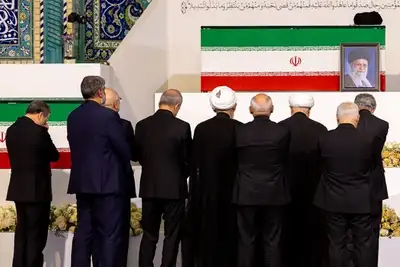
A senior adviser to the commander of Iran’s Revolutionary Guards warned that the ongoing conflict could escalate into a global war if it continues, while also signaling Iran’s readiness to deploy newly produced weapons in any renewed fighting.

Mohammad Reza Naqdi said Iran could launch missiles and drones manufactured as recently as April 2026 if hostilities resume, dismissing claims that its launch capabilities had been destroyed.

“They say they have destroyed our missile launchers. We can produce launchers in any metal workshop," he said.