Iranian lawmaker Ebrahim Azizi said on Friday ships passing through the Strait of Hormuz must comply with a new maritime system set by the Islamic Republic.
“It is time to comply with the new maritime system of the Strait of Hormuz; this system is determined by the Islamic Republic of Iran, not social media posts,” he said in a post on X.
US crude oil prices dropped sharply on Friday, closing at their lowest level since March 10 after Iran said it would reopen the Strait of Hormuz to commercial shipping, according to CBS News.
US crude settled down 11.45% at $83.85 per barrel, marking the second-largest one-day decline since the war began.
Despite the drop, US oil remains up about 25% since Feb. 28 and roughly 45% since the start of the year.
As Washington signals that a deal with Tehran may be close, a central question remains unresolved: who, if anyone, is actually winning?
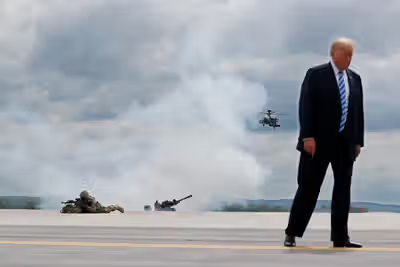
US President Donald Trump said on Friday he expects an agreement with Iran “in the next day or two,” even claiming Iran has “agreed to everything,” including halting uranium enrichment and transferring its highly-enriched uranium stockpiles to the US.
The remarks came hours after Iran announced the reopening of the Strait of Hormuz following weeks of disruption, an announcement that sparked rare public criticism from within the Islamic Republic targeting the negotiating team.
Despite Tehran's declared reopening of the strait, Trump said the US will continue blockading Iranian ports until a final deal is achieved.
Speaking at Iran International's English podcast Eye for Iran, maritime sanctions expert Charlie Brown framed the strategy behind the current US blockade as one that could either be about pressure to deal or pressure to collapse.
“I think it’s clear that the goal would be, you know, the first case is pressure to come to negotiate, but the other case would be pressure to collapse the regime system and make space for a new system,” said Brown, a senior advisor at United Against Nuclear Iran who tracks Iran’s shadow fleet and illicit tanker networks.
That dual objective, forcing negotiations while simultaneously weakening the system sits at the heart of the current moment. But whether it is working remains far less clear.
Pressure campaign vs. economic reality
At the center of that uncertainty is the Strait of Hormuz, where a US-led pressure campaign has targeted Iran’s oil exports — the Islamic Republic's economic lifeline.
Both Brown and energy expert Dr. Iman Nasseri, Managing Director for the Middle East at FGE, agreed the impact is real, but warned it is too early to measure its effectiveness.
“The effects of a blockade will definitely take time,” Brown said, cautioning against drawing quick conclusions.
Nasseri, one of the leading experts on Iran’s oil flows and regional energy markets, echoed that view, emphasizing that even under ideal conditions, economic pressure unfolds slowly.
“In normal conditions three to four weeks but in Iranian situation and sanctions evasion it could take up to three months for a cargo to land in the destination market,” he said.
That delay means Iran can continue generating revenue in the short term, even as restrictions tighten.
“Iran is still selling oil which is out there at sea today without loading anything,” Nasseri explained, underscoring how existing cargoes can sustain income flows even as new exports are disrupted.
Shipping data reinforces that point. According to TankerTrackers.com, 633 Iran-linked tankers have been tracked globally, with 397 sanctioned by US authorities. Yet dozens continue operating, including at least 72 vessels currently moving freely in the Middle East.
The system — built on ship-to-ship transfers, AIS spoofing and shadow banking remains active, even under pressure.
That raises a broader question: whether global markets can absorb the disruption long enough for pressure on Iran to fully materialize.
While the economic battle unfolds at sea, the nuclear file remains central to any potential deal and to competing claims of success.
Trump’s assertion that Iran has agreed to halt enrichment would represent a major concession. But nuclear experts caution that the reality is more complex.
“I’d say the probability the regime would want to build the bomb has gone up, but the probability that they can succeed has gone down,” said David Albright, founder of the Institute for Science and International Security.
Albright also warned that focusing only on Iran’s most enriched uranium stockpiles risks missing the bigger picture. Iran possesses thousands of kilograms of lower-enriched uranium that could be further processed if enrichment continues — meaning any deal that does not fully end enrichment could leave a pathway intact.
Taken together, his assessment points to a paradox: Iran may be more motivated than ever to pursue nuclear capability, even as its ability to do so has been degraded by military strikes.
That tension complicates any claim that diplomacy alone has resolved the nuclear threat.
Regional shifts and Iran’s influence
Beyond the nuclear and economic fronts, regional dynamics suggest Iran’s position may be shifting — though not collapsing.
One of the most significant developments has been direct diplomatic engagement between Lebanon and Israel, a move that signals potential decoupling from Tehran’s influence.
“This was the first time that the United States recognizes that the government of Lebanon is sovereign enough and adult enough to sit in face-to-face talks bilaterally without Saudis or Iranians or Syrians or anybody else in the room,” said Hussain Abdul Hussain, a research fellow at the Foundation for Defense of Democracies and author of the Arab Case for Israel.
A newly agreed ceasefire between Israel and Lebanon is set to last 10 days, with the possibility of being “extended by mutual agreement” if negotiations show progress
That shift challenges one of Iran’s long-standing pillars of regional power: its network of proxy forces.
For years, Lebanon has effectively been treated as an extension of Iran’s regional strategy through Hezbollah. But the current talks — taking place independently of Tehran — suggest a possible shift toward decoupling.
Abdul Hussain underscored that divide more directly, describing how Lebanon’s leadership is increasingly asserting its independence from Iran’s negotiations.
“You do you, we do Lebanon,” he said, characterizing the government’s stance as separate from Tehran’s diplomatic track.
A moment of uncertainty
Taken together, the developments across Hormuz, the nuclear file and the regional landscape point to a single conclusion: it is too early to declare a winner.
The United States has demonstrated its ability to impose pressure — militarily and economically — while Iran has shown it can still adapt, sustain revenue and shape the narrative.
For now, the outcome is not defined by victory, but by how long each side can sustain the pressure before it breaks.
You can watch Eye for Iran on YouTube or listen on any podcast platform of your choosing
US Central Command chief Brad Cooper said on Friday American forces are fully enforcing a maritime blockade on Iranian ports and can sustain it “as long as necessary,” according to an interview with Al Arabiya.
“We are watching every Iranian ship in every port, full stop,” Cooper said, adding that US forces “have eyes on every Iranian port.”
Cooper added 19 vessels had attempted to violate the blockade since it was imposed on Monday but turned back after US warnings. “No ships have or will evade US forces,” he said.
More than 40 Iranian lawmakers warned it would be a “mistake” to continue negotiations with the United States without first securing the release of frozen Iranian assets.
“We declare that continuing negotiations while one of the stated conditions has not been fulfilled is wrong and unacceptable,” forty-one lawmakers said in a statement published by Fars News Agency.
They stressed that “unfreezing the assets of the Iranian people” was a core precondition for entering talks and called for resistance until it is achieved.
The lawmakers also accused the US of repeatedly violating the ceasefire, warning that failing to respond due to ongoing negotiations risks “normalizing this dangerous situation.”
They further criticized the lack of parliamentary oversight, noting that the legislature has not held full sessions for weeks and calling for formal meetings to resume so lawmakers can review developments and make decisions.
“Continuing negotiations in such conditions, with an untrustworthy and hostile counterpart aware of all details, requires proper, timely and transparent communication,” the statement said, urging officials to provide clearer public explanations to maintain domestic support.