• العربية
  • فارسی
Brand
  • Iran Insight
  • Politics
  • Economy
  • Analysis
  • Special Report
  • Opinion
  • Podcast
  • Iran Insight
  • Politics
  • Economy
  • Analysis
  • Special Report
  • Opinion
  • Podcast
  • Theme
  • Language
    • العربية
    • فارسی
  • Iran Insight
  • Politics
  • Economy
  • Analysis
  • Special Report
  • Opinion
  • Podcast
All rights reserved for Volant Media UK Limited
volant media logo

Hormuz status unchanged until ‘common framework’ reached - CNN

Apr 11, 2026, 22:51 GMT+1

The status of the Strait of Hormuz will remain unchanged until Iran and the United States agree on a “common framework” to continue negotiations, an Iranian security source told CNN on Saturday.

The source said “excessive demands” from the US side on several issues, including the strategic waterway, have so far prevented the two sides from establishing a shared basis to move talks forward.

Most Viewed

Iran negotiators ordered to return after internal rift over Islamabad talks
1
EXCLUSIVE

Iran negotiators ordered to return after internal rift over Islamabad talks

2
ANALYSIS

US blockade enters murky phase as tankers spoof signals and buyers hesitate

3
ANALYSIS

Why the $100 billion Hormuz toll revenue is a myth

4

US tightens financial squeeze on Iran, warns banks over oil money flows

5
ANALYSIS

US blockade targets Iran oil boom amid regional disruption

Banner
Banner

Spotlight

  • Hardliners push Hormuz ‘red line’ as US blockade tests Iran’s leverage
    INSIGHT

    Hardliners push Hormuz ‘red line’ as US blockade tests Iran’s leverage

  • Ideology may be fading in Iran, but not in Kashmir's ‘Mini Iran'
    INSIGHT

    Ideology may be fading in Iran, but not in Kashmir's ‘Mini Iran'

  • War damage amounts to $3,000 per Iranian, with blockade set to add to losses
    INSIGHT

    War damage amounts to $3,000 per Iranian, with blockade set to add to losses

  • Why the $100 billion Hormuz toll revenue is a myth
    ANALYSIS

    Why the $100 billion Hormuz toll revenue is a myth

  • US blockade targets Iran oil boom amid regional disruption
    ANALYSIS

    US blockade targets Iran oil boom amid regional disruption

  • Iran's digital economy battered by prolonged blackout
    INSIGHT

    Iran's digital economy battered by prolonged blackout

•
•
•

More Stories

Iran brings unusually broad team to US talks to blunt future blame

Apr 11, 2026, 22:45 GMT+1
•
Maryam Sinaiee

Iran has sent a negotiating team to the Islamabad talks with the United States spanning an unusually broad political spectrum—suggesting a possibly calculated effort to pre-empt future hardline backlash while pursuing negotiations.

The delegation which held lengthy talks with the US team in Islamabad on Saturday includes not only Parliament Speaker Mohammad-Bagher Ghalibaf and his political allies but also Ali-Akbar Ahmadian, Secretary of the Defence Council, and more moderate technocrats such as Central Bank of Iran Governor Abdolnaser Hemmati.

However, the presence of Mahmoud Nabavian—a hardline parliamentarian known for his staunch opposition to negotiations with the West—has generated particular surprise.

Nabavian, a cleric affiliated with the ultra-conservative Paydari (Steadfastness) Party, has for years denounced figures like Mohammad-Javad Zarif and the relatively moderate government of Hassan Rouhani as “traitors” for pursuing the 2015 nuclear deal, formally known as the Joint Comprehensive Plan of Action.

His inclusion in the delegation appears to be interpreted as a calculated move by Ghalibaf. By bringing a vocal critic of negotiations into the process, he may be attempting to share responsibility for the outcome and pre-empt future criticism from hardline factions that wield significant influence within Iran’s political and military structures.

With figures like Nabavian involved, any eventual agreement—or failure to reach one— is less easily attributed to a single political camp.

According to political activist Hossein Shirzad, the delegation’s structure suggests a broader objective beyond traditional diplomacy. “The composition of the delegation … indicates that negotiations are aimed at presenting a ‘political business plan’ to Donald Trump’s representatives for Iran’s future,” he wrote on X. He added that “the discussions are likely about the quality of an agreement, not the agreement itself.”

Shirzad also claimed that “the issue has already been resolved behind the scenes. Ghalibaf wants to prove that he has the expertise and executive capability to manage Iran and control the remaining structure. He is seeking personal and factional guarantees.”

Mojtaba's green light

Despite the significance of the negotiations, Iran’s new supreme leader has not issued an explicit public endorsement.

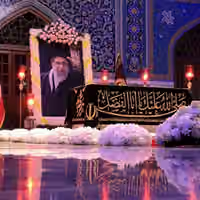
However, in a written message marking the fortieth day after his father’s death, Mojtaba Khamenei referred to the “announcement of the decision to negotiate with the enemy” and called for public mobilization to influence the outcome, remarks that many interpret as implicit approval of the negotiation process.

He also referenced verses from Surah Al-Fath in the Quran, alluding to the Treaty of Hudaybiyyah—a peace agreement between Prophet Muhammad and his adversaries in Mecca. In Islamic tradition, this treaty is seen as a strategic move that reduced conflict and ultimately strengthened Muslims despite their weaker position at the time.

Such symbolic references carry strong weight among the Islamic Republic’s ideological base.

Ghalibaf and his rivals in the conservative camp

Divisions and rivalry within Iran's conservative camp remain pronounced. On one side stands Ghalibaf and his pragmatic allies—often described as technocratic conservatives—who advocate negotiation from a position of strength. They reject ultimatums but view diplomacy as a rational tool for managing tensions and reducing external pressure, with indirect talks seen as the most viable path under current conditions.

For Ghalibaf, success in these talks could significantly bolster his political standing after multiple failed bids for the presidency over the past two decades. A diplomatic breakthrough could help secure his position as a leading figure in Iran’s future political landscape.

On the other side are more radical conservatives, including Saeed Jalili and factions such as the Paydari Party, who have consistently opposed any engagement with the United States. These groups have framed past agreements as “surrender” and continue to adopt a hardline stance.

Jalili has remained notably silent in recent days, fueling speculation in political circles that under the new leadership he may have been replaced in his role at the Supreme National Security Council by Ali Bagheri-Kani, also present alongside the delegation.

Hardline opposition beyond political elites

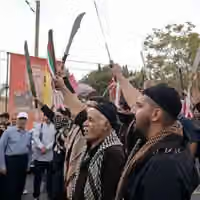
Hardline opposition extends beyond political elites into public discourse. In street protests and on social media, critics have condemned any potential agreement as a sign of “humiliation” and “betrayal of the leader’s blood.”

In one widely circulated video, a speaker denounced Ghalibaf’s trip to Pakistan for talks with JD Vance, prompting crowds to chant “Hayhat Min al-Dhilla” (“Never accept humiliation”)—a phrase historically attributed to Imam Hussain on the Day of Ashura.

State media also reflects this tension. While negotiations are widely understood to require leadership approval, some broadcasters have continued to voice dissent.

For instance, a presenter on IRGC-affiliated Ofogh TV questioned the rationale for talks, asking: “If the Zionist regime has violated the ceasefire, based on which commitment should we remain silent and go negotiate? Three of Iran’s ten conditions for negotiation have been violated.”

Even so, other voices within state media have pointed to historical precedents, noting that several Shia Imams engaged in dialogue or cooperation with their adversaries, suggesting that negotiation, in itself, is not incompatible with ideological principles.

Strait will not open through Hollywood games, Iranian MP syas

Apr 11, 2026, 22:35 GMT+1

Iranian lawmaker Mahmoud Nabavian said on Saturday global political and economic leaders that the Strait of Hormuz will not reopen via “fairy tales and Hollywood games.”

“The world will experience new management in the Strait of Hormuz,” he posted on X.

Tense US-IRGC naval standoff as destroyers pass Strait of Hormuz - WSJ

Apr 11, 2026, 22:29 GMT+1

US Navy destroyers on Saturday transited the Strait of Hormuz for the first time during the war, triggering a tense radio confrontation with Iran’s Islamic Revolutionary Guard Corps (IRGC) Navy as high-level negotiations between Washington and Tehran were underway in Pakistan, the Wall Street Journal reported.

The report said IRGC naval forces — which have tightened control over shipping in the strait since the ceasefire and introduced tolls on vessels — challenged the US warships as they attempted passage.

“This is the last warning. This is the last warning,” Iranian forces said over radio communications, according to audio from a nearby civilian vessel.

The US destroyer responded that it was transiting in accordance with international law and had no hostile intent.

“Passage in accordance with international law. No challenge is intended to you,” the ship said.

US Central Command said the vessels operated in the Persian Gulf and left the area as planned without incident. It said the transit was intended to signal that Washington does not recognize Iranian control over the strait and to support efforts to restore commercial navigation.

IRGC Navy asserts control over Strait of Hormuz, denies US vessel passage

Apr 11, 2026, 22:26 GMT+1

Iran’s Islamic Revolutionary Guard Corps Navy (IRGCN) said on Saturday it maintains full intelligent control of the Strait of Hormuz and permits passage only to non-military vessels under strict regulations.

In a post on X, IRGC denied reports of American ships transiting the strait and warned that any attempt by military vessels to pass will face “decisive and firm action.”

‘Very good sign’ Iran talks running into the night, former US official says

Apr 11, 2026, 22:23 GMT+1

Former US Deputy Assistant Secretary of State Gordon Gray said the fact that US and Iranian delegations are continuing talks late into the night in Islamabad is an encouraging signal.

Speaking to Al Jazeera, Gray said the extended negotiations suggest both sides are engaging with serious intent, even if they remain far apart at the initial stage.

“It shows that both sides are negotiating with serious intent, even if they may be far apart in the initial discussions,” he said.