Trump, Saudi crown prince discuss Iran war, ceasefire talks - Axios
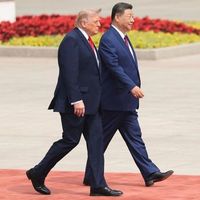
US President Donald Trump discussed the war with Iran with Saudi Crown Prince Mohammed bin Salman and briefed him on talks over a possible ceasefire, Axios reported.
US President Donald Trump discussed the war with Iran with Saudi Crown Prince Mohammed bin Salman and briefed him on talks over a possible ceasefire, Axios reported.


US Central Command said on Wednesday that daily operations and training are continuing for the 3,500 sailors and Marines aboard the USS Tripoli in its area of responsibility.
CENTCOM added that the forces are maintaining readiness and staying prepared for potential missions.
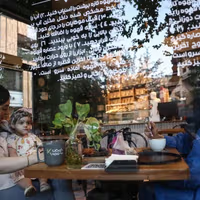
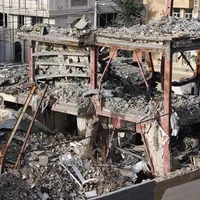
A heated online dispute over photographs showing civilian victims of strikes in Iranian cities has exposed both the deep mistrust many Iranians feel toward official information and a widening rift among the public itself over how to interpret images emerging from the war.
As photos of wounded civilians circulated widely on social media, some users accused photographers and authorities of staging scenes for propaganda, claiming that individuals depicted in widely shared images were actors and that injuries, dust and distress visible in the photos had been artificially created using makeup and staged scenes.
The accusations spread quickly across Persian-language social media, with skeptics pointing to perceived similarities between people appearing in images linked to separate incidents as supposed evidence.
Even the Persian-language account of Israel’s foreign ministry weighed in on the controversy by reposting one of the disputed images and writing: “If they call the Gaza filmmaking industry ‘Pallywood’, what do they call this?”
But the claims were soon challenged by fact-checkers and other users, and in some cases the accusations were later withdrawn.
Iran’s independent fact-checking platform Factnameh said a review of several of the controversial images found no evidence supporting claims that they had been staged or taken at different times and locations as alleged.
“Given the presence of debris and victims, the idea that actors were staged in such a scene is highly unlikely,” the platform said, noting that the individuals in the images show clear differences in facial features and body structure despite some similarities.
Mehdi Ghasemi, one of the photographers whose work came under scrutiny, rejected the allegations and defended his work.
“I’m 47 years old, and it’s been 33 years since I received my first documentary photography award, and I haven’t taken a single reconstructed or manipulated frame,” he wrote on X.
One user who had asserted that a woman in a widely circulated photograph was an actress later deleted the post and issued an apology after acquaintances identified the woman and her husband as real individuals whose home had been destroyed in the strikes.
The controversy has unfolded amid tight wartime restrictions on reporting and photography in Iran.
Critics argue that permits to document sensitive scenes are tightly controlled and often granted only to photographers seen as aligned with the authorities, making independent documentation of chaotic strike sites difficult.
Combined with broader limits on information flow during the conflict, those restrictions have left social media as one of the primary arenas for competing narratives about events on the ground.
The dispute reflects how deeply distrust of official narratives has taken root in Iranian society after decades of censorship and propaganda. In such an environment, even genuine documentation can quickly become the subject of suspicion.
“The issue is exactly like the story of the boy who cried wolf,” one user wrote online.
“When a government lacks legitimacy to this extent and has always chosen to lie at every step, eventually no one believes the truth either. Now factor in cutting off communication channels on top of that, and you end up with the situation we are in.”
For others, however, the rush to dismiss images of civilian suffering as staged propaganda risks deepening divisions at a moment when the war itself is already reshaping daily life across the country.
The Israeli military said on Wednesday that it had struck two money exchange offices in Beirut that were used to finance Hezbollah and were linked to Iran.
In a statement, the Israel Defense Forces said the sites were used to transfer and conceal funds, including Iranian money, for Hezbollah’s activities.
“Hezbollah’s systematic use of money exchange offices for terror financing and money laundering, which was uncovered by the IDF a year ago, is one of the primary methods for Hezbollah to finance and conceal Iranian funds,” the IDF said.
It added that the offices, named “Boa Chance” money exchange office and the “Trade Point International” money exchange office, were targeted after identifying that they continued transferring funds used for attacks against Israel.
US military officials are planning potential ground assaults inside Iran, including targeting Kharg Island and seizing enriched uranium sites, the Atlantic reported on Wednesday, citing people familiar with the matter.
The report said the operations would require approval from US President Donald Trump and would involve deploying troops on Iranian territory.
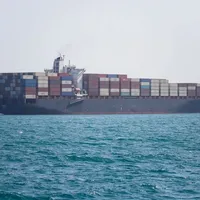
Those familiar with the options said putting US troops inside Iran would rank among the most dangerous missions of Trump’s presidency and warned the operations would not necessarily end the war quickly or secure broader objectives such as regime collapse or reopening the Strait of Hormuz.
The plans come as thousands of additional US troops arrive in the region.
US Vice President JD Vance has been in contact with intermediaries about the Iran war, including as recently as Tuesday, Reuters reported, citing a source briefed on the matter.
The source said US President Donald Trump directed Vance to privately communicate that he was open to a ceasefire if certain US demands were met, including the reopening of the Strait of Hormuz.
Vance also delivered what a source described as a “stern message” in contacts with intermediaries that Trump was growing impatient and warned there would be increasing pressure on Tehran unless it agreed to a deal.
