Iran says Israel behind Kuwait desalination plant attack
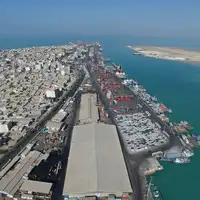
A spokesperson for Khatam al-Anbiya Central Headquarters said on Monday that Israel had struck a desalination facility in Kuwait, after Kuwait said an Indian worker was killed in an Iranian attack on a power and water plant.
The spokesperson said the strike was carried out “to blame the Islamic Republic,” and warned that US bases and Israeli interests in the region would remain targets.
The statement urged regional countries to be alert to what it described as efforts by the US and Israel to destabilize the region.
The Israeli military said on Monday it had struck military infrastructure at Imam Hossein University in Tehran, describing it as a key facility linked to the Islamic Revolutionary Guard Corps.
It said the university was commanded by Mohammad Reza Hassani Ahangar, a senior IRGC officer, and that the institution and some of its officials had been sanctioned by several countries.
The military said the site served as a central academic and research hub and was used for weapons development under what it described as civilian cover.
It said targets included wind tunnels used for ballistic missile testing, a chemistry center it said was linked to chemical weapons research, and engineering facilities tied to weapons development.
Israel said the strikes aimed to damage Iran’s weapons production and development capabilities.
US President Donald Trump warned that Washington could target Iran’s key infrastructure if a deal is not reached and the Strait of Hormuz is not reopened.
Writing on Truth Social, Trump said, “If for any reason a deal is not shortly reached, which it probably will be, and if the Hormuz Strait is not immediately ‘Open for Business,’ we will conclude our lovely ‘stay’ in Iran by blowing up and completely obliterating all of their Electric Generating Plants, Oil Wells and Kharg Island (and possibly all desalinization plants!).”
He added, “The United States of America is in serious discussions with A NEW, AND MORE REASONABLE, REGIME to end our Military Operations in Iran. Great progress has been made.”
Trump said the sites had not yet been targeted and described the potential strikes as retaliation, adding they would be “in retribution for our many soldiers, and others, that Iran has butchered and killed over the old Regime’s 47 year ‘Reign of Terror.’”
Iran said on Monday its ambassador to Lebanon would remain in Beirut despite a Lebanese order to leave, turning a diplomatic reprimand into a broader test of how far the Lebanese state can push back when its decisions collide with the interests of Tehran and Hezbollah.
Iranian Foreign Ministry spokesperson Esmail Baghaei said the envoy would stay. “Considering the discussions raised by the relevant Lebanese parties and the conclusions reached, the Iranian ambassador will continue his work as ambassador in Beirut and is still present there,” he said.
His remarks came days after Lebanon’s Foreign Ministry withdrew accreditation for ambassador-designate Mohammad Reza Sheibani, declared him persona non grata and asked him to leave by March 29, saying he had violated diplomatic convention by making statements about Lebanon’s internal politics.
Foreign Minister Youssef Raggi said he had instructed the ministry’s secretary-general to summon Iran’s chargé d’affaires to deliver the decision.
But as the deadline passed, there was no public sign that the order would be enforced. Instead, Iran and Hezbollah’s allies inside Lebanon made clear that the expulsion order would not be carried out.
An Iranian diplomatic source said the ambassador had no intention of leaving and would remain “in accordance with the wishes of the speaker of parliament Nabih Berri and of Hezbollah.”
Reuters has also reported that Berri, one of Lebanon’s most powerful Shi’ite politicians and a close Hezbollah ally, opposed the move and asked the envoy to remain.
Who decides for Lebanon?
The standoff has unfolded in the shadow of a wider confrontation over who decides questions of war, diplomacy and sovereignty in Lebanon.
The latest war erupted early in March after Hezbollah opened fire in support of Iran, drawing Lebanon into the conflict.
Prime Minister Nawaf Salam has sharply criticized Hezbollah’s decision to enter the war and has said only the Lebanese state should decide questions of war and peace.
He has also accused Iran’s Revolutionary Guard of directing Hezbollah’s operations in Lebanon. “It is not the duty of the Lebanese to avenge Khamenei’s killing,” Salam said in comments about slain Supreme Leader Ali Khamenei reported last week.
That accusation lands heavily in Lebanon because Hezbollah’s relationship with Iran is long-standing and structural, not incidental.
Hezbollah was founded in the early 1980s with Iranian backing and has for decades been Tehran’s closest and most powerful ally in Lebanon. The Council on Foreign Relations describes it as an Iran-backed Shi’ite movement that became the most powerful non-state armed group in the region.
Against that backdrop, the ambassador’s refusal to leave has become more than a diplomatic dispute. It is now a test of whether the Lebanese state can enforce a decision once Hezbollah and its allies oppose it.
Lebanon presented the expulsion order as part of a broader effort to curb Iranian influence after the war began, but the envoy’s continued presence in Beirut has raised questions about the state’s ability to carry it through.
Israel was quick to seize on that symbolism.
Foreign Minister Gideon Saar said on Monday that the deadline had expired and that the Iranian ambassador was “sipping his coffee in Beirut, mocking the host ‘country’.” He added that “Lebanon is a virtual state that is, in practice, occupied by Iran.”
European Council President Antonio Costa said on Monday he had a call with Pakistan Prime Minister Shehbaz Sharif on the Iran war.
In a post on X, Costa said he had discussed Sharif’s assessment of the war and the outcome of recent consultations in Islamabad involving the foreign ministers of Egypt, Saudi Arabia, Pakistan, and Turkey.
“The EU is gravely concerned over the prolongation of the war and its increasing global impact,” he said.
Pakistan said on Sunday it was preparing to host what it described as meaningful talks in the coming days aimed at ending the war.