Explosions reported across several Iranian cities early Monday
Reports of loud explosions are emerging from several cities across Iran early Monday morning local time, including Qom, Qazvin, Tehran and the Persian Gulf port city of Bandar Abbas.
Earlier in the night, blasts were also reported in Karaj near Tehran, as well as at a petrochemical site in the northwestern city of Tabriz, according to reports circulating from Iran.
Details remain unclear and there has been no immediate official confirmation of the latest incidents.
US President Donald Trump said Iran will abandon its nuclear ambitions and hand over its enriched material, warning the country risks losing its future if it refuses.
“They are decimated right now. They’re gonna give up nuclear weapons. They’re gonna give us the nuclear dust. They’re gonna do everything that we want to do,” he said.
“They’re gonna go on and maybe have a great country again. But if they don’t do that, they’re not gonna have a country. They’re not even gonna have a country,” he added.
Newly released surveillance footage appears to show repeated strikes hitting a primary school in the southern Iranian city of Minab on the first day of the war, an attack Iranian authorities say killed more than 100 children and teachers.
The Shajareh Tayyebeh primary school, located in Minab in Hormozgan province, served boys and girls aged 7 to 12.
The school building stood in an area that once formed part of a Revolutionary Guards naval base but had reportedly been separated from the military compound by a wall for several years. Iranian officials say the school was privately run.
Research by Amnesty International’s Crisis Evidence Lab and its Iran team says US authorities could—and should—have known the building was a school and failed to take feasible precautions to avoid civilian harm.
Amnesty said the findings point at best to a serious intelligence failure by the US military and warned the strike could constitute an indiscriminate attack in violation of international humanitarian law.
Reuters has reported that two sources familiar with the matter said the strike may have resulted from outdated intelligence used during targeting, while an internal US military review found American forces were likely responsible for the attack.
The first strike occurred around 10 a.m. on February 28, when students were resting during a break. The explosion destroyed roughly half of one of the school’s buildings.
Mikail Mirdoraghi (9) killed in the school strike
Teachers gathered surviving children in the school’s prayer hall and called parents to collect them. Shortly afterward, a second missile struck the same building, killing many of the remaining children, teachers and some parents who had rushed to the scene.
Iranian officials, including the mayor of Minab and the Ministry of Education, say the school was struck three times in total.
Images published by Iranian media in the days after the attack showed rescue workers pulling remains, severed limbs and children’s backpacks from beneath the rubble.
Iranian authorities say 168 people were killed, including about 120 children, as well as teachers and several parents who had come to retrieve their children after the first explosion. Nearly 100 others were reported injured.
The Norway-based human rights group Hengaw says it has independently identified 58 victims so far, including 48 children and 10 adults.
Behind the casualty figures are the stories of children whose lives ended in ordinary moments between lessons.
Among them were three girls—Mahdis Nazari, 7, and Sonar and Niayesh Salehi, both 9—members of their school’s skating team. Photos shared online before the attack show them at training sessions and competitions.
Iran’s skating federation later confirmed their deaths.
Another child whose story has circulated widely online is nine-year-old Mikail Mirdoraghi, a third-grade student. A photograph of him standing on the stairs of his home with a water bottle slung over his shoulder, waving goodbye, has been widely shared.
Mikail’s family had moved from Andimeshk in Khuzestan province to Minab because of his father’s job. After the attack, his 31-year-old mother, Shakiba Derikvand, identified his body among victims placed in refrigerated vehicles.
He was found lying beside his friend Alireza, still clutching his school backpack. His body was largely intact, though his face was bloodied, his mother said.
He was buried three days later in Andimeshk. A widely circulated image shows his grandfather lying beside the flower-covered grave.
“Mikail was afraid of the dark,” he reportedly said. “We always slept beside him. I don’t want him to be alone here at night.”
One of the most haunting details to emerge is a drawing Mikail reportedly made the night before the strike.
Found later in his backpack, it shows a school building with the Iranian flag above it, five children standing in the yard and three missiles descending toward them.
US president Donald Trump is considering a military operation to seize Iran’s stockpile of enriched uranium as part of efforts to prevent Tehran from developing nuclear weapons, the Wall Street Journal reported.
According to the report, the plan under discussion would involve US forces entering Iran to secure and remove roughly 1,000 pounds of enriched uranium.
Officials told the newspaper the mission could require troops to operate inside the country for several days or longer.
Trump has not made a final decision, the report said, and is also pressing advisers to pursue a diplomatic option that would require Iran to hand over the uranium as part of a negotiated settlement.
The proposal highlights the extraordinary steps under consideration as the war continues, with Washington weighing both negotiations and direct action to eliminate Iran’s enriched uranium stockpile.
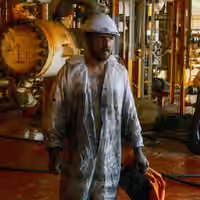
Oil prices are on track for a record monthly surge as US-Israeli strikes on Iran show now signs of subsiding.
Brent crude climbed 2.98 percent to $115.93 a barrel early Monday, bringing its gains to more than 62 percent since February 27. That jump exceeds the spike seen after Iraq’s invasion of Kuwait in 1990.
US benchmark WTI crude also surged, rising 3.01 percent to $102.64 a barrel. The contract has climbed more than 65 percent since the start of the war.
Analysts warn the rapid rise in oil prices could fuel inflation worldwide and increase the risk of recession if the conflict continues to disrupt supply routes and regional infrastructure.
Donald Trump said the United States sees the possibility of a deal with Iran soon and described negotiations with Tehran as progressing well.
Speaking to reporters on Sunday, Trump said the administration was “doing extremely well” in negotiations and that Washington was engaging with Iran through both direct and indirect channels.
“Do see a deal in Iran, could be soon,” Trump said, adding that talks were taking place “directly and indirectly” with Iranian officials.