

A senior Iranian army commander said the Iranian people would decide when the war ends and issued a direct threat against US forces, warning that American troops would face deadly consequences in any ground confrontation.
The commander of the army’s northwestern headquarters said Iran’s armed forces had adjusted their tactics since the start of the war to deliver what he described as crushing responses to each attack.
He also said that major powers now need Iran’s permission to pass through the Strait of Hormuz and accused the enemy of turning to psychological warfare by alternating between talk of agreements, negotiations, attacks on infrastructure and ground invasion.
He mocked US special forces and said Iranian forces had not forgotten earlier encounters with American troops, before warning that Iran was sharpening its knives and would “cut the throats” of US soldiers.
He also addressed Donald Trump directly, saying American graves were ready if US forces entered the fight.
Witnesses told Iran International that Iraqi forces had been stationed in residential housing used by Revolutionary Guards personnel on Autobusrani Street in Bandar Abbas.
The report came a day after multiple images circulated showing Iraqi forces parading in Iranian streets, particularly in Khorramshahr, where men riding in Toyota Hilux vehicles and carrying Iraqi flags were seen moving through the city.
The Iran-backed Hashd al-Shaabi militia, which has been accused of taking part in the January crackdown in Iran, has come under intensified attack in Iraq over the past week.
A senior Iranian official warned that any US move to seize Iranian islands would bring a forceful response from the Islamic Republic and heavy losses for American forces.
Gholamreza Mesbahi-Moghadam, a member of the Expediency Council, said sending troops to Iranian islands would amount to “collective suicide” and said US forces would face a decisive response if they entered them.
He also said Iran should perhaps have used the Strait of Hormuz years earlier as a strategic gateway to prevent entry by countries hostile to the Islamic Republic.
Pakistan hosted talks in Islamabad on Saturday with the foreign ministers of Turkey, Saudi Arabia and Egypt to discuss regional de-escalation amid the US-Israel conflict with Iran.
Turkish Foreign Minister Hakan Fidan met Pakistan’s Deputy Prime Minister and Foreign Minister Mohammad Ishaq Dar on the sidelines of the gathering.
The meetings come as regional powers step up diplomatic contacts in search of ways to contain the fallout from the war.
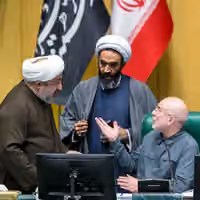
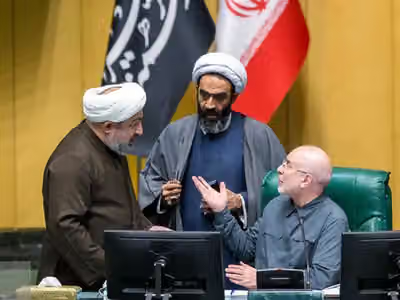
Iran’s parliament speaker Mohammad Bagher Ghalibaf said the war had reached a “critical stage,” praising public mobilization while warning the United States against pursuing what he described as surrender terms under the guise of negotiations.
In a message marking 30 days of what officials call “national defense,” Ghalibaf said public presence in the streets had become a central front in the conflict.
“The street in these 30 nights was the manifestation and mirror of the social power of a nation that does not know defeat,” he said, adding that “the enemy is angered and disturbed by the street.”
He said public rallies and slogans had bolstered military action, adding: “With the chant ‘no compromise, no surrender, fight against America,’ you gave strength to the missiles.”
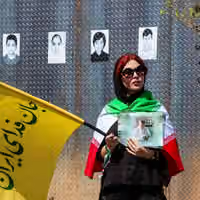
The Islamic Republic has staged pro-government rallies across cities since the start of the war.
He also pointed to what he described as setbacks for the United States and its allies, saying “the symbols of American power, from F-35s to aircraft carriers and regional bases, have suffered major blows,” while adding that strikes against Israel had been “effective, precise and foundational.”
At the same time, he accused Washington of sending mixed signals on diplomacy. “The enemy publicly sends messages of negotiation and dialogue, and in secret plans for a ground attack,” he said.
Ghalibaf dismissed reported US proposals, saying: “America is presenting its wishes and what it did not achieve in war in the form of a 15-point list and is seeking it through diplomacy.”
He warned that any attempt to force Iran into submission would be resisted. “As long as the Americans seek Iran’s surrender, our answer is clear: ‘We will not submit,’” he said.
He added that Iranian forces were prepared for further escalation, saying “our men are waiting for the ground entry of American soldiers to set them ablaze,” while insisting that missile strikes and military operations would continue.