• العربية
  • فارسی
Brand
  • Iran Insight
  • Politics
  • Economy
  • Analysis
  • Special Report
  • Opinion
  • Podcast
  • Iran Insight
  • Politics
  • Economy
  • Analysis
  • Special Report
  • Opinion
  • Podcast
  • Theme
  • Language
    • العربية
    • فارسی
  • Iran Insight
  • Politics
  • Economy
  • Analysis
  • Special Report
  • Opinion
  • Podcast
All rights reserved for Volant Media UK Limited
volant media logo
INSIGHT

Iran’s former diplomats warn of prolonged regional war

Behrouz Turani
Behrouz Turani

Iran International

Mar 26, 2026, 21:14 GMT+0
Inside of a house destroyed in US-Israeli strikes on Tehran, Iran, March 23, 2026

Former Iranian diplomats are warning that the war between Iran, the United States and Israel could fundamentally reshape the Middle East’s security order, with some predicting a prolonged conflict and deeper regional instability.

The comments come as U.S. President Donald Trump said Thursday he would pause planned strikes on Iran’s energy infrastructure for 10 days until April 6, saying the move followed a request from Tehran and that negotiations were continuing.

Iranian officials have confirmed receiving proposals for talks but say they are reviewing them while insisting Iran will not accept ultimatums.

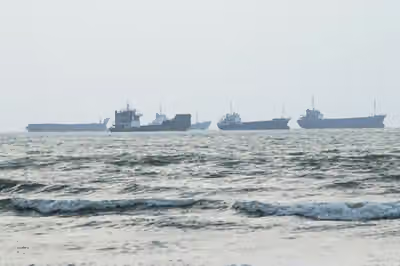
The war, now entering its fourth week, has already drawn in multiple regional actors and heightened tensions around strategic chokepoints such as the Strait of Hormuz, raising concerns that a wider confrontation could disrupt global energy flows and destabilize the region further.

Saba Zanganeh, a former diplomat close to the office of Iran’s Supreme Leader, told the moderate outlet Fararu on March 25 that the conflict should prompt regional governments to reconsider their security policies and alliances.

He said regional governments have often acted as secondary players under foreign influence, worsening conflicts rather than resolving them. The current war, he added, offers a stark lesson that continuing the existing model will deepen regional crises.

He argued that decades of instability stem from what he described as “a flawed strategic paradigm shared by regional states and external powers,” which he said has repeatedly produced destruction and fragmentation in countries including Iraq, Syria, Lebanon, Libya, Sudan, Somalia and Yemen.

Hossein Mousavian, Iran’s former ambassador to Germany, offered a more confrontational assessment.

Speaking to Etemad Online, he said Iranian officials increasingly view Persian Gulf Arab states as partners in the conflict, sharing what he described as a common objective of the “complete destruction of Iran.”

Mousavian said Tehran is preparing for the possibility of a broader confrontation involving the United States and its regional allies.

Another former diplomat, Kourosh Ahmadi, suggested the conflict may last far longer than initially expected.

Speaking to Fararu, he noted that both Trump and Israeli Prime Minister Benjamin Netanyahu first suggested the war might last only four to seven days before revising their estimates to several weeks. Even those expectations may prove unrealistic, he said.

Ahmadi pointed to Iran’s ability to restrict or control shipping in the Strait of Hormuz as a decisive factor in prolonging the conflict. As long as Tehran maintains that leverage over one of the world’s most critical energy chokepoints, he argued, the war is unlikely to end quickly.

“Israel seeks the collapse and incapacitation of Iran, not merely political concessions,” he said, arguing that Washington’s goals were more limited and often diverged from that of Israel.

Despite their different emphases, the three former diplomats share a similar underlying assessment: the current conflict risks evolving into a prolonged regional crisis whose consequences could reshape the Middle East for years.

Most Viewed

IRGC-linked media calls for fees on Hormuz undersea internet cables
1

IRGC-linked media calls for fees on Hormuz undersea internet cables

2
TEHRAN INSIDER

Tehran’s youth emerge from war more cynical, not more hopeful

3
PODCAST

Can Tehran weaponize the Strait of Hormuz for years to come?

4

Drug prices jump up to 400% as shortages strain Iranian pharmacies

5

Iran International wins four WAN-IFRA Middle East digital media awards

Banner
Banner

Spotlight

  • The strange stability between Tehran and the Taliban
    ANALYSIS

    The strange stability between Tehran and the Taliban

  •  Tehran’s youth emerge from war more cynical, not more hopeful
    TEHRAN INSIDER

    Tehran’s youth emerge from war more cynical, not more hopeful

  • Iran-UAE breakdown leaves Iranian expats in limbo
    INSIGHT

    Iran-UAE breakdown leaves Iranian expats in limbo

  • Canada’s Middle East role: From Pearson’s legacy to passive diplomacy
    ANALYSIS

    Canada’s Middle East role: From Pearson’s legacy to passive diplomacy

  • Iran runs dry as Islamic Republic funds ideology and foreign proxies
    ANALYSIS

    Iran runs dry as Islamic Republic funds ideology and foreign proxies

  • Ghalibaf pushes for the role many thought he already had
    INSIGHT

    Ghalibaf pushes for the role many thought he already had

•
•
•

More Stories

Trump says US in ‘substantial’ talks with Iran as strikes continue

Mar 26, 2026, 17:28 GMT+0

President Donald Trump said Thursday that the United States is engaged in serious negotiations with officials in Tehran, but vowed to keep striking Iran for the time being.

“We have very substantial talks going on with respect to Iran, with the right people,” Trump told reporters at a Cabinet meeting, signaling that diplomatic channels remain open despite the ongoing conflict.

The president pointed to what he described as a recent gesture involving oil tankers in the Strait of Hormuz as evidence that the interlocutors involved in the discussions hold influence inside Iran’s leadership.

“They said, to show you that we’re real and solid and we’re there, we’re going to let you have eight boats,” Trump said, referring to oil tankers transiting the strategic waterway.

He added that the number later increased to 10 vessels, suggesting to him that those involved in the talks had the authority to deliver concrete steps.

Steve Witkoff, the US envoy involved in the diplomatic effort, said Washington has presented Iran with a 15-point framework for a potential peace agreement, describing it as the basis for ongoing discussions.

Witkoff said the proposal had been circulated through intermediaries and that talks were producing what he called “strong and positive messaging,” though he said the administration would keep the details confidential.

Iranian officials have confirmed that they have received proposals from the United States and said they are reviewing them, though they have not publicly described the terms or acknowledged direct negotiations.

The diplomatic signals come against the backdrop of continued military escalation. Friday will mark four weeks since the United States and Israel launched strikes on Iran, after negotiations that Witkoff said on Thursday had been going nowhere.

It also marks the end of a five-day extension announced by Trump this week to his deadline for Tehran to reopen the Strait of Hormuz or face airstrikes on Iranian power plants.

When asked whether the deadline remained in effect through Friday, Trump declined to give a clear answer.

Efforts to arrange another round of talks also appear uncertain.

Pakistan’s foreign minister said Thursday that expectations for negotiations in Islamabad this weekend may be premature, cooling speculation that the two sides could meet there in the coming days.

Pentagon officials have confirmed that additional troops are being moved into the Middle East, and Axios reported Thursday that Trump has been presented with military options that include strikes on Iranian targets and the potential seizure of strategic islands.

Trump did not rule out further escalation when asked about the possibility of taking control of Iranian oil resources, similar to what the United States attempted in Venezuela.

“That could be an option,” he said.

Iran’s reported gas halt to Turkey exposes limits of its energy power

Mar 26, 2026, 16:59 GMT+0
•
Umud Shokri

Brief concern in Turkey this week over a halt in Iranian gas flows quickly gave way to official reassurances, but the episode exposes deeper limits in Iran’s ability to sustain exports even to key regional partners.

On March 24, reports indicated that Iran had suspended natural gas exports to Turkey following damage to facilities at the South Pars gas field after a March 18 strike. The disruption affects flows that accounted for roughly 14% of Turkey’s gas supply in 2025.

While Ankara’s response was swift and reassuring—with officials stressing that storage, diversification, and system flexibility prevented supply problems—the episode reveals a deeper issue on the Iranian side.

The halt is not simply a temporary interruption; it reflects structural constraints within Iran’s gas sector that limit its ability to sustain exports even to key regional partners.

A system under strain

The disruption originates from damage to South Pars, the world’s largest gas field and the backbone of Iran’s energy system. Because most of its output is consumed domestically, Iran operates with minimal export flexibility. Even limited disruptions can force immediate cuts to external deliveries.

Despite holding the world’s second-largest gas reserves, Iran has struggled to translate resource abundance into export capacity due to sanctions, underinvestment, and rising domestic demand.

As a result, exports to Turkey via the Tabriz–Ankara pipeline have often been inconsistent, with repeated disruptions over the past decade linked to technical issues and winter shortages.

In practice, Iran’s gas exports function less as a strategic tool than as a residual output constrained by domestic priorities.

Asymmetry

Energy relations between Iran and Turkey have long been framed as mutually beneficial: Iran gains export revenue while Turkey secures relatively affordable pipeline gas. In reality, the relationship is asymmetrical.

Iranian gas typically accounts for around 7–8 billion cubic meters annually. It is an important but non-dominant share of Turkey’s supply mix. Turkey’s broader portfolio, including Russia, Azerbaijan and LNG imports, limits dependence on any single supplier.

For Iran, by contrast, Turkey represents one of the few stable export outlets available under sanctions.

This imbalance becomes clear during disruptions. While Turkey can replace lost volumes through alternative sources, Iran cannot easily offset lost exports or the reputational damage that follows.

The timing is also significant. Turkey’s long-term gas contract with Iran is due to expire in mid-2026, and renegotiation was already expected to involve reduced volumes. Repeated supply interruptions are likely to strengthen Ankara’s bargaining position and further weaken Iran’s leverage.

Credibility and market impact

Turkey’s ability to absorb the disruption reflects years of diversification. The country consumes more than 50 bcm of gas annually and can draw on multiple pipeline suppliers as well as LNG imports.

Substitution, however, carries economic costs. Iranian pipeline gas has historically been cheaper than spot LNG, meaning replacement supplies raise import expenses.

Spot LNG prices in the Mediterranean have already risen amid broader geopolitical tensions, implying higher energy bills for Turkey if the disruption persists.

Yet these dynamics also underline Iran’s limited influence. Supply interruptions may impose short-term costs, but they do not create dependency. Instead, they highlight Turkey’s ability to adapt while reducing Iran’s strategic relevance over time.

In energy markets, credibility is as important as capacity. Repeated disruptions—whether caused by infrastructure damage, domestic shortages, or external shocks—undermine confidence in Iran as a dependable supplier.

Unlike major exporters such as Qatar or the United States, which maintain surplus capacity and flexible supply chains, Iran operates with structural constraints that limit responsiveness.

Turkey’s gas disruption therefore reveals more about Iran than about Turkey. Despite vast reserves, Iran lacks the infrastructure, investment and flexibility needed to turn those resources into consistent geopolitical influence.

Rather than demonstrating strength, the episode highlights constraint. Turkey’s ability to adapt reduces Iran’s leverage, while recurring supply interruptions erode its credibility as a regional energy partner.

In today’s energy landscape, influence depends not only on resources but on reliability—and that is where Iran continues to fall short.

Iran blocks accounts of Starlink users as crackdown continues

Mar 26, 2026, 12:24 GMT+0

Iranian police said on Thursday they had blocked 61 bank accounts belonging to users of Starlink satellite internet in the central city of Yazd, as part of a broader crackdown on unauthorized connectivity.

A local police commander said six Starlink devices were seized and six people detained following searches carried out with judicial approval.

Authorities accused the suspects of trading access to the service, sharing information with foreign-based outlets and engaging in activities deemed hostile. The individuals were referred to prosecutors, police said.

The move comes amid a broader wave of arrests across Iran, with authorities detaining dozens in recent days on security-related charges, including alleged links to militant activity, contacts with foreign media and online activity. Officials have also reported seizing weapons, explosives and Starlink devices in multiple provinces.

Starlink is banned in Iran, where authorities have imposed a near-total internet blackout during the war. Monitoring group NetBlocks says connectivity has dropped to around 1% of normal levels, leaving satellite services among the few ways to access the global internet.

IRGC rhetoric frames US island assault as chance to capture troops

Mar 26, 2026, 02:29 GMT+0
•
Behrouz Turani

Some Tehran commentators say any US attempt to seize Iranian islands in the Persian Gulf could play directly into the IRGC’s long-standing strategy of capturing American troops for leverage.

Much of the commentary in Iranian media and political circles frames such a scenario as an opportunity rather than a risk for Tehran, arguing that deploying US forces on Iranian territory would expose them to capture by the Islamic Revolutionary Guard Corps (IRGC) and potentially inflict a political humiliation on Washington.

The idea has deep roots in Iran’s political rhetoric. Mohsen Rezai, the former IRGC commander who once floated the proposal of capturing US troops and demanding large sums for their release, now serves as a senior military adviser to Iran’s new Supreme Leader, Mojtaba Khamenei.

Former IRGC commander Hossein Kanani Moghaddam said last week that one scenario allegedly considered by the United States involved focusing on Iran’s southern islands and attempting to seize them to gain control over Persian Gulf oil routes.

“If Trump were to deploy air and naval forces along with Delta Force commandos in a ground operation, the battlefield would shift entirely in our favor,” Kanani Moghaddam said. “By killing or capturing American soldiers, we could raise the level of US losses to a point where they would quickly regret their actions.”

He added that such losses could trigger a political backlash in Washington and even lead to impeachment proceedings against President Donald Trump.

The prospect of an occupation of an Iranian island has also been linked in Iranian commentary to the broader diplomatic standoff between Tehran and Washington.

Despite Trump’s references to “constructive negotiations,” Iranian officials argue that US military threats undermine any possibility of diplomacy.

On March 25, Foreign Ministry spokesman Esmail Baghaei said Iran had already experienced “two catastrophic examples” of trusting US diplomacy. “Over the past nine months, the United States has attacked Iran twice in the middle of negotiations,” he said. “This was a betrayal of diplomacy.”

In a March 23 interview with the Iranian outlet Fararu, Jalal Sadatian, Iran’s former chief diplomat in London, said Trump could not simultaneously threaten military action against Iranian territory while expecting Tehran to accept ceasefire proposals.

Sadatian also warned that Iranian retaliation could expand beyond direct confrontation with US forces. He pointed to the IRGC’s earlier warnings that electricity-generation facilities and desalination plants in regional countries could be targeted if Iran’s own critical infrastructure were attacked.

According to Sadatian, Tehran had long warned that any attack on Iran would trigger a broader regional war. He argued that Washington underestimated Iran’s willingness and ability to strike US bases across the region.

IRGC pressured Pezeshkian to appoint Zolghadr as security chief

Mar 25, 2026, 21:18 GMT+0

Masoud Pezeshkian appointed Mohammad Bagher Zolghadr as secretary of Iran’s Supreme National Security Council under direct pressure from senior commanders of the Islamic Revolutionary Guard Corps, including newly installed IRGC chief Ahmad Vahidi, according to informed sources.

The sources, who spoke on condition of anonymity due to the sensitivity of the matter, said the appointment was imposed on Pezeshkian and other members of the council amid intensifying internal struggles within the Islamic Republic’s new leadership and as part of the IRGC’s effort to consolidate full control over power.

According to the sources, following the killing of Ali Larijani—and with no visible sign of Mojtaba Khamenei participating in decision-making—the IRGC selected Zolghadr as the new secretary of the Supreme National Security Council.

Despite opposition from some remaining senior officials and Pezeshkian’s own dissatisfaction, the Guards compelled the president to issue the appointment decree.

Mehdi Tabatabaei, deputy for communications and information at Pezeshkian’s office, confirmed the appointment on Tuesday in a post on X, writing: “With the opinion and approval of the esteemed leader of the Islamic Revolution, and by decree of President Masoud Pezeshkian, Mohammad Bagher Zolghadr has been appointed secretary of the Supreme National Security Council.”

Sources told Iran International that the move reflects the diminishing role of Pezeshkian’s government and other power centers within the Islamic Republic’s highest security decision-making body.

It also highlights the IRGC’s expanding dominance over the country’s power structure, particularly over the Supreme National Security Council.

Mohammad Bagher Ghaziani, better known as Mohammad Bagher Zolghadr, currently also serves as secretary of the Expediency Council. In 2021 he replaced Mohsen Rezaei in that position by decree of Sadegh Amoli Larijani.

Following the killing of Mohammad Pakpour, Ahmad Vahidi was introduced as commander-in-chief of the IRGC, although no formal appointment decree signed by Mojtaba Khamenei—the Islamic Republic’s new leader and commander-in-chief—has been made public.

Vahidi Shahcheraghi, known as Ahmad Vahidi, had previously been appointed deputy commander of the IRGC by former Supreme Leader Ali Khamenei on December 27, 2025, replacing Ali Fadavi. After Hossein Salami was killed during the 12-day war, Ali Khamenei had named Mohammad Pakpour as IRGC commander-in-chief.

Despite the absence of any publicly released decree signed by Mojtaba Khamenei, Vahidi has now been introduced as commander-in-chief of the IRGC.

At the same time, Mohsen Rezaei, a former IRGC commander, has reportedly been appointed as Mojtaba Khamenei’s military adviser under a decree attributed to the new leader.

Since Mojtaba Khamenei was introduced as the Islamic Republic’s third supreme leader, he has not appeared in public, and only a few written messages attributed to him have been released.

US President Donald Trump and senior members of his administration—including Vice President J.D. Vance and Defense Secretary Pete Hegseth—have said Mojtaba Khamenei is alive but seriously wounded. They have also emphasized that there is no sign of him actively exercising authority in the Islamic Republic.

Senior Israeli officials, including Prime Minister Benjamin Netanyahu, have likewise reported that Mojtaba Khamenei was injured and warned that there is no guarantee he will survive.