• العربية
  • فارسی
Brand
  • Iran Insight
  • Politics
  • Economy
  • Analysis
  • Special Report
  • Opinion
  • Podcast
  • Iran Insight
  • Politics
  • Economy
  • Analysis
  • Special Report
  • Opinion
  • Podcast
  • Theme
  • Language
    • العربية
    • فارسی
  • Iran Insight
  • Politics
  • Economy
  • Analysis
  • Special Report
  • Opinion
  • Podcast
All rights reserved for Volant Media UK Limited
volant media logo

Persian Gulf states call Iran attacks 'existential threat' as UN backs reparations push

Mar 25, 2026, 13:37 GMT+0
Smoke rising from an area near the Dubai International Airport is seen through the windshield of a vehicle, after a drone attack hit a fuel tank in Dubai, United Arab Emirates, March 16, 2026,

The United Nations Human Rights Council on Wednesday backed a resolution by Persian Gulf states and Jordan condemning Iran’s attacks on regional countries, after their diplomats told the body they faced an “existential threat” from Tehran’s strikes.

The 47-member council adopted by consensus a motion brought by Bahrain, Kuwait, Oman, Qatar, Saudi Arabia, the United Arab Emirates and Jordan, decrying Iran’s “unprovoked and deliberate” attacks, calling on Tehran to immediately cease them and demanding full and swift reparations for victims.

Kuwait’s ambassador, Naser Abdullah H. M. Alhayen, told the Geneva-based council that Persian Gulf states were confronting “an existential threat to international and regional security” and said Iran’s actions were undermining international law and sovereignty.

The United Arab Emirates’ ambassador, Jamal Jama al Musharakh, said Iran was attempting to destabilize the international order through “reckless adventures of expansionism.”

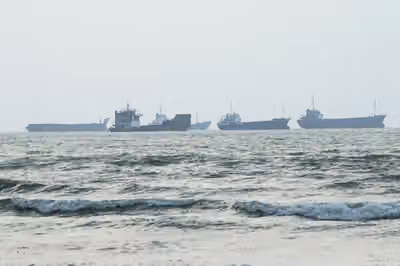
The resolution came during an emergency session on the widening regional conflict, in which regional states, the European Union and ASEAN members condemned Iran’s attacks in the Persian Gulf and the Strait of Hormuz.

UN High Commissioner for Human Rights Volker Turk warned that the conflict could draw in countries around the world on an unprecedented scale and urged influential states to use all available means to help end the war.

He said: “Attacks on civilians and civilian infrastructure must end. If they are deliberate, such attacks may constitute war crimes.”

Iran defended its actions and said more than 1,500 civilians had been killed in US-Israeli strikes so far.

Iran’s ambassador to the UN in Geneva, Ali Bahreini, said: “We fight on behalf of all of you against an enemy that, if not restrained today, will be beyond containment tomorrow,” referring to Israel.

Oman, one of the sponsors of the resolution and a previous mediator between Washington and Tehran, was among the few states to note that US-Israeli strikes had preceded Iran’s retaliation.

Ambassador Idris Abdul Rahman Al Khanjari said those strikes “were the spark that ignited the escalation currently affecting the region and the consequences are threatening states and their vital economic interests and their security and stability.”

The council’s motion also asked the UN rights chief to monitor the situation. An independent rights group, the International Service for Human Rights, cautioned against “selective outrage” and called for scrutiny of abuses by all sides.


Most Viewed

A Khamenei in-law is openly recruiting to replace the Islamic Republic
1

A Khamenei in-law is openly recruiting to replace the Islamic Republic

2

US imposes new Iran sanctions as officials say Hormuz deal is near

3

Mecca pact ties three Sunni powers together as Iran-backed attacks loom

4
VOICES FROM IRAN

Iranians turn on Pezeshkian over protest death toll comments

5
PODCAST

Ending Iran war could expose regime to its greatest threat yet, experts say

Banner
Banner
Banner

Spotlight

  • US miscalculated Iran’s resilience and hurt deal prospects, expert says
    ANALYSIS

    US miscalculated Iran’s resilience and hurt deal prospects, expert says

  • What the Pentagon learned from the Iran war
    INSIGHT

    What the Pentagon learned from the Iran war

  • Iran hardliners push renewed hijab crackdown despite widespread defiance

    Iran hardliners push renewed hijab crackdown despite widespread defiance

  • A Khamenei in-law is openly recruiting to replace the Islamic Republic

    A Khamenei in-law is openly recruiting to replace the Islamic Republic

  • Executions in Isfahan renew calls to end German city partnership

    Executions in Isfahan renew calls to end German city partnership

  • Iran's energy crisis is political, not seasonal
    ANALYSIS

    Iran's energy crisis is political, not seasonal