Three weeks into blackout, Iran internet remains restricted, NetBlocks says


Iran’s internet blackout has entered its third week, with more than 504 hours of disrupted connectivity and the public largely cut off from the global internet, monitoring group NetBlocks said.
"At hour 504, few circumvention tools work as authorities crack down on satellite and VPN users outside the state-approved whitelist", NetBlocks wrote.
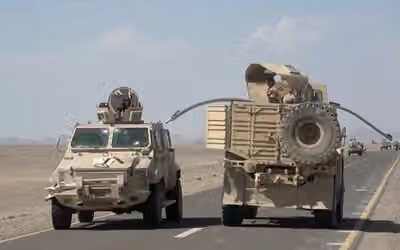
Explosions and military activity were reported in several parts of Iran early on Saturday, according to eyewitness accounts sent to Iran International.
In Fardis, west of Tehran in Alborz province, a Basij base and an old prayer site were said to have been turned into a base for special forces. Witnesses in Isfahan reported the sound of fighter jets overhead and several large explosions before dawn.
In southern Iran, Bandar Abbas on the Persian Gulf was rocked by repeated explosions from around 8 a.m., with blasts heard about every 10 minutes. On Qeshm Island in the Strait of Hormuz, witnesses reported the sound of several fighter jets at about 5 a.m.
A village in Ramsar, a city on the Caspian Sea coast, was hit at 3:37 a.m., with a strong explosion heard and a residential unit struck. In Astaneh-ye Ashrafiyeh, also in the north near the Caspian Sea, an area was targeted around 4 a.m. and a large blast was heard.
US Ambassador to the United Nations Michael Waltz said on Friday that Iran is seeking to push up energy prices and create global economic pressure to ensure its survival.
Speaking at a CNN town hall, Waltz siad Tehran is trying to “sow chaos” by targeting its neighbors, critical infrastructure, and energy markets, adding that it aims to “hold the world hostage.” He said President Donald Trump has weighed those risks against the possibility of Iran acquiring a nuclear weapon.
Waltz said Washington is taking measures to contain rising prices and plans to expand domestic energy production, including oil, gas, and nuclear, to counter what he described as Iran’s strategy.
Iran’s Consulate General in Mumbai said on Friday Tehran currently has “essentially no floating crude or surplus available for international markets,” responding to recent remarks by the US Treasury Secretary aimed at reassuring global oil buyers amid the ongoing supply disruption tied to the war with Iran.
The Trump administration announced on Friday it has lent 45.2 million barrels of crude from the Strategic Petroleum Reserve (SPR) to oil companies in an effort to ease soaring prices driven by the ongoing war on Iran, according to Reuters.
The initial loan covers 52% of the up to 86 million barrels the administration planned to release last week, with the broader plan aiming for 172 million barrels to be delivered through this year and into next.
Companies receiving the SPR loans include BP Products North America, Gunvor USA, Marathon Petroleum, and Shell Trading, the US Energy Department said.
Switzerland announced on Friday it will block the export of war materiel to the United States and other nations involved in the conflict with Iran for the duration of the war.
“The export of war materiel to countries involved in the international armed conflict with Iran cannot be authorized for the duration of the conflict,” the Swiss government said, adding that exports to the US “cannot currently be authorized.”
The US was Switzerland’s second-largest weapons importer last year, after Germany, according to SWI swissinfo. Switzerland added it has long refused military exports to Israel and does not export war materiel to Iran.