• العربية
  • فارسی
Brand
  • Iran Insight
  • Politics
  • Economy
  • Analysis
  • Special Report
  • Opinion
  • Podcast
  • Iran Insight
  • Politics
  • Economy
  • Analysis
  • Special Report
  • Opinion
  • Podcast
  • Theme
  • Language
    • العربية
    • فارسی
  • Iran Insight
  • Politics
  • Economy
  • Analysis
  • Special Report
  • Opinion
  • Podcast
All rights reserved for Volant Media UK Limited
volant media logo

Saudi air defenses intercept missile near Al-Kharj, no casualties

Mar 18, 2026, 08:14 GMT+0

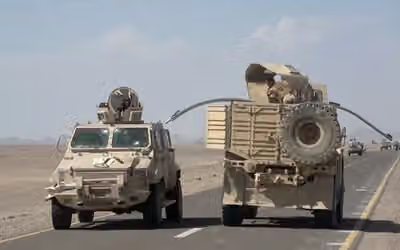
The Saudi Ministry of Defense said on Wednesday it intercepted a ballistic missile fired toward Al-Kharj, with debris falling near Prince Sultan Air Base.

The ministry said the incident caused no damage or casualties.
Most Viewed

Iran restores internet after 88-day blackout, keeps social media blocked
1

Iran restores internet after 88-day blackout, keeps social media blocked

2
INSIGHT

Qatar emerges as key broker in US-Iran frozen funds dispute

3
VOICES FROM IRAN

Iranians greet internet return with grief, anger and defiance

4

Rising care costs hit Iranians with spinal injuries

5
INSIGHT

Khamenei vows Israel’s annihilation as Hezbollah steps up attacks- why now?

Banner
Banner

Spotlight

  • Khamenei vows Israel’s annihilation as Hezbollah steps up attacks- why now?
    INSIGHT

    Khamenei vows Israel’s annihilation as Hezbollah steps up attacks- why now?

  • Could Iran be building a Chinese-style internet system?
    ANALYSIS

    Could Iran be building a Chinese-style internet system?

  • Oil pressure and economic strain drive Iran-US talks
    ANALYSIS

    Oil pressure and economic strain drive Iran-US talks

  • Qatar emerges as key broker in US-Iran frozen funds dispute
    INSIGHT

    Qatar emerges as key broker in US-Iran frozen funds dispute

  • Family forced into nighttime burial after student killed in protests
    EXCLUSIVE

    Family forced into nighttime burial after student killed in protests

  • Trump vs Tehran: how not signing became the deal
    OPINION

    Trump vs Tehran: how not signing became the deal

•
•
•

More Stories

Wave of explosions reported across Iran in early morning hours

Mar 18, 2026, 07:28 GMT+0

Explosions were reported across several parts of southern, western and central Iran early on Wednesday, according to eyewitness accounts sent to Iran International.

Bandar Abbas, the southern Iranian port city on the Persian Gulf, saw a series of blasts near naval and port facilities. Around 8:00 a.m., explosions were heard from the direction of the navy area and Shahid Bahonar port. More blasts followed at about 8:15 a.m. in the Jahanbar area, and at 8:40 a.m. near the oil terminal and control tower at Shahid Rajaee port.

Ahvaz, the main city of Iran’s southwestern Khuzestan province, was shaken by a strong explosion around 9:30 a.m. in the Zeytoun Karmandi neighborhood, rattling windows in nearby homes.

An explosion was heard around 5:00 a.m. in Songhor, a town in Iran’s western Kermanshah province near the Iraq border.

Near Kazerun, a city in Iran’s southern Fars province, an explosion was heard at about 6:55 a.m.

In Malard, west of Tehran, multiple explosions were reported between 6:50 a.m. and 7:10 a.m. In nearby Fardis, in Alborz province west of the capital, several blasts were heard around 7:11 a.m., including in the Naz district.

What the Balkans can tell Iranians about life after war

Mar 18, 2026, 07:23 GMT+0
•
Naeimeh Doostdar

Recent history in the Balkans may offer a useful lens for the postwar questions now confronting many ordinary Iranians.

That question has taken on added urgency after repeated suggestions by President Donald Trump this week that the war could end in the very near future.

Among the most instructive comparisons is the NATO intervention in Yugoslavia in 1999—a conflict that carried sharply different meanings depending on where it was experienced.

For many outside observers, the war began with NATO’s 78-day bombing campaign launched in March of that year after the collapse of peace talks. But for those on the ground in Kosovo, the conflict had already been unfolding for years.

It had taken shape not through airstrikes, but through a gradual tightening of control: checkpoints, dismissals from public jobs, the closure of Albanian-language schools and the growing presence of security forces.

By the time NATO intervened, many Kosovo Albanians saw the bombing not as the start of war but as a new phase of a conflict they had already been living through.

For many Kosovo Albanians, the bombing was accompanied by fear but also a measure of hope. By early 1999, large numbers of civilians were already fleeing violence, and accounts from refugee camps in Albania and North Macedonia often reflected a similar sentiment.

Fragments of those fears and hopes remain preserved in television reports from the time, now widely available online.

“We are afraid of the planes, but we are more afraid of the soldiers who burned our homes,” a young man from Prizren tells the BBC in one such report.

Another refugee says: “When we heard NATO had attacked, we thought maybe someone had finally come to stop this.”

For others, the calculus was more reluctant. A teacher later reflected: “We did not want war. But once it began, we felt it might be the only way for things to change.”

At the same time, civilians in Serbia experienced the war very differently.

In Belgrade, air raid sirens sent residents into shelters night after night as bridges, factories and military sites were targeted. In the early days, a sense of defiance took hold, with people gathering in public spaces despite the risk.

“We know it is dangerous, but we do not want to leave our city alone,” one student said.

As the bombing continued, defiance gave way to exhaustion. Power outages became more frequent, daily life more strained and uncertainty more acute.

“At first, people were angry. After a while, we were just tired,” one resident later said.

The Kosovo war illustrates how the same military intervention can carry entirely different meanings depending on lived experience.

For many Serbs, NATO’s campaign became a symbol of foreign aggression and national humiliation. For many Kosovo Albanians, it represented the possibility — however uncertain — that years of repression might finally end.

After 78 days, Yugoslav forces withdrew and international peacekeeping troops entered Kosovo. For many Kosovo Albanians, that marked the beginning of a return to homes that were often damaged or destroyed. For many Serbs, the war remained a defining national trauma.

The contrast endures in how the conflict is remembered.

“We hated the war,” one Kosovar later wrote. “But without it, we might still be living in that fear.”

A Serbian citizen offered a starkly different view: “For us, this war was neither freedom nor justice. It was simply bombing.”

As Iranians begin to consider what might follow the current conflict, the Balkan experience offers no simple answers—only a reminder that the meaning of war is rarely shared equally.

If the war does end soon, as Trump suggests, its consequences inside Iran may prove equally contested.

Iran’s stance on nuclear arms is unlikely to shift, FM says

Mar 18, 2026, 06:47 GMT+0

Iran’s position against developing nuclear weapons is unlikely to change significantly, Foreign Minister Abbas Araghchi said on Wednesday, according to remarks relayed by Iranian media from an interview with Al Jazeera.

Araghchi said Iran’s new Supreme Leader Mojtaba Khamenei, had not yet publicly expressed his view on the issue.

Late Supreme Leader Ali Khamenei's "nuclear fatwa" has served as a shield for Tehran's denial of nuclear weapon ambitions for two decades.

The Iranian foreign minister said fatwas depend on the Islamic jurist who issues them and added that he was not yet in a position to judge the new Supreme Leader’s jurisprudential or political views.

Dubai authorities say all air interceptions successful, no injuries

Mar 18, 2026, 06:21 GMT+0

Authorities in Dubai said on Wednesday that all air interception operations were successful and no injuries were reported.

They urged the public to rely on official sources for updates.

Netanyahu shows US envoy list of Iranian officials marked as targets

Mar 18, 2026, 06:13 GMT+0

Israeli Prime Minister Benjamin Netanyahu released a video of his meeting with US Ambassador to Israel Mike Huckabee in which he pulled a list from his pocket and said it showed Iranian officials targeted by Israel.

Netanyahu appeared to present the list as a record of Iranian officials marked for elimination, saying two had already been removed while others remained.

“I’m alive, but I have this card,” Netanyahu said. “It’s a punch card. Today, I erased two names on the punch card, and you see how many more to go on this batch?”

The video also referred to online rumors that Netanyahu had been killed and that videos presented as proof he was alive were AI-generated. Netanyahu mocked those claims by joking about having five fingers on each hand.