Iran strikes were defensive, aimed at imminent threat, Speaker Johnson says
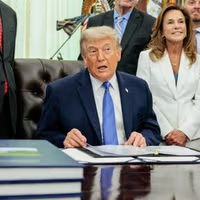
Speaker Mike Johnson said the United States carried out defensive, limited operations in response to an imminent threat from Iran, emphasizing that the missions were not part of a broader intervention or nation-building effort.
“We are not in the nation building business. We are not interventionalist. We are not out trying to be the world's policeman… No one in our party believes that, even the people that they call Neo-cons are coming back to reality because of our financial situation," Johnson said in an interview with Michael Knowles of Daily Wire.
“The Iran situation was real. I’m in the Gang of Eight. I got all the classified briefings… The Intel said we were of an imminent danger of an attack on our personnel, our service members, our civilians, our installations in that region… Iran was going to have a barrage of missiles. This is all the unclassified part. Now it’s all been reported," he added.
“Israel was going to act unilaterally. It’s their right as a nation to do it… And we had to act first to prevent mass casualties on our side. The Commander in Chief had a tough decision. It’s not a declaration of war, it’s defensive, limited mission. I think that mission is getting accomplished, and the world’s gonna be better off because of it," Speaker Johnson said.
“They were producing new ballistic missiles in Iran at a rate of about 700 a month, far outpacing what our regional allies could keep up with. And, of course, they were pursuing their nuclear ambitions again," he added.
Lebanese Parliament Speaker Nabih Berri meets Iran's slain Supreme Leader Ali Khamenei in May 2024
Lebanon’s Parliament Speaker Nabih Berri receives more than $500,000 per month from the Islamic Republic in order to support Tehran's interests and those of its allied group Hezbollah in Lebanon, informed sources told Iran International.
Officials in Tehran say the sums are meant to “buy” unity among Lebanon’s Shiite leadership to ensure that they “act in accordance with Iran’s interests, not Lebanon’s interests.”
Nabih Berri did not respond to Iran International’s request for comment. One of his advisers said that Berri would not comment on the matter at this time.
Berri has not publicly opposed Hezbollah’s attacks on Israel in support of Iran, the sources said, because he does not want to risk losing his financial resources.
The 88-year-old politician heads Lebanon's Amal Movement and holds significant sway in Lebanon’s domestic and foreign policy.
The Shiite organization, formed in the 1970s, remains one of the country’s main political actors. It maintains close political ties with Hezbollah, and both belong to Lebanon’s Shiite political camp.
On March 1, Hezbollah targeted Israel in support of Tehran. Israel launched a new military operation in retaliation.
The sources said Berri has been unwilling to support efforts by the Lebanese government to disarm Hezbollah because, in exchange for receiving large sums from Tehran, he must “advance measures in the Lebanese parliament that align with Tehran’s interests.”
In recent months, Lebanon’s President Joseph Aoun and Prime Minister Nawaf Salam have tried to pressure Hezbollah to disarm in order to reduce tensions with Israel and the international community.
Army forces have confiscated Hezbollah weapons in parts of southern Lebanon, but senior Lebanese officials have said that fully implementing the plan could trigger internal tensions, as Hezbollah has refused to hand over its entire arsenal.
Hezbollah Secretary-General Naim Qassem and officials of the Islamic Republic have repeatedly opposed disarming the group.
Following Hezbollah’s attack on Israel, the Lebanese government announced that the group's military activities would be banned.
On March 6, Israeli Defense Minister Israel Katz warned the Lebanese government that if it remains unable to fulfill its commitments regarding Hezbollah’s disarmament, Lebanon will “pay a very heavy price.”
Tehran considers Hezbollah one of the main pillars of the so-called Axis of Resistance—a term used by Iranian officials to refer to allied armed groups such as Hamas, Islamic Jihad, Hezbollah, Iraq’s Popular Mobilization Forces, and the Houthis in Yemen.
The Wall Street Journal reported in November 2025 that Tehran transferred hundreds of millions of dollars in oil revenue to Hezbollah in the preceding year through exchange offices, private companies and a financing network in Dubai.
Israel’s Kan network reported in December 2025 that Tehran had agreed to pay $1 billion to Hezbollah.
Neither report can be independently verified by Iran International.
The office of the Speaker of Lebanon’s Parliament, in a statement issued after the article was published, called the claim "false and baseless."
US President Donald Trump said he believes Iran’s newly appointed Supreme Leader, Mojtaba Khamenei, is still alive “in some form,” despite not being seen publicly since taking office amid the war with the United States.
“I think he probably is. I think he is damaged, but I think he’s probably alive in some form, you know,” Trump said in an interview with Fox News Brian Kilmeade, set to air on Friday.
“Iran had thousands of missiles pointed at all these Middle Eastern countries for the last four months… They were going to take over the Middle East… UAE, Qatar, Oman and Saudi Arabia. All these nations were afraid of Iran and they are not anymore. But they had reason to be afraid. We have knocked the hell out of them like no other nation could and they still have remnants left," Trump said.
“There’s nothing to be afraid of. They have no Navy and we sunk all their ships.” Trump added. “Go through the strait of Hormuz and show some guts. There’s nothing to be afraid of.”
Israeli Ambassador to the United States, Yechiel (Michael) Leiter said on Thursday Israeli and allied forces struck Basij checkpoints in Tehran and will continue to attack proxy Hezbollah in Lebanon.
"The cracks in the Iranian regime are widening: officials, stationed aoutside of Iran are abandoning their posts and asking for asylum in various countries," Leiter posted on X.
"One of the two American aircraft involved in the accident over Iraq landed safely in Israel. Our Airforce chief was debriefed by the AFCENT commander on the initial details of the event," he added. "Our strikes on Iran and its proxies continue: today we hit Basij forces and roadblocks in Tehran, who were restricting the movement of locals. We also struck Hezbollah command centers and launchers across Lebanon."
The Chehel Sotun (40 Columns), a 17th century pavilion and garden in Iran's historic city of Isfahan, was damaged in US-Israeli strikes, March 9, 2026
Airstrikes in Iran have damaged several historic landmarks, including UNESCO-listed sites, raising concern among cultural experts and officials about the protection of heritage during the conflict.
UNESCO’s World Heritage Centre has confirmed damage to several sites on its global heritage list, though the full extent remains unclear, its director Lazare Eloundou Assomo said.
Several of the affected buildings carried the Blue Shield emblem, an international symbol used to identify protected cultural heritage sites under international law and often described as the “Red Cross for cultural heritage.”
Iran’s Foreign Minister Abbas Araghchi later criticized UNESCO’s response. “It's natural that a regime that won't last a century hates nations with ancient pasts. But where's UNESCO? Its silence is unacceptable,” he wrote on X.
Among the sites affected is the historic Golestan Palace, a Qajar-era complex in central Tehran added to the UNESCO list in 2013.
According to Afarin Emami, director of the Golestan Palace World Heritage complex, blast waves from airstrikes on March 1 shattered windows and damaged delicate mirrorwork in several halls.
Debris spread around in a hall at Tehran's historic Golestan Palace, after a US-Israeli strike, March 1, 2026
Images published by Iranian media show damaged crystal chandeliers and wooden doors and windows torn from their frames.
Emami said museum objects inside the palace were not harmed because they had been moved to secure storage after earlier tensions raised concerns about possible escalation.
The nearby Grand Bazaar of Tehran, a vast network of corridors forming a key part of the capital’s historic fabric, also sustained damage. Other buildings affected in Tehran include the former Senate Palace and the historic former Police Headquarters.
Several days later, further blast waves reportedly caused damage in Isfahan, one of Iran’s most important historic cities.
Images circulating online show shattered windows, cracked walls and fallen mirrorwork at multiple sites, including the Safavid-era Chehel Sotoun Palace and the Ali Qapu Palace in the Naqsh-e Jahan area.
The primary target appeared to be the provincial governor’s office building in the nearby Rashk-e Jahan complex, which was reportedly directly bombed. Ashraf Hall, a Safavid structure known for its gold-decorated ceilings, sustained significant damage, with photographs showing fallen tiles scattered among office furniture.
Governor's office (Rashk-e Janan Palace) in Isfahan after bombing
Elsewhere, Iranian media reported damage in Sanandaj, where several historic mansions lost sections of plaster decoration, mirrorwork and wooden doors. In northern Iran, reports suggest the Safavid-era Safi Abad Palace in Behshahr may have been affected by nearby strikes targeting a military radar facility, though no confirmed photographs have been released.
Near the historic Falak-ol-Aflak Castle in western Iran, the provincial cultural heritage office located within the castle’s protected zone was destroyed and five staff members and heritage protection personnel were reportedly injured. The fortress itself was not damaged.
The incidents have triggered heated debate among Iranian social media users, with some criticizing the government’s own handling of cultural heritage protection.
One user wrote on X: “At least write that the Islamic Republic should not build military bases next to heritage sites when you write that a historic monument was damaged by Israeli or US attacks.”
Others argued the destruction must be viewed in the broader context of the conflict. “We can rebuild buildings,” one commenter wrote. “Save your tears for the 40,000 people who were killed.”
Some groups, including the Jurists’ Council for a Democratic Iran, have called on all sides to respect international conventions protecting cultural heritage during armed conflict.