Israel says prepared to continue war with Iran as long as needed
Israel is prepared to continue the war with Iran for as long as necessary, a spokesperson for the Israeli military said on Wednesday.
Israel is prepared to continue the war with Iran for as long as necessary, a spokesperson for the Israeli military said on Wednesday.




The US State Department said on Wednesday that Iran and Iran-aligned militias may be planning to target US-owned oil and energy infrastructure and hotels in Iraq.
The US Embassy in Baghdad issued a separate warning on X, asserting that Iran and its armed allies may be planning attacks on US-owned oil and energy infrastructure in Iraq.
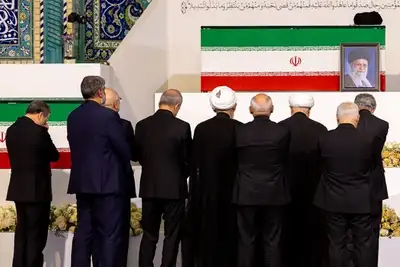
Iran’s new supreme leader Mojtaba Khamenei inherits not merely his father’s office but also the constitutional ambiguities and political compromises that accompanied Ali Khamenei’s own controversial elevation nearly four decades earlier.
The death of Khamenei in the February 2026 US–Israeli airstrikes on Tehran has triggered the most consequential constitutional transition in the Islamic Republic since 1989—and revived a question that has long shadowed the system since its founding: whether supreme authority rests primarily on religious legitimacy or political power.
Within days, Iranian state media announced that the Assembly of Experts had selected his son, Mojtaba Khamenei, a figure long powerful behind the scenes but lacking broad clerical standing, as the new Supreme Leader.
The office of Supreme Leader is defined primarily by Articles 5, 107, 109 and 110 of the Constitution of the Islamic Republic of Iran.
Article 5 establishes the principle of velayat-e faqih, entrusting governance during the occultation of the Twelfth Imam to a qualified jurist combining religious authority with political competence. Article 107 assigns the Assembly of Experts the responsibility of selecting the Supreme Leader, while Article 109 sets out the required qualifications, including justice, political insight and administrative ability.
The precedent of 1989
When Khomeini died in June 1989, the Islamic Republic faced an immediate leadership vacuum. No obvious successor possessed comparable clerical stature.
The Assembly of Experts ultimately chose Ali Khamenei, then president, despite his limited standing as a senior jurist; the constitution was soon revised to accommodate the decision, stating that the leader need not possess the full recognition as a grand ayatollah.
The amendment reflected political calculation rather than abstract principle.
The episode established an enduring precedent: constitutional interpretation could adapt to political necessity. In practice, legitimacy rested not only on religious authority but also on institutional alignment and security power.
Mojtaba Khamenei now confronts a similar dilemma. Like his father in 1989, he is not widely recognised within the traditional hierarchy of Shiʿi scholarship as a senior jurist.
Wartime succession
Under Article 107, the Assembly of Experts must deliberate and appoint the Supreme Leader, ordinarily implying a formal session. Yet Mojtaba’s selection occurred amid ongoing war and severe disruption following the airstrikes that killed Ali Khamenei.
Public information about the process remains sparse. It is unclear whether the assembly gathered physically, voted remotely or reached its decision through emergency consultation. Iranian state media confirmed his appointment but provided few procedural details.
Such ambiguity does not necessarily invalidate the decision within the Islamic Republic’s flexible constitutional practice. Still, the opacity surrounding the process has intensified debate over the legitimacy of the succession.
For more than a decade Mojtaba sought to strengthen his clerical credentials. Beginning in 2009, he taught dars-e kharej—advanced jurisprudence seminars traditionally led by senior clerics aspiring to marjaʿ status. Observers widely interpreted the move as preparation for a possible future succession.
Reports from Persian-language sources suggest some senior grand ayatollahs objected to what they saw as a politically engineered effort to manufacture clerical authority. Attempts were reportedly made to obtain written attestations of Mojtaba’s ijtihad, though evidence of broad clerical recognition remains limited.
After roughly thirteen years, Mojtaba suspended the classes in September 2024 as succession speculation intensified.
Power without office
Power in the Islamic Republic has rarely flowed through formal titles alone. It often moves through the networks surrounding the Supreme Leader.
Over two decades Mojtaba emerged as one of the most influential yet least publicly visible figures in the Iranian state. His authority derived not from elected office but from his role inside Beit-e Rahbari, where he functioned as a gatekeeper to his father—managing access, filtering political actors and coordinating with security institutions.
In practice this amounted to a tightly controlled security network of clerical aides, intelligence officials and Revolutionary Guard commanders whose influence depended less on formal office than on proximity to the Leader.
This informal authority allowed Mojtaba to cultivate a patronage base closely tied to the IRGC. The United States Treasury sanctioned him in 2019, stating that he acted on behalf of the Supreme Leader while maintaining close relationships with IRGC elements and the Basij militia.
The Guards connection
The relationship between the Supreme Leader and the Revolutionary Guards deepened decisively during the 2009 post-election unrest.
Following the disputed presidential vote that returned Mahmoud Ahmadinejad to power, mass protests erupted across Iran. The Revolutionary Guards and Basij militia ultimately played the decisive role in suppressing the demonstrations.
The events of 2009 reaffirmed the supremacy of the Supreme Leader while strengthening the alliance between the leadership and the security apparatus. Many analysts argue Mojtaba played a coordinating role inside the Leader’s office during the crisis.
One figure embodied the partnership between the Supreme Leader and the Revolutionary Guards more fully than any other: General Qasem Soleimani, commander of the Quds Force.
Soleimani maintained unusually direct access to Ali Khamenei and operated with a degree of autonomy rare within the Islamic Republic’s formal hierarchy, shaping Tehran’s regional military strategy across Iraq, Syria and beyond.
His killing by a United States drone strike in January 2020 removed a central node in the system that linked the Leader to the Guards’ external operations.
Although the IRGC remained institutionally powerful, no successor fully replicated Soleimani’s combination of battlefield authority, political influence and personal access to the Supreme Leader..
Continuity and uncertainty
Another turning point came with the death of President Ebrahim Raisi in a helicopter crash in 2024.
Long viewed as a plausible successor with stronger clerical credentials, Raisi’s absence narrowed the field and sharpened attention on Mojtaba Khamenei, whose embedded position within Beit-e Rahbari and longstanding ties to the security apparatus left him uniquely placed when wartime succession arrived.
Mojtaba Khamenei’s accession does not resolve the deeper tensions within the Islamic Republic. Like his father in 1989, he assumes power without universally recognised clerical authority. His legitimacy rests instead on political coalition, institutional continuity and the support of the Revolutionary Guards.
At the same time, the war that accompanied his elevation has destabilised the very networks that sustained his rise. The destruction of Beit-e Rahbari and the deaths within the leadership circle have left the inner workings of the system partially obscured.
Mojtaba inherits the same contradiction that shaped his father’s rise: a system that claims religious authority yet repeatedly turns to political necessity in moments of crisis.
In 1989, that necessity elevated Ali Khamenei as the republic emerged from the long shadow of the Iran–Iraq War. In 2026, it has elevated his son amid war once again—leaving the durability of Iran’s constitutional order dependent, as before, less on theology than on power.
Gulf Cooperation Council Secretary-General Jasem Mohamed Al Budaiwi condemned Iran over the drone strike on fuel storage tanks at Oman’s Salalah port, saying the council states stand united behind Oman in defending its security, stability and territorial integrity.
Earlier Wednesday, Omani authorities confirmed drones struck fuel tanks at the port while others were shot down. Oman said the tanks were damaged but no casualties were reported.
Iranian media reported that President Pezeshkian told Oman’s sultan that the incident will be investigated.
The FBI warned police departments in California that Iran could retaliate for US strikes by launching drones at the US West Coast, ABC News reported, citing an alert sent to law enforcement agencies.
The alert said Iran had allegedly aspired to conduct a surprise attack using unmanned aerial vehicles from an unidentified vessel off the US coastline targeting unspecified locations in California if the United States carried out strikes against Iran, according to the report.
“We have no additional information on the timing, method, target, or perpetrators of this alleged attack,” the alert said, according to ABC News.
The warning was distributed to law enforcement agencies at the end of February, the report said.
IRGC-affiliated Fars News reported that Israeli drones targeted multiple checkpoints across Tehran on Wednesday evening, killing several security personnel and Basij members stationed there. The report described the attacks as “terrorist” strikes.
According to Fars, explosions and clashes were reported at several locations in the capital.
An unnamed official cited by the outlet said the attacks were a joint operation by Israel’s Mossad and monarchist groups aimed at infiltrating operatives and carrying out sabotage inside the country.