Pentagon says 140 US service members wounded in Iran war
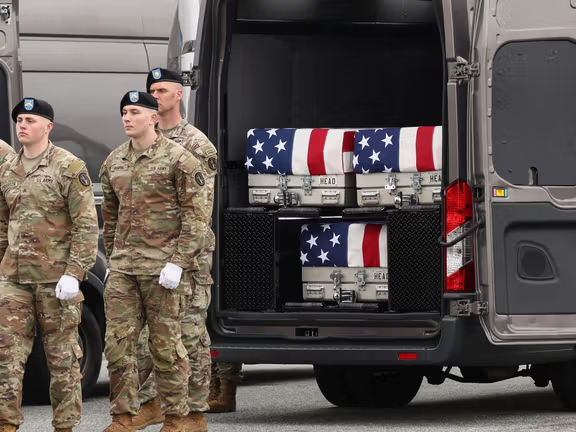
The Pentagon said Tuesday that around 140 US service members have been injured during 10 days of ongoing attacks linked to the conflict with Iran.
Chief Pentagon spokesperson Sean Parnell said the casualties include eight troops with life-threatening injuries who are receiving the highest level of medical treatment.
“Since the start of Operation Epic Fury, approximately 140 US service members have been wounded over 10 days of sustained attacks,” Parnell said in a statement. “The vast majority of these injuries have been minor, and 108 service members have already returned to duty.”
So far, seven US troops have also been killed in Operation Epic Fury, according to official figures.






Supporters of the Islamic Republic have gathered in several cities to show loyalty to the new leader. The officialdom has congratulated him in unison. But Khamenei Jr is yet to appear.
There has been no speech, no televised address and very few photos or videos of the new leader. The only recording attributed to him so far is a short old video announcing that his religious classes have been canceled.
The lack of information has been so striking that even state media appears uncertain about how to present him to the public.
Older photographs have been circulated, stylized illustrations or AI-generated renderings have appeared online to fill the visual vacuum. These images are not presented as authentic photos but symbolic representations.
The situation raises a central question: what scenario may explain the unusual debut of Iran’s new Supreme Leader?
Scenario one: delayed unveiling
The simplest explanation is that the Islamic Republic intends to introduce Mojtaba through a carefully managed televised address or recorded message once security conditions allow.
In this scenario, the leadership transition would be framed as orderly and unified, with Mojtaba reiterating familiar themes of resistance, continuity and cohesion under wartime pressure.
Even so, the delay itself invites scrutiny. Authorities could cite security concerns, but the absence of even a brief recorded message—particularly after the steady stream of congratulatory statements from senior officials—has raised questions about the pace and choreography of the transition.
For now, the silence has only heightened curiosity about how and when the new leader will first address the public.
Scenario two: leadership by statement
A second possibility is that Mojtaba may initially govern largely through written statements rather than public appearances. Such an approach would allow the system to project continuity while limiting exposure during a volatile security moment.
Iran’s leadership has long relied on tightly managed messaging, and written statements attributed to Mojtaba could reiterate established positions while reinforcing the central role of the Islamic Revolutionary Guards Corps, which appears to wield growing influence over wartime decision-making.
State television has already described Mojtaba as a veteran of the “Ramadan war,” part of an emerging narrative that presents him as shaped by wartime experience. Under this scenario, his absence would reflect caution rather than weakness.
Scenario three: managed vacuum
A third possibility is that Mojtaba’s continued absence reflects deeper uncertainty within the leadership itself.
The Islamic Republic is operating under sustained Israeli and US strikes, and the rapid announcement of his succession may have served primarily to prevent internal competition at a moment of acute vulnerability.
Another explanation is that Mojtaba may have been injured in the same attacks that killed his father and other senior figures—a scenario that would help explain both the speed of his appointment and his continued absence.
Naming him quickly could have forestalled rivalries among powerful factions while allowing the Revolutionary Guards and other security institutions to consolidate operational control.
In such circumstances, Mojtaba would function largely as a symbolic leader while practical authority remained concentrated within the security establishment, the Islamic Revolutionary Guard Corps in particular.
Presenting an absent or wounded successor could also suppress dissent by discouraging open criticism of someone portrayed as a victim of the same war that killed the previous Supreme Leader.
Continuity and risk
Such a strategy, however, carries risks. If the leader continues to remain unseen for an extended period, public skepticism could deepen further, particularly among a population already wary of official narratives.
The lack of clarity may also reinforce uncertainty within the elite at a time when the system is under exceptional strain.
In the short term, projecting continuity appears to be the system’s priority. By naming a successor quickly, even if still absent, the establishment in Tehran may hope to signal stability to both domestic and international audiences.
Whether that image can be sustained, however, may ultimately depend on one simple question: when and if Iran’s new Supreme Leader finally appears.
The longer he remains unseen, the more his absence risks becoming a political fact in its own right—one that could deepen uncertainty at a moment when Tehran can least afford it.
