Trump urges Australia to grant asylum to Iranian women’s soccer team


US President Donald Trump urged Australia to grant asylum to members of Iran’s national women’s soccer team, saying they would face grave danger if returned to Iran.
“Australia is making a terrible humanitarian mistake by allowing the Iran National Woman’s Soccer team to be forced back to Iran, where they will most likely be killed,” Trump wrote on X. “Don’t do it, Mr. Prime Minister, give ASYLUM. The US will take them if you won’t.”
His remarks came after the office of Prince Reza Pahlavi confirmed five players — Fatemeh Pasandideh, Zahra Ghanbari, Zahra Sarbali, Atefeh Ramazanzadeh and Mona Hamoudi — had left the team’s training camp and sought refuge in Australia. According to the statement, the players said they had joined what was described as Iran’s “Lion and Sun Revolution.”
There has been mounting concern over the team’s safety after several players stood in silence and did not sing Iran’s national anthem before an Asian Cup match in Australia, drawing criticism from Iranian state media.
Global players’ union FIFPRO has said it is “really concerned” about the team’s welfare and has been unable to contact the players. A petition urging Australia to protect the squad has gathered tens of thousands of signatures.


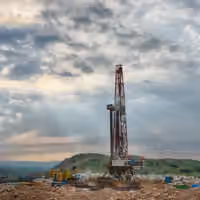


A Greek-operated oil tanker carrying Saudi crude has sailed through the Strait of Hormuz with its destination listed as India, according to ship tracking data from Kpler and Lloyd’s List Intelligence, Reuters reported.
The Shenlong Suezmax tanker, which can carry about 1 million barrels, loaded crude at Saudi Arabia’s Ras Tanura port, MarineTraffic data showed.
The vessel last recorded its position inside the strait on March 8 before updating its destination to Mumbai. The tanker’s Athens-based manager, Dynacom, did not immediately respond to a request for comment.
US Central Command rejected claims by Russian and Iranian state media that a US Patriot missile accidentally struck a neighborhood in Bahrain while attempting to intercept an incoming threat.
“Russian and Iranian media claimed earlier today that a US Patriot missile missed … and inadvertently hit a neighborhood in Bahrain. LIE,” CENTCOM said in a post on X.
It added that “an Iranian drone struck a residential neighborhood, injuring 32 civilians in Bahrain, including children who required medical treatment,” citing the Bahraini government.
Tehran may have assumed that a US–Israeli attack would activate the loose alignment it has cultivated with Moscow, Beijing and other non-Western powers. So far, it has instead exposed its limits.
What Iranian officials often presented as an emerging geopolitical counterweight to Western power appears, for now, far from a wartime coalition.
Russia and China have condemned the attacks and called for restraint, but neither has shown willingness to intervene militarily on Iran’s behalf.
Reports suggest Moscow may have shared limited intelligence that could assist Iranian targeting of US assets in the region. Even if so, such cooperation remains indirect and far short of what a wartime alliance would entail.
For Moscow, deeper involvement carries obvious risks. Russia remains heavily engaged in Ukraine and under sustained military and economic pressure from the West. Opening another confrontation with the United States in the Middle East would pose significant strategic dangers.
Yet instability in the region could still bring Moscow indirect gains. As a major oil exporter, Russia benefits from higher global energy prices, which help cushion the impact of Western sanctions.
A wider conflict could also divert Western political attention from Ukraine, easing pressure on its primary theater.
China’s calculus points in the same direction: distance. Beijing’s interests in the Middle East are largely economic—stable energy supplies, secure shipping routes and predictable markets. A major regional war threatens all three.
At the same time, a prolonged conflict that absorbs American attention and resources could indirectly ease pressure on China in its broader rivalry with Washington.
North Korea, often cited as part of an emerging anti-Western axis, has remained largely silent. Pyongyang lacks the logistical capacity to project meaningful military power into the Middle East and has little incentive to risk confrontation with the United States in a distant conflict.
For decades, Tehran invested heavily in expanding its regional influence through a network of non-state actors stretching from Lebanon to Yemen. Groups such as Hezbollah, Hamas and the Houthis were meant to provide strategic depth, allowing Iran to pressure adversaries indirectly while avoiding direct confrontation.
That network now faces growing strain.
Hamas has been significantly weakened by prolonged conflict with Israel. Hezbollah remains Iran’s most capable partner, but its structure also reveals a deeper limitation in Tehran’s approach: the system often depends on personal relationships between commanders rather than durable institutional frameworks, making coordination more fragile when individuals are removed.
The Houthis retain the capacity to disrupt shipping routes and launch missile or drone attacks across the region. But their strength lies primarily in asymmetric disruption; in a high-intensity campaign driven by air power and long-range strikes, such actions cannot quickly alter the strategic balance inside Iran itself.
Elsewhere, several militia groups cultivated by Tehran in Iraq appear reluctant to escalate dramatically, underscoring the limits of Iran’s ability to mobilize partners during a major confrontation.
In recent years, Iran has sought to present itself as part of a broader alignment against Israel while simultaneously pursuing pragmatic openings with Arab states. The China-brokered rapprochement with Saudi Arabia in 2023 suggested the possibility of a more stable Gulf balance.
But that détente depends heavily on regional stability. If Iranian actions—or those of allied militias—threaten shipping lanes or energy infrastructure, Arab governments may prove far less inclined to view Tehran as a reliable long-term partner.
If the conflict continues while its partners remain cautious, Iran risks growing isolation. Its ties with Russia and China are shaped primarily by overlapping interests rather than formal alliance commitments.
Strategic priorities diverge, and even governments opposed to Western dominance remain wary of dependence or rivalry.
A deeper alignment might have emerged under different geopolitical conditions, much as sustained confrontation during the Cold War pushed Western states toward institutional alliances such as NATO.
But that moment has not arrived. The war suggests it may not—at least not on terms Iran had imagined.
US Secretary of State Marco Rubio said the United States is engaged in an operation against what he called “the world’s leading hostage taker” and “the world’s leading sponsor of terrorism, the regime in Iran.”
Speaking on US Hostage and Wrongful Detainee Day, Rubio said the mission’s objectives are clear: “It is to destroy the ability of this regime to launch missiles, both by destroying their missiles and their launchers. Destroy the factories that make these missiles and destroy their navy.”
He accused Tehran of attempting to destabilize the region, saying, “They are trying to hold the world hostage. They are attacking their neighbors… their energy infrastructure, their civilian population. They’re attacking embassies. This is a terrorist government.”
Rubio said the United States was “well on our way to achieving that objective,” adding that “every single day, this regime in Iran has less missiles, has less launchers, their factories work less and their navy is being eviscerated.”
He also referenced the long-running case of former FBI agent Robert Levinson, who disappeared in Iran in 2007, calling it “a reminder of the nature of the regime that we’re dealing with in Tehran.”
FBI Deputy Director Christopher Raia said Monday that evidence suggests former FBI agent Robert Levinson died while in captivity in Iran, calling the case deeply personal and pledging continued efforts to uncover the truth.
Speaking at a flag-raising ceremony marking US Hostage and Wrongful Detainee Day, Raia said Levinson — who disappeared in Iran in 2007 — is believed to have died there and remains the longest-held American hostage in US history.
“Our evidence suggests that Bob died in captivity in Iran,” Raia said, noting that nearly 19 years have passed since Levinson’s abduction.
Raia said the FBI continues to pursue leads and released posters last year identifying individuals believed responsible for Levinson’s kidnapping, detention and probable death. He said the bureau has also shared information with US and foreign partners to seek accountability.

