Prince Pahlavi backs strikes on IRGC, urges military to join people | Iran International
Prince Pahlavi backs strikes on IRGC, urges military to join people
Prince Reza Pahlavi said the US and Israeli campaign targeting the Revolutionary Guards and the Islamic Republic’s “infrastructure of terror” has broad support among Iranians.
In a post on X, he said the establishment is using civilians as “human shields,” calling it “a crime against humanity,” and added that the protection of civilians and Iran’s vital national infrastructure must remain a priority.
Addressing Iran’s armed forces directly, he urged them to defect. “Lay down your arms and join the people. If you do, there will be a place for you in a free Iran,” he wrote.
Israeli military images of an underground tunnel complex attributed to Ali Khamenei appear to confirm long-circulating rumors of a network stretching several kilometers beneath central Tehran, under medical centers, schools, and residential neighborhoods.
On March 5, shortly after heavy strikes targeted areas near the Pasteur government complex in central Tehran – a district that houses the Iranian presidency and several key government offices – the Israeli military published a video depicting what it described as Khamenei’s underground bunker system.
The complex resembles a subterranean city. According to the video and accompanying imagery, the facility appears to have been used as a secure shelter for Iran’s leadership and may still be used by remaining officials following Khamenei’s death.
A tunnel network stretching nearly five kilometers
Analysis of the imagery released by the Israeli military, using publicly available online mapping tools, suggests the tunnel network extends close to five kilometers in length.
To understand the scale of the project, it helps to compare it with ordinary infrastructure construction in Tehran.
According to statements by Tehran mayor Alireza Zakani and members of the Tehran City Council, building one kilometer of metro tunnel in Tehran currently costs between 5,000 and 6,000 billion tomans – roughly $30-36 million at an exchange rate of about 166,000 tomans per dollar.
This estimate covers only the excavation and structural work. It does not include interior finishing, equipment, ventilation systems, or other underground facilities.
Based on those figures, building five kilometers of underground tunnel would cost about 25,000 to 30,000 billion tomans, or roughly $150-180 million.
Given the secrecy and security requirements surrounding such a project, the actual cost was likely significantly higher than that of a standard transportation tunnel.
Under normal conditions, tunneling contractors in Tehran can excavate around 10 meters per day. At that pace, building a five-kilometer tunnel system would take at least 500 days – roughly 17 months.
Considering the classified nature of the project and the additional infrastructure involved, the construction timeline may have been considerably longer.
The core of the complex: beneath a medical facility
The video appears to place the central section of the bunker complex southwest of the presidential compound in the Pasteur district.
The site sits directly beneath the Shahid Shourideh Medical Center, a clinic affiliated with Iran’s Ministry of Agriculture. The facility has operated since 1985 and effectively functions as part of the broader Pasteur government complex.
Based on the height of vehicle ramps and the dimensions of vehicles visible in the imagery, the central installation appears to be located 40 to 50 meters underground.
From there, the tunnel system extends northwest toward another entrance near the end of Rajabi Street, roughly 200 meters from the Shourideh hospital complex.
Shahid Shourideh Medical Center, which is affiliated with Iran’s Ministry of Agriculture, sits above what appears to be the main core of Khamenei’s bunker complex, estimated to be 40 to 50 meters underground.
Easternmost entrance: next to an elementary school
The easternmost known entrance to the tunnel network appears to be located in the Sheikh Hadi neighborhood, along Valiasr Street, beneath the Jami multi-story parking garage.
This parking structure stands directly beside Hejrat Girls’ Elementary School, while Saheb a-Zaman Boys’ Elementary School lies about 100 meters away.
At the northern edge of the network sits another multi-story garage known as the 12 Farvardin Parking Complex, located near the intersection of Jomhouri Eslami Street and Danesh Street.
Both parking structures were inaugurated on December 4, 2017, as part of a paired urban development project attended by Tehran’s then-mayor Mohammad Najafi.
One entrance to the tunnel network appears to lie beneath a building opposite the Karimeh Ahl-e Beit clinic near Hor Square in central Tehran.
An entrance beneath a mosque, beside a school
Another entrance appears west of Pasteur Square, between Hor Metro Station and the square itself.
This access point lies beneath Tohid Mosque. Adjacent to the mosque is a building, and behind it stands Shahid Kadkhodaei Boys’ Elementary School.
Roughly 200 meters away, another possible entrance is located on the southwestern side of Pasteur Square, along a street that houses the AJA University of Command and Staff – the staff college of the Islamic Republic of Iran Army.
Nearby are the Karimeh Ahl-e Beit dental clinic and medical clinic, as well as the 29 Farvardin Pharmacy, which is affiliated with Iran’s army.
The easternmost entrance to the tunnel complex appears to lie beneath the Jami multi-story parking garage, directly next to Hejrat Girls’ Elementary School.
Western entrance beside a football school
The westernmost identified entrance to the tunnel network appears to lie beneath a small building near an office responsible for issuing hunting weapon permits.
Immediately next to the building, sharing a wall, is a football training school, while dense residential complexes surround the area.
This location sits near the intersection of Sepah and Kamali streets, along Kashan Street, at the end of Fourth Street.
The tunnels also lie close to the Yas and Namjou residential complexes, which are affiliated with the Iranian army.
One of the entrances to the tunnel network appears to lie beneath a mosque next to Shahid Kadkhodaei Boys’ Elementary School.
Turkey deployed six F-16 fighter jets and air defense systems to northern Cyprus on Monday to bolster the security of the Turkish Cypriot community amid the war in Iran, the defense ministry said, adding that Ankara could take additional measures if needed.
"In the context of the latest developments in our region, six F-16 fighter jets and air defense systems have been deployed to the Turkish Republic of Northern Cyprus as of today," the ministry said in a statement.
The Fatemiyoun Brigade of Afghan fighters pledged loyalty to Mojtaba Khamenei after he was named Iran’s new supreme leader, following the death of his father Ali Khamenei in US-Israeli airstrikes.
The Iran-backed militia said it viewed itself as “a sword in the hands of the new leader of the Islamic Revolution” and vowed to defend the foundations of the Islamic system against what it described as American and Israeli enemies.
The group said in a statement that the appointment of Mojtaba Khamenei had strengthened hope among supporters of the “axis of resistance.”
The Fatemiyoun Brigade, composed largely of Afghan fighters and organized by Iran’s Islamic Revolutionary Guard Corps, said its members would continue to stand with Iran and allied groups in ongoing regional confrontations.
Iran’s Assembly of Experts announced in a statement on Sunday that Mojtaba Khamenei has been chosen as the country’s new supreme leader, days after Iran International first reported his selection under pressure from the Revolutionary Guards.
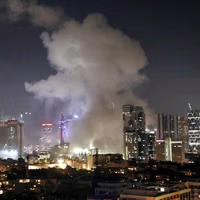
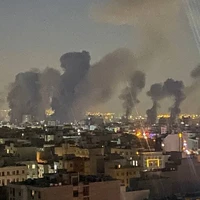
Explosions and air raid activity shook several Iranian cities early Monday, eyewitnesses told Iran International.
In the southwestern city of Masjed Soleyman, strikes hit areas near an army aviation base and close to the local petrochemical complex before dawn.
In Shiraz, the Electronics Industries complex was targeted, with a witness saying the facility had been attacked several times previously.
Across Isfahan province, attacks struck multiple areas including Sepahan Shahr, Dowlatabad, Malek Shahr, Kaveh, Shahin Shahr, Zarrin Shahr, Mahmoudabad and Najafabad.
Explosions were also heard near major industrial and defense sites, including Mobarakeh Steel Company and the Isfahan defense industries. Around 16 blasts were reported near the Lenjan defense industries area and the Haft Tir industrial complex. The IRGC-affiliated Amir al-Momenin University in Sepahan Shahr was also struck.
Air defense activity and explosions were reported near Bakeri military base outside Dezful in southwestern Iran, while two blasts were heard west of Tabriz in the northwest.
In southern Iran, witnesses reported fighter jets over Bandar Abbas followed by bombing near the city’s air base. Several powerful explosions were also reported in the port city of Jask.
Overnight, multiple explosions were reported in the Fardis area of Karaj in central Iran. In Tehran’s District 15, IRGC and Basij forces were seen stationed at Mofatteh 2 school.
Blasts were also heard in the city of Ghods near Tehran, and four powerful explosions were reported in Takestan.
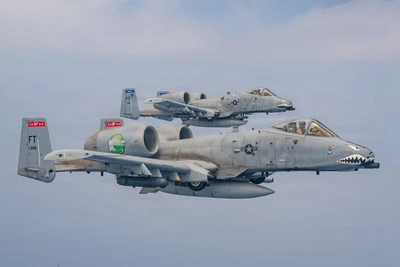
The United States and Israel have struck around 4,000 targets across Iran in one of the most intense bombing campaigns involving US forces in decades, The New York Times reported, outlining a broad effort to dismantle Tehran’s leadership, military infrastructure and nuclear program.
Early strikes hit Iran’s leadership compound in central Tehran, killing Supreme Leader Ali Khamenei along with several top officials, including IRGC commander-in-chief Mohammad Pakpour, Defense Minister Aziz Nasirzadeh, Armed Forces Chief of Staff Abdolrahim Mousavi and senior security official Ali Shamkhani.
The campaign has heavily targeted Iran’s missile and air defense capabilities. The Israeli military says more than 300 missile launchers and around 150 air defense systems have been disabled. Underground missile bases near Kermanshah and other sites were hit, with satellite imagery showing craters and destroyed entrances to subterranean facilities.
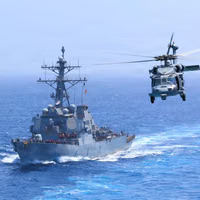
The United States says it has severely degraded Iran’s navy, destroying about 30 vessels, including a submarine, and sinking an Iranian warship with a torpedo — the first such US action since World War II. A drone carrier ship was also struck. The naval operations aim to limit Iran’s ability to threaten shipping in the Strait of Hormuz, through which roughly a fifth of global oil supplies transit.
Security and intelligence institutions have also been targeted, including facilities linked to the Islamic Revolutionary Guard Corps and the Basij militia. Israel estimates that hundreds of Guards and Basij personnel have been killed.
Nuclear infrastructure has been struck as well. Satellite imagery cited by the Times shows damage to the Natanz enrichment site, including destroyed entrances to underground centrifuge halls. A previously undisclosed underground facility near Tehran was also hit, which Israel says was linked to nuclear weapons development.