• العربية
  • فارسی
Brand
  • Iran Insight
  • Politics
  • Economy
  • Analysis
  • Special Report
  • Opinion
  • Podcast
  • Iran Insight
  • Politics
  • Economy
  • Analysis
  • Special Report
  • Opinion
  • Podcast
  • Theme
  • Language
    • العربية
    • فارسی
  • Iran Insight
  • Politics
  • Economy
  • Analysis
  • Special Report
  • Opinion
  • Podcast
All rights reserved for Volant Media UK Limited
volant media logo

Iran won’t leave Trump alone for killing Khamenei, Larijani says

Mar 7, 2026, 20:48 GMT+0
Donald Trump gestures as he gets into a vehicle with the assistance of U.S. Secret Service personnel after he was shot in the right ear during a campaign rally at the Butler Farm Show in Butler, Pennsylvania, US, July 13, 2024.

Ali Larijani, the secretary of Iran's Supreme National Security Council, told the state TV on Saturday that the Islamic Republic will not "leave Trump alone" over his killing of Supreme Leader Ali Khamenei.

“Trump got a taste of what happened in Venezuela and liked it, thinking he could quickly do the same in Iran. Now he’s stuck," Larijani said.

"We will not leave him alone. He must pay the price for what he did. He killed our leader and martyred more than 1,000 of our people. This is not a simple matter.”

"We won't leave him alone until reciprocating what he did," he reiterated in a post on his X account.

Most Viewed

Iran diplomacy wobbles as factions compete to avoid looking soft on US
1
INSIGHT

Iran diplomacy wobbles as factions compete to avoid looking soft on US

2
ANALYSIS

The politics of pink: how Iran uses cuteness to rebrand violence

3

Scam messages seek crypto for ships’ safe passage through Hormuz, firm warns

4
EXCLUSIVE

Family told missing teen was alive, then received his body 60 days later

5
TEHRAN INSIDER

The future has been switched off here

Banner
Banner

Spotlight

  • Diplomacy tolls at Hormuz as conflict returns to its doorstep
    OPINION

    Diplomacy tolls at Hormuz as conflict returns to its doorstep

  • Opposition to US talks grows in Tehran as ceasefire deadline nears
    INSIGHT

    Opposition to US talks grows in Tehran as ceasefire deadline nears

  • Tehran moderates see ‘no deal–no war’ limbo as worst outcome
    INSIGHT

    Tehran moderates see ‘no deal–no war’ limbo as worst outcome

  • The future has been switched off here
    TEHRAN INSIDER

    The future has been switched off here

  • Lights out, then gunfire: Witnesses recount Mashhad protest crackdown
    VOICES FROM IRAN

    Lights out, then gunfire: Witnesses recount Mashhad protest crackdown

  • Is Iran entering its Gorbachev moment?
    INSIGHT

    Is Iran entering its Gorbachev moment?

•
•
•

More Stories

Larijani vows to keep striking regional countries used for attacks on Iran

Mar 7, 2026, 20:19 GMT+0

Iran’s top security official Ali Larijani warned on Saturday that Tehran would continue attacking neighboring countries if they allow their territory to be used for attacks against Iran, hours after President Masoud Pezeshkian apologized to Arab neighbors.

Speaking in a televised interview, Larijani said "countries in the region must either stop the United States from using their territory against Iran themselves, or we will do it."

“Two regional countries have said they will prevent attacks by the United States from their soil, although we find it unlikely,” Larijani said. “We will wait and see. If they prevent it, we will have no issue with them.”

He also said Iran has no issue with Baku but cautioned that any hostile action originating from its territory would draw a response.

“We have no issue with Azerbaijan, but if a conspiracy or flights against Iran are carried out from that country, we will respond,” he warned.

Over 150 Iranians including diplomats depart Lebanon for Russia - Reuters

Mar 7, 2026, 19:52 GMT+0

More than 150 Iranian nationals, including diplomats and their families, have left Lebanon and are being flown to Russia on a Russian plane, Reuters reported citing a senior Lebanese security source.

Another 20 Iranians had left on Friday following the start of a new conflict between Hezbollah and Israel, the report added.

The departure comes after the Israeli military threatened Iran’s representatives in Lebanon and conducted strikes near the embassy.

Netanyahu says Israel not seeking to divide Iran but liberate it

Mar 7, 2026, 19:32 GMT+0

Israeli Prime Minister Benjamin Netanyahu said in a speech on Saturday that the Israeli-US operation "will create the conditions enabling the Iranian people to take their destiny into their own hands."

"We do not seek to divide Iran—we seek to liberate it, to free it from the yoke of tyranny and live with it in peace," he said.

"I believe that if you rise at the decisive moment, the day will not be far when Israel and Iran will once again be strong friends."

Iran war leadership rift exposed as Guards keep striking Arab neighbors

Mar 7, 2026, 19:12 GMT+0
•
Maryam Sinaiee

Iran’s Revolutionary Guards continued launching attacks on neighboring countries despite President Pezeshkian’s apology to regional states and his order for the armed forces to halt such strikes, highlighting tensions over who controls wartime decisions.

Iran's Revolutionary Guards started launching attacks against the United Arab Emirates, Bahrain, Kuwait, and the Iraqi Kurdistan shortly after President Pezeshkian said in a televised speech he had instructed them to halt such attacks.

The IRGC strikes followed unusually sharp verbal attacks by hardliners which highlighted the limited influence Pezeshkian exercises within Iran’s power structure despite his membership in the temporary three-member leadership council that is currently exercising powers normally held by the country’s supreme leader in wartime.

Pezeshkian said on Saturday that Iran’s armed forces had sometimes acted “at their own discretion” during the recent conflict. He added that, following a decision by the “temporary leadership council,” military forces had now been instructed not to attack neighboring countries “unless they intend to attack us from that country.”

The first institutional response came from the spokesman of Khatam al-Anbiya Central Headquarters, the body that coordinates operational command of Iran’s armed forces, including both the regular army and the IRGC.

The spokesman declared that any location used to launch attacks against Iran would be considered a legitimate target. “Every point that serves as the origin of aggression against Iran is a legitimate target,” he said, adding that with the continuation of offensive operations, “all military bases and interests” of the US and Israel in the region would remain the “main targets” of IRGC attacks.

Within hours, the IRGC also announced missile strikes on Dubai Airport and Juffair Base in Bahrain, which hosts the US Navy’s Fifth Fleet headquarters.

However, judiciary chief Gholam‑Hossein Mohseni‑Ejei, who also serves on the three-member leadership council, responded quickly. He said evidence from Iranian armed forces showed that “the geography of some regional countries has openly and covertly been placed at the disposal of the enemy” and used for attacks on Iran.

He added that “intense attacks” on such targets would continue and stressed that “this strategy is currently being implemented and the government and other pillars of the system are united on this matter.”

Factors behind the apology

Saudi Arabia on Saturday warned Iran that continued attacks on the kingdom and ​its energy sector could push Riyadh to respond in kind, Reuters reported citing four sources familiar with the matter.

The message was conveyed before Pezeshkian's televised apology, according to Reuters.

Another factor behind Pezeshkian’s apology may have been reports of a drone attack Thursday in the Nakhchivan autonomous region of Azerbaijan, which maintains extensive military cooperation with Israel.

Iran has denied involvement. However, officials in Baku also said they had also foiled several alleged sabotage plots attributed to the IRGC, including a plot targeting the Baku–Tbilisi–Ceyhan (BTC) oil pipeline.

Following the incident, Azerbaijan ordered the immediate withdrawal of its diplomats from Tehran and Tabriz, closed its border with Iran, and demanded an apology.

In a separate incident earlier this week, Iran’s armed forces denied firing a ballistic missile toward Turkish airspace, which Turkish authorities said was intercepted by NATO air and missile defense systems over the eastern Mediterranean.

Turkish President Recep Tayyip Erdogan said Ankara had issued “warnings in the clearest terms” to prevent similar incidents from recurring.

According to analyst Abdolreza Davari, who defended Pezeshkian’s stance, escalating tensions with the United Arab Emirates (UAE) could be very costly to Iran’s external economy which depends heavily on financial and trade channels through the United Arab Emirates.

The UAE has warned it could move to seize Iranian state-linked assets within its jurisdiction if tensions escalate further, according to regional analysts and officials familiar with the dispute.

Hardline backlash and possible moves to limit Pezeshkian’s authority

Some political figures defended Pezeshkian. Davari said the president was simply conveying a decision by the temporary leadership council to halt attacks on neighboring states. He argued that until a new supreme leader is chosen, council decisions carry the authority of the supreme leader and must be implemented.

Hardline critics, however, reacted harshly to the president’s remarks. Former lawmaker Jalal Rashidi Kouchi wrote on X: “An apology is made when a mistake has occurred, whether intentionally or unintentionally. We made no mistake. Your message showed no sign of authority.”

The conservative website Raja News described Pezeshkian as “an irritant to a nation ready for the final confrontation with arrogance” and called for preventing him from sending what it called “signals of weakness.”

The article also warned that Pezeshkian’s description of military strikes as “at their own discretion” could provide justification for neighboring states or international institutions to challenge what it called Iran’s “legitimate and sovereign defense.”

Hardline member of parliament Hamid Rasaei wrote on X that Pezeshkian’s comments were unacceptable, arguing that countries hosting US bases should be the ones apologizing. “The armed forces know their duty well and, as before, will target with powerful missiles wherever the Iranian nation and homeland are attacked. The firm demand of the Iranian people is exactly this.”

Several lawmakers, including Hamed Yazdian and Mohammad Mannan Raisi, urged the Assembly of Experts to quickly appoint a new supreme leader, arguing that statements like Pezeshkian’s risk placing Iran in a position of weakness.

Tehran representative Kamran Ghazanfari also threatened to pursue a parliamentary motion declaring the president politically incompetent — a process that would require signatures from one-third of lawmakers and a two-thirds vote to remove him.

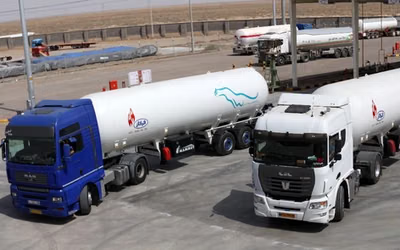
State media says oil depot targeted in southern Tehran

Mar 7, 2026, 19:03 GMT+0

An oil depot in southern Tehran was targeted in an attack by US and Israeli fighter jets, IRGC-affiliated Fars News reported Saturday.

Semi-official Mehr News said the facility lies near the Tehran oil refinery.

An informed source told Iranian news agency ILNA that the airstrike has not damaged Tehran's refinery and there is no disruption in its operation.

The source said the Rey oil depot and pipelines have been targeted according to initial evidence.