NetBlocks says Iran internet blackout tops 120 hours with connectivity near 1%


Iran’s internet blackout has exceeded 120 hours, with connectivity still hovering around 1% of ordinary levels, NetBlocks said on Thursday.
“Meanwhile, an increasingly Orwellian environment is emerging as telcos threaten users who try to connect to the global internet with legal action,” the internet monitoring group said.
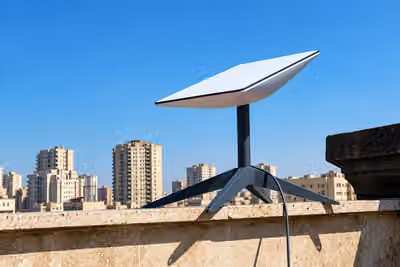

Missiles and drones flying from the direction of Iran fell on the territory of the airport in the Azerbaijani exclave of Nakhchivan International Airport, a source close to the Azerbaijani government told Reuters.
The airport is located roughly 10 km (6 miles) from the border with Iran.
Iran’s Assembly of Experts is set to hold an emergency session on Thursday to formally announce Mojtaba Khamenei, a son of the late Supreme Leader, as the next leader, despite opposition from some members who warn against “hereditary leadership,” Iran International has learned.
The meeting comes two days after Iran International reported that the Assembly of Experts had chosen Mojtaba Khamenei as the next Supreme Leader under pressure from the Revolutionary Guards.
Two sources from the offices of Assembly of Experts representatives told Iran International that at least eight members will not attend the emergency session on Thursday in protest at what they described as “heavy pressure” from the Revolutionary Guards to impose Mojtaba Khamenei.

The first emergency meeting of the clerical body to choose a successor to Ali Khamenei was held on Tuesday, but ended prematurely after Israeli airstrikes targeted the Assembly building in the city of Qom.
According to sources, Thursday’s meeting will be held online and managed from a building near the shrine of Fatima Masumeh in Qom. Some representatives and members of the Assembly’s leadership board who live in Qom may attend in person.
French Foreign Minister Jean-Noel Barrot spoke with his Iranian counterpart and said France opposes the Iranian strikes, the foreign ministry said on Thursday.
Barrot also urged the release of French citizens currently held in Iran.
He reiterated France’s commitment to stability in the Middle East, called for de-escalation and the resumption of diplomatic dialogue, and stressed that international law must govern the use of force, the ministry said in a statement.
Iran’s Assembly of Experts is set to hold an emergency session on Thursday to formally announce Mojtaba Khamenei, a son of the late Supreme Leader, as the next leader, despite opposition from some members who warn against “hereditary leadership,” Iran International has learned.
The meeting comes two days after Iran International reported that the Assembly of Experts had chosen Mojtaba Khamenei as the next Supreme Leader under pressure from the Revolutionary Guards.
Two sources from the offices of Assembly of Experts representatives told Iran International that at least eight members will not attend the emergency session on Thursday in protest at what they described as “heavy pressure” from the Revolutionary Guards to impose Mojtaba Khamenei.
The first emergency meeting of the clerical body to choose a successor to Ali Khamenei was held on Tuesday, but ended prematurely after Israeli airstrikes targeted the Assembly building in the city of Qom.
According to sources, Thursday’s meeting will be held online and managed from a building near the shrine of Fatima Masumeh in Qom. Some representatives and members of the Assembly’s leadership board who live in Qom may attend in person.
Arguments by opponents of Mojtaba
Sources told Iran International that a group of opponents contacted the Assembly’s chairman and members of its leadership board on Wednesday, warning that declaring Mojtaba Khamenei leader could raise public concerns about the leadership becoming hereditary and the Islamic Republic resembling a monarchy.
“Ayatollah Ali Khamenei was not pleased with the idea of his son’s leadership and never allowed this issue to be raised during his lifetime,” one Assembly member told the chairman and members of the body’s leadership in calls, according to the sources.
Another member argued that Mojtaba Khamenei “does not have an established, public clerical and jurisprudential standing,” and for that reason his selection as the state's Supreme Jurist (Vali-ye Faqih) would lack religious legitimacy, the sources added.
These representatives called for Mojtaba Khamenei to withdraw and for a new vote to be held at Thursday’s session.
Some opponents also signaled that if Mojtaba Khamenei does not withdraw, they may consider the selection process "invalid," a step that could deepen divisions within the ruling establishment and intensify the Islamic Republic’s legitimacy crisis.
Tensions during first Assembly session
After the historic National Assembly building in Tehran –where the clerical body traditionally meets – was bombed on Monday, the first session to select Ali Khamenei’s successor was held online on Tuesday without public announcement.
Information sent to Iran International indicates that from early Tuesday, Revolutionary Guard commanders across different cities pressured Assembly members to vote for Mojtaba Khamenei through in-person meetings and phone calls.
Sources said repeated contacts and psychological and political pressure on representatives continued until minutes before the online meeting began, creating what they described as an “unnatural” atmosphere inside the session. The Assembly leadership board insisted the vote be held quickly due to the country’s security situation.
Several members opposed to Mojtaba Khamenei were given limited time to present their arguments, but the leadership board moved forward with the vote, cutting short further discussion.
A source close to one Assembly representative told Iran International that the atmosphere was initially heavy because of Revolutionary Guard pressure, but more representatives might have spoken against the move if more time had been allowed.
Sources said that after the vote and shortly before the count was completed, the Assembly building in Qom – where the online session was being managed – was struck in Israeli airstrikes and communications were cut.
Hours later, members of the Assembly were informed in phone calls that Mojtaba Khamenei had been selected as Supreme Leader by a majority of votes.
Legal questions and continued pressure
After the result was relayed to members, objections about how the legal process had been conducted surfaced in calls with the Assembly chairman and some members of the leadership board.
The leadership board then decided to delay the official announcement until a second session.
That second session is scheduled to take place online on Thursday and will be managed from a location near the shrine of Fatima Masumeh in Qom. Sources said the site was chosen because its religious significance could reduce the likelihood of an airstrike if its location became known.
Information received by Iran International also indicates that threatening pressure from the Revolutionary Guards to persuade opposing representatives has continued.
According to the sources, Guards commanders have been contacting and lobbying members directly to discourage them from boycotting the meeting or expressing public opposition.
Sources said the Guards argue that given the country’s “special conditions” and ongoing security situation, the new leader must be announced as quickly as possible and that any delay could worsen instability and deepen a decision-making vacuum at the top of the system.
China called for an end to military operations in the Middle East and a return to dialogue in a phone call between Foreign Minister Wang Yi and Saudi Foreign Minister Faisal bin Farhan on Thursday.
Chinese Foreign Ministry spokesperson Lin Jian said Beijing did not want to see the conflict in the Middle East spread and escalate, including impacts on Saudi Arabia and other countries in the region.
The spokesperson added that Beijing appreciated Saudi restraint and its commitment to resolving differences peacefully.