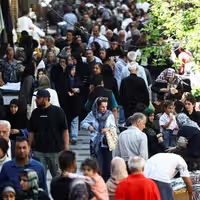
Iran internet blackout passes 48 hours, NetBlocks says
Iran’s internet blackout surpassed 48 hours on Monday, NetBlocks said, leaving much of the country unable to communicate as the conflict in the region widened.
The London-based monitoring group said Iran’s connectivity had fallen to near-total levels, limiting access to online services and contact with relatives outside the country.
"Shutdowns are a go-to tactic for the regime, with the previous instance in January lasting several weeks and masking severe human rights violations," NetBlocks said on X.
The Islamic Revolutionary Guard Corps urged people in Israel on Monday to stay away from military bases and government and security sites and leave the country immediately.
“We recommend that residents of the occupied territories stay away from military bases, security and government centers and immediately leave the occupied territories,” the IRGC said in a statement.
It said the latest wave, involving Kheibar missiles, targeted what it described as government facilities in Tel Aviv and military and security centers in Haifa and eastern Jerusalem, adding that “the sirens in Israel will never fall silent.”
Israel’s Health Ministry said on Monday that 777 people had been evacuated to hospitals since the start of Operation Roaring Lion on Saturday.
Of those, 86 were hospitalized or in emergency rooms, the ministry said. Four were in serious condition, including two whose injuries were not directly caused by missile strikes.
Twenty people were listed in moderate condition and 58 in good condition, while four others were undergoing medical evaluation.
The ministry added that dozens of people were injured in accidents while running to shelters.
Iran's top security official Ali Larijani on Monday morning accused US President Donald Trump of plunging the region into turmoil with what he called “delusional ambitions,” saying Washington is now worried about further American casualties.
"Trump dragged the region into chaos with 'delusional ambitions' and is now concerned about further casualties among American forces," Larijani said in a post on X.
"With delusional conduct, he turned his self-made slogan “America First” into “Israel First” and sacrificed American soldiers for Israel’s power-seeking.…And with new fabrications, he once again imposes the cost of his personality cult on American soldiers and their families."
A police officer works at the scene after a deadly mass shooting outside Buford's, a popular roadhouse-style bar in Austin, Texas, US on March 1, 2026.
Concerns over the activation of Iran’s sleeper cells in America have increased after a deadly shooting in Austin involving a suspect with alleged ties to Iran and a separate gun attack on an Iranian dissident’s gym in Canada.
A flag of the Islamic Republic and photographs of Iranian regime leaders were discovered inside the apartment of the suspect in the deadly Austin bar shooting, CBS News reported citing sources.
Authorities identified the suspect as 53-year-old Ndiaga Diagne, a naturalized US citizen originally from Senegal, the Associated Press reported, citing law enforcement officials.
He opened fire early Sunday at a bar in Austin’s West Sixth Street district, killing two people and injuring about 14 others before being shot and killed by police.
The suspect was wearing clothing bearing Islamic references, including a sweatshirt reading “Property of Allah” and a shirt featuring the flag emblem of the Islamic Republic of Iran, and a Quran was found in his vehicle, the report said.
The FBI and the Joint Terrorism Task Force are assisting in the investigation, and officials said there were indicators that could suggest a possible terrorism nexus, according to the Associated Press.
The suspect’s alleged X account shows a reply last year to a post by Iran’s Foreign Minister Abbas Araghchi, who wrote that any strike on Iran would be “immediately reciprocated.” In response, the account identified as Ndiaga Diagne wrote that the “Islamic Revolution is eternal and here to stay until the end of time.”
Canada gym attack
Separately, hours after the announced death of Iran’s Supreme Leader Ali Khamenei following US-Israeli strikes on Tehran, a boxing gym in Richmond Hill, Ontario, run by Iranian-Canadian dissident activist and cruiserweight champion Salar Gholami, was struck by gunfire overnight.
Video shared by Gholami showed multiple bullet holes across the front windows of Saliwan Boxing Club on Yonge Street, some displaying pro-Iranian liberation flags and images. At least two panes were shattered, and an evidence marker was visible above one of the bullet holes.
"Seventeen live rounds were fired randomly at the gym, and it was sprayed with bullets," Gholami told Iran International, describing the shooting as intimidation directed at critics of the Islamic Republic.
"This is the result of shaking hands with the mullahs and delaying action. When the Canadian government leaves the door open for them to enter, this will no longer be a safe place even for Canadians themselves. Seventeen bullets means it could have left behind 17 Canadian bodies."
Salar Gholami's gym in Toronto hit by multiple bullets
Concerns over sleeper cells
Following the US-Israeli strikes on Iran and the killing of Ali Khamenei, retaliatory measures including by Iranian sleeper cells cannot be ruled out, a senior German lawmaker said on Sunday.
“The Iranian regime has repeatedly demonstrated in the past that it carries out its terror beyond its own borders,” Marc Henrichmann told the Sueddeutsche Zeitung newspaper.
Last June, US law enforcement stepped up its monitoring of potential Iran-backed operatives within the United States amid the 12-day Israeli war on Iran which was later joined by the US.
In the days after Israel launched its attacks on Iran, the FBI under its director Kash Patel boosted surveillance over what sources cited by CBS described as Hezbollah-linked sleeper cells.