Mourners perform rare dance to revolutionary anthem at protester’s grave
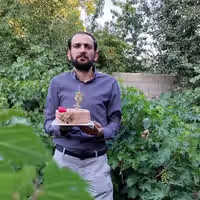
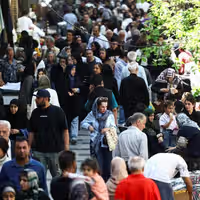
Mourners in Mobarakeh, central Iran, danced to a pro-monarchy revolutionary anthem in an unconventional act of defiance against the Islamic Republic at the 40th-day memorial for protester Rostam Mobarakabadi who was shot dead by security forces on January 9 in Esfahan.
Kaveh, The Blacksmith, which is referenced in the revolutionary song, is a figure in Iranian mythology who leads an uprising against a ruthless foreign ruler Zahhak.
Iran’s President Masoud Pezeshkian said the country will not yield to pressure from world powers.
“We made a pact in the government that even if all the powers of the world stand unfairly against us to make us bow, we will not surrender,” Pezeshkian said at a ceremony honoring Paralympic medalists on Saturday.
“You did not surrender to difficulties, and we too, despite all the problems they created and the wounds inflicted on our society, will not surrender to problems and coercion,” he added.
The president of Sharif University of Technology said opponents want the university to move online after students held anti-government protests on campus, where clashes were also broke out and some students were injured.
“The enemy wants the university to become virtual, but we will not allow it,” Masoud Tajrishi said.
“We want to show that we can manage the university. Anyone who carries out illegal acts at the university must be dealt with,” he added.
Exterior view of Khatam al-Anbia Hospital in Tehran
Islamic Revolutionary Guards Corps commanders have held meetings inside hospitals in recent days, hospital staff told Iran International, raising concerns over the growing militarization of civilian spaces and potential risks to patients, medical workers and the public.
Several military commanders and IRGC personnel convened sessions inside the medical facility over the past week, accompanied by security teams and holding discussions unrelated to healthcare, a hospital employee in Tehran said. The source spoke on condition of anonymity due to fear of repercussions.
“The presence of these individuals, along with their protection units, has alarmed staff because the meetings had nothing to do with medical matters,” the employee said.
The reports come against a backdrop of previous allegations that security forces used public institutions during unrest, blurring the line between civilian and military functions.
Use of civilian sites during protests
During the January 8 and 9 protests and the days that followed, multiple accounts described security operations from within public buildings. Witnesses and local media reported gunfire at demonstrators from inside a governor’s office and from the roof of a hospital in Gorgan. In Arak and Sari, schools were used to station forces and hold detainees.
Similar reports emerged from Shiraz, Gorgan and Tehran describing the deployment of armed personnel in hospitals and, in some cases, gunfire from the rooftops of medical centers toward protesters. Authorities have not publicly clarified the scope or legal basis of such deployments.
Security forces have also gathered in recent days at certain sports stadiums and arenas, a move sources describe as an effort to shield personnel and equipment from potential US or Israeli strikes by embedding them in densely populated civilian areas.
Iranian military and clerical officials visit a hospital ward, speaking with medical staff.
“No justification for human shields”
Jamshid Barzegar, a political analyst and journalist, said the shift of military activity into hospitals reflects a pattern long seen in the Islamic Republic’s regional alliances.
“The Islamic Republic has once again brought inside the country a criminal pattern it has tested for years through its proxy forces in the region: militarizing civilian spaces and using civilians as human shields.”
Barzegar argued that similar tactics had been employed by allied groups in Syria, Gaza, Lebanon and Yemen, placing military assets in or near civilian infrastructure.
“Now that the Islamic Republic has cast the shadow of war over Iran, we are seeing the same methods being applied domestically,” he said. “In the bloodiest and largest crackdown on public protests in Iran’s history during January 8 and 9 and the days after, the presence of security forces resembled the conduct of extremist groups.”
Moving senior IRGC meetings into hospitals and deploying forces in stadiums and schools, Barzegar said, exposes civilians to heightened danger in any potential conflict.
“This is not only a sign of strategic weakness, but a message that the lives of ordinary Iranians carry little weight in the government’s calculations,” he said.
Under the Geneva Conventions and their additional protocols, he added, using medical facilities for military purposes can jeopardize their protected status under international humanitarian law.
“When commanders enter hospitals with protection teams and hold non-medical meetings, they are effectively taking patients and medical staff hostage to their own security considerations,” Barzegar said. “There is no justification for using civilians as human shields.”
Legal risks and accountability
Hossein Raisi, a human rights lawyer and academic, said international humanitarian law strictly prohibits converting civilian facilities such as hospitals, clinics, places of worship and historic sites into venues for military operations.
“Any party that knowingly turns a civilian site into a center of military activity during armed conflict commits a war crime,” Raisi said.
Even if an adversary attacks such a location, causing casualties or damage, that attack may also constitute a war crime if carried out deliberately and without regard for civilian protection, he added.
Security forces gather in a school courtyard during the January protests in Iran.
“Transferring military command functions into an active hospital where patients and medical staff are present does not transform that location into a legitimate military target,” Raisi said.
“Civilians are not aware of these hidden changes and have no meaningful opportunity to leave.”
If military units or equipment are placed near schools, children or medical facilities with knowledge that an attack could cause civilian deaths, those responsible could face serious legal consequences, Raisi said.
“Under the laws of war, both sides have an obligation to minimize harm to civilians,” he noted.
“If casualties occur because civilians were deliberately exposed to risk, responsibility can attach to those who created that situation as well as to those who launched an unlawful attack.”