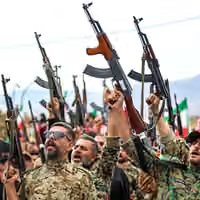
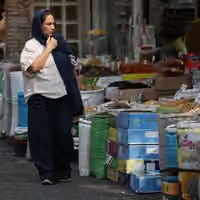
A group of Iranian-Australian citizens has submitted a petition to Australia’s parliament calling for the government to withdraw recognition of the Islamic Republic as the legitimate representative of the Iranian people.
The petition argues that a large majority of Iranians reject the Islamic Republic as their lawful representative and instead support the leadership of exiled Prince Reza Pahlavi for a transition to a secular democracy that preserves Iran’s territorial integrity and upholds the Universal Declaration of Human Rights.
Around 13,000 people had signed the petition at the time of publication.
Iranian Foreign Minister Abbas Araghchi’s name has been removed from the updated list of speakers at the UN Human Rights Council session on February 23.
The removal followed an online campaign that urged the UN to withdraw his invitation and called on other delegations to walk out if Araghchi or any other Iranian representative took the floor.

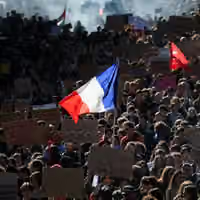
Iranian director Jafar Panahi, who has spoken out about deadly crackdowns during nationwide protests in Iran, said on Thursday that he will return to the country once the Oscar campaign for his film "It Was Just an Accident" concludes, despite ongoing threats.
“I have been outside Iran for some time because of the Oscar campaign for this film, but as I have said before, as soon as the campaign ends, I will return to Iran,” Panahi said in an interview with The Atlantic.
Panahi referenced the government’s response to past protests, including internet shutdowns that he said signaled impending violence.
“When the protests broke out, I was in Paris. When they shut down the internet, my friends and I issued a statement saying that when they shut down the internet, it means they are going to commit a big massacre,” he said.
He described the scale of casualties during the unrest as deeply traumatic for the public.
“Now you cannot think about individuals. The numbers are so high and the pain is so strong that people feel they are each other’s family members. So when one person dies, everyone feels the pain, and everyone is in mourning,” he added.
The night air on Jan. 8 in northeastern Tehran filled with chants rising in defiance. Among them stood Pooya Faragerdi, a violinist whose life was measured in music and a heart that beat for Iran. Then came the gunfire.
Faragerdi, 44, was shot by security forces near a police station in Pasdaran that night.
Videos verified by Iran International from Pasdaran on Jan. 8 showed wounded protesters lying bloodied on the street as others tried to help, with gunfire audible in the background.

An electronic petition submitted to the website of Canada’s House of Commons on Thursday calls on the government to declare the Islamic Republic of Iran illegitimate and recognize exiled Prince Reza Pahlavi as a representative of the Iranian people during a democratic transition.
The petition (e-7152), sponsored by Conservative MP Melissa Lantsman and initiated by Golsa Ghamari, a former provincial legislator from Toronto, has so far received 508 validated signatures.
“It will be open until March 14 and I will present it after that when the house returns the following week I believe. The government will have 45 days to answer,” Lantsman told Iran International.
An e-petition must gather 500 or more signatures to receive certification for presentation to the House, which opens the door to a formal government response.
The petition urges Canada to designate the Islamic Republic as a foreign occupying entity lacking domestic support, recognize Prince Reza Pahlavi and the Iranian Transitional Team as legitimate representatives, support their plan for a transition to secular democracy, and engage in discussions about Iran’s future governance.
The Foundation for Individual Rights and Expression (FIRE) published an essay by an Iranian-American scholar on Thursday describing how the Islamic Republic systematically silenced his mother’s voice through censorship, threats of imprisonment and forced exile.
The piece details his mother’s experience as a former journalist and activist in Iran, her eventual flight to the United States and the ongoing trauma of government surveillance, confiscated recordings and an erased public presence.
“Iran didn’t just take her freedom; it replaced her voice with silence, ensuring that even her words from decades ago could no longer reach the people she once spoke for,” Faraz Harsini said.
The essay highlights what it describes as the broader suppression of independent journalism and dissent in Iran, framing it as part of a deliberate strategy to erase dissenting voices.