No education for Iran in second kick of a mule, US envoy to Israel warns


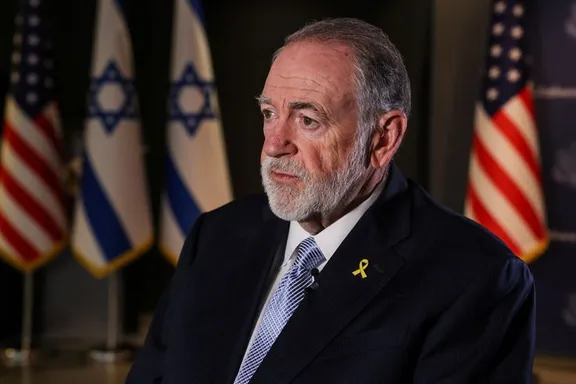
US Ambassador to Israel Mike Huckabee said he hopes Iran chooses a negotiated path but warned that Tehran may face another “kick of a mule” if it refuses President Donald Trump’s demands.
“You would think they'd learned something” from the US June strikes on their nuclear facilities, Huckabee told PBS. “In the South, where I grew up, we say there's no education in the second kick of a mule. They got a real kick of a mule last summer. I'm wondering, did they get any education from that one?”
“If not, they may stand behind the mule again,” he added. “And there probably won't be much education in the second kick of a mule.”
A senior Iranian reformist has accused security bodies of deliberately escalating and even staging violence including alleged killings among their own ranks to legitimize a sweeping crackdown on protests, sharply disputing the official narrative blaming foreign actors.
Ali Shakouri-Rad said the protests on January 8 and 9 were a predictable outcome of years of accumulated social discontent, even if the scale of the response surprised political factions and security institutions alike.
Shakouri-Rad rejected remarks promoted by official media that foreign intelligence services or opposition networks orchestrated the violence.
“I do not believe this, and I think many people do not believe it either,” he said, referring to claims that Israel’s Mossad or networks associated with exiled Prince Reza Pahlavi were responsible for the violence.
Shakouri-Rad said the breadth of demonstrations across almost 400 cities exceeded expectations across Iran’s political spectrum. “Reformists, conservatives and the security institutions did not think this many people would respond to Reza Pahlavi’s call,” he said.


"President Trump's envoys Jared Kushner and Steve Witkoff visited on Saturday together with CENTCOM Commander Admiral Brad Cooper the USS Abraham Lincoln which is stationed in the Arabian sea not far from Iran," Axios reported on Saturday citing two sources with knowledge of the matter.
The two officials were invited to visit the carrie by the commander of US Central Command, Admiral Brad Cooper, CNN reported citing a senior US official.
The intention of the trip was to express gratitude for the American service members in the region, according to the official speaking to CNN.

Iran’s foreign minister said Tehran opposes removing uranium from the country but is prepared to reduce the level of enrichment.
“Our main position is opposition to any removal of uranium from the country, but we are ready to reduce the enrichment ratio,” Araghchi told Aljazeera Arabic on Saturday.
Iran does not seek a regional war, he said, adding that regional countries share the same view, but warned that “any US attack would overshadow this.”

Iran’s foreign minister said Tehran will keep enriched uranium inside the country, set enrichment levels based on national needs and restrict talks with Washington to the nuclear file.
“The level of enrichment depends on Iran’s needs, and enriched uranium will not leave the country,” Araghchi said in remarks to Al Jazeera on Saturday.
Iran’s nuclear case, he said, can only be resolved through negotiations, adding that a fair, win-win outcome requires realistic talks and confidence-building. Araghchi said the path of dialogue must be free of any threats or pressure and expressed hope that this approach would be reflected in US behavior.
Iran, he argued, is ready to reach a “reassuring” agreement on enrichment but said that enrichment is Iran’s right and must continue. Zero enrichment, he added, is outside the framework of negotiations, claiming that even the bombing of facilities has failed to eliminate Iran’s capabilities.
Contacts with the United States, Araghchi said, have been indirect and limited to the nuclear file, describing the talks as having a “good start” while cautioning that a long road remains to build trust.
He also ruled out any discussions on Iran’s missile capabilities, saying: “Negotiations on missiles are not possible, neither now nor in the future.”
On regional developments, Araghchi said what is unfolding in the Middle East is not defensive in nature but aimed at enabling Israel to feel dominance and superiority over others.
“If Washington attacks us, there is no possibility of attacking US soil, but we will strike their bases in the region,” Araghchi warned.
He further added that there is currently no specific date for a second round of talks, but Tehran and Washington believe it should be held soon.
A senior Iranian reformist has accused security bodies of deliberately escalating and even staging violence including alleged killings among their own ranks to legitimize a sweeping crackdown on protests, sharply disputing the official narrative blaming foreign actors.
Ali Shakouri-Rad said the protests on January 8 and 9 were a predictable outcome of years of accumulated social discontent, even if the scale of the response surprised political factions and security institutions alike.
Shakouri-Rad rejected remarks promoted by official media that foreign intelligence services or opposition networks orchestrated the violence.
“I do not believe this, and I think many people do not believe it either,” he said, referring to claims that Israel’s Mossad or networks associated with exiled Prince Reza Pahlavi were responsible for the violence.
Protests and unexpected scale
Shakouri-Rad said the breadth of demonstrations across almost 400 cities exceeded expectations across Iran’s political spectrum. “Reformists, conservatives and the security institutions did not think this many people would respond to Reza Pahlavi’s call,” he said.
While protests were foreseeable given sustained grievances among workers, teachers and retirees, he said, the social response exposed a deeper rupture that institutions had failed to anticipate.
‘Injecting violence’ to justify force
The reformist politician argued that violence was introduced by those seeking to suppress protests and then use that violence as justification. “I can more easily believe that those who wanted to suppress what they called unrest carried out these acts,” he said.

This approach, he noted, was not new, arguing that security agencies have historically escalated confrontations to rationalize harsher measures. “From the beginning it has been like this, and it has grown worse over time,” he added.
Shakouri-Rad cited an academic article by a doctoral student at Guards-run Imam Hossein University that described “manufacturing deaths among one’s own forces” as a method for controlling unrest. He said the model included the killing of Basij or police personnel or attacks on symbolic sites, later attributed to protesters to justify coercive action.

Shakouri-Rad described an incident in which protesters who fled into a dead-end alley were shot and killed by a Basij member. The shooter, he said, was not inherently violent but shaped by an environment of polarization that placed weapons in the hands of poorly trained forces.
Criticism of the presidency
Shakouri-Rad criticized President Pezeshkian for publicly relying on security briefings to explain the killings, saying it stripped the president of his standing as a centrist figure. Repeating those assessments on state television, he said, alienated the public, which had witnessed events firsthand.
“People were present and knew what had happened,” he noted, adding that the president should have questioned the security bodies over how such events unfolded.
He also questioned how alleged armed networks could operate across hundreds of cities without the knowledge of Iran’s security agencies, saying the lack of accountability, resignations or formal inquiries underscored the credibility gap.
A leader-backed presidency
Shakouri-Rad said Pezeshkian’s rise to the presidency was a project backed by Supreme Leader Ali Khamenei, rather than the result of open political competition. Reformists, he said, assisted the process without understanding its nature.
Pezeshkian, he said, could have acted as a bridge to defuse crises only if real authority had been delegated.
Shakouri-Rad described the January killings as among the “darkest moments in Iran’s modern history,” saying the wounds left by injustice and the killing of young people – most of them under 30 – would not heal without truth, accountability and a fundamental change in governance.
Referring specifically to the bloodshed on January 8 and 9, Shakouri-Rad said: “It is not something we can erase easily in the coming years, or even in decades to come.”