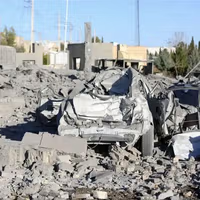
For nearly three weeks, millions inside Iran were cut off from the outside world as authorities imposed sweeping restrictions on internet access and international phone lines after the violent suppression of protests. For Iranians in the diaspora, the silence was devastating.
Many describe days and nights spent refreshing news feeds, replaying worst-case scenarios, and bracing for phone calls that never came. Even when limited connections were restored, the anxiety did not ease.
“Psychologically, not knowing what is happening—or whether family members are safe—keeps the body and mind in a prolonged state of stress,” Canadian-Iranian clinical counsellor Farnaz Farrokhi told Iran International.
A state of constant alarm
Farrokhi says many in the diaspora are experiencing “constant anxiety, compulsive news checking, feelings of helplessness and guilt, and emotional disconnection from loved ones.”
“What I’m seeing is the continuation of collective trauma, layered on top of long-standing emotional wounds from years of instability, loss, and fear,” she said, adding that many are also grappling with survivor’s guilt—being physically safe while loved ones are not.
For Narges, an IT specialist living in the Netherlands, the days of disconnection were unbearable.
“At work, my colleagues’ laughter and jokes were painful,” she said. “But I couldn’t—and didn’t have the right to—transfer my anxiety to them. I couldn’t interact the way I normally do.”
She took two days off, hoping rest would help. It did not.
“At home it was no better. Every time the phone rang, the doorbell sounded, or even a small object fell, I jumped. My heart would start racing.”
Trauma spilling into family life
For Taraneh, an Iranian living in Italy, the emotional toll extended to her six-year-old son.
“I try very hard not to let my son see the painful images—bodies piled together in black bags,” she said. “But sometimes I can’t hide my grief or my tears.”
Her son keeps asking why she is crying.
“I don’t have an answer that makes sense to him,” she said. “And not being able to explain my feelings makes me feel even worse.”
Even after limited international calls were allowed, communication remained fragile. Calls were brief, unstable, and often cut off without warning. Some families waited days for a single connection.
Fear of surveillance shaped many conversations. Families resorted to coded language, wary that saying too much could endanger loved ones.
“When my parents finally called, we could only cry. We didn’t know what to say to each other,” said Leila, a London-based Iranian expat. “We both knew about the massacre, but we couldn’t talk about it because there was every reason to believe our conversation wouldn’t stay private.”
“My mum said it had rained a lot there,” Leila recalled. “I knew she meant the bloodshed—not rain. It hadn’t rained at all.”
An open wound
For some, reconnection brought devastating news: learning days—or even weeks—later that relatives or friends had been killed, injured, or arrested.
“Today I saw the father of one of my child’s classmates at the school gate,” Germany-based mother Neda Soltani wrote on X. “He looked stunned. He burst into tears and said his cousin in Tehran had been killed—and he had only found out this morning.”
“Two Iranians stood there crying at the school gate,” she added. “Others just walked past.”
Farrokhi warns that without acknowledgement, safety, and the restoration of trust and communication, the psychological toll on the diaspora will continue to deepen.
“This is not just about grief,” she said. “It’s about living in a constant state of alarm—never knowing when the next rupture will come.”