The European Union will move rapidly to implement a legally binding designation of Iran’s Islamic Revolutionary Guard Corps as a terrorist organisation, Germany’s foreign minister said on Wednesday, calling the decision long overdue.
In a statement issued on January 29, Foreign Minister Johann Wadephul said the designation sent a strong political message and showed that the EU recognised the scale of repression inside Iran.
“The next step will be the rapid implementation towards a legally binding listing,” he said, adding that the bloc stood “side by side with the Iranian people” and opposed repression.
Wadephul accused the Revolutionary Guard and its auxiliary forces of attacking protesters with extreme violence, carrying out executions, and playing a destabilising role across the Middle East.
“In short, they have blood on their hands,” he added.
Prominent jailed Iranian dissident Mostafa Tajzadeh accused Iran’s rulers of ordering mass killings during January’s nationwide crackdown and then lying about the scale of the violence, saying the bloodshed was both predictable and preventable.
“I have no doubt that the official statistics and narrative of what happened this January are a brazen lie," he wrote in a letter from prison posted on Telegram by moderate outlet Saham News.
"Only the formation of an independent, national truth-finding committee can reveal the real dimensions of this crime,” he added.
Tajzadeh also accused Supreme Leader Ali Khamenei of refusing to listen to society, clinging to monopolistic power, and turning politics into a battlefield.
Warning that Iran's current situation was "unsustainable," he argued that only responsible civic action and a historic national dialogue could prevent further catastrophe.
A number of Middle Eastern governments are trying to push the US and Iran into talks to avert a possible conflict, but the efforts have so far failed to gain traction, the Wall Street Journal reported.
Egyptian Foreign Minister Badr Abdelatty held separate phone calls on Wednesday with Iran’s foreign minister and US special envoy Steve Witkoff, but made no progress, the WSJ reported, citing people familiar with the conversations. Iran strongly objected to US terms and warned that targets across the region would be fair game in the event of a US strike, according to the report.
Efforts by Qatar, Oman and Saudi Arabia in recent days were similarly unsuccessful, the report added, citing people familiar with those outreach efforts.
Qatar and Oman also sought ways to revive the negotiations, including proposals for some form of nonaggression pact, but the efforts have not gained traction, the report added, citing people familiar with the discussions.
Turkey has also been urging Washington to negotiate with Iran to avert a conflict Ankara views as destabilizing, the report said.
Turkish President Recep Tayyip Erdogan proposed a three-way meeting with the US and Iranian presidents during a call with President Donald Trump on Wednesday, the report added citing an unnamed official briefed on the call.
Trump has received briefings on a range of military options against Iran developed jointly by the White House and the Pentagon, the report added, citing US officials.
Among the options presented to Trump is what officials described as a “big” plan that would involve striking “regime and Islamic Revolutionary Guard Corps facilities in a large-scale bombing campaign,” according to the report.
Less extensive options include strikes on what officials described as “symbolic regime targets,” allowing room for escalation if Iran does not agree to end its nuclear work, as well as options such as cyberattacks on Iranian banks or tougher sanctions, the report added, citing the officials.

President Donald Trump’s response to Iran’s recent unrest appears to reflect a strategy of gunboat diplomacy: the use of military pressure, rhetorical escalation, and economic coercion to extract concessions without committing to war or formal regime change.
Iran’s currency plunge in late December 2025 sparked nationwide protests that quickly escalated from economic grievances into calls for an end to the Islamic Republic. The crackdown that followed was unusually violent, killing thousands under a sweeping internet blackout.
Trump’s response was neither a formal call for regime change nor an immediate move toward military conflict. Instead, it combined public threats, diplomatic suspension, and economic pressure with visible military signaling designed to raise the cost of repression while preserving strategic flexibility.
“A massive Armada is heading to Iran,” Trump wrote on Truth Social last week, describing the fleet—led by the aircraft carrier Abraham Lincoln—as “ready, willing, and able to rapidly fulfill its mission, with speed and violence, if necessary.”
The signalling grew more explicit on Wednesday, when the US president urged Iran to “quickly ‘Come to the Table’” and negotiate a deal. He warned that “the next attack will be far worse” than last June’s strikes on Iran’s nuclear sites if an agreement was not reached.
The military centerpiece of Trump’s strategy is the redeployment of the USS Abraham Lincoln carrier strike group, restoring credible strike capacity at a moment when Iran’s leadership is consumed by internal unrest.
Escorted by multiple destroyers and carrying nearly 90 aircraft, including F-35s, the Lincoln gives Washington a flexible range of options—from limited strikes on Revolutionary Guard assets to broader operations.
Additional US combat aircraft, armored units, and air-defense systems have been repositioned across regional bases, underscoring the signaling intent. The objective appears to be readiness without commitment.
Trump’s apparent aim is to exploit Iran’s weakened position to coerce strategic concessions—not only on the nuclear and missile programs, but also on Tehran’s regional proxy activity. That pressure has been reinforced by a proposed 25 percent tariff on countries trading with Iran, announced on January 12.
Washington’s approach appears calibrated to push for negotiations while Tehran is at its most vulnerable, stopping short of an explicit commitment to military action or regime change.
The ambiguity looks deliberate—and strategic. It may work, but it is not risk-free. US credibility could erode if threats are not followed through. External pressure may also strengthen hardliners in Tehran by reinforcing narratives of foreign orchestration, potentially unifying a fractured elite.
Iran’s armed allies in the region retain some capacity to retaliate against US interests or Israel. Whether they choose to do so is unclear, but the risk of escalation into a broader conflict cannot be dismissed.
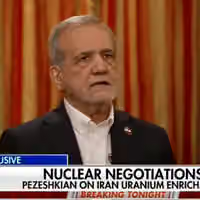
Tehran, for its part, has hardened its rhetoric, warning of an “unrestrained” and “unprecedented” response to any US military operation, while simultaneously expressing openness to what it calls “fair” negotiations.
Pressure on Iran is also building beyond Washington. On Thursday, the European Union took what its foreign policy chief, Kaja Kallas, described as a “decisive step” toward designating the Islamic Revolutionary Guard Corps as a terrorist organisation—its strongest signal yet that patience with the Islamic Republic is wearing thin.
At the same time, Kallas cautioned that the region “doesn’t need another war,” underscoring Europe’s own balancing act between pressure and restraint.
Iran’s streets are quiet after a bloody crackdown. But the economy is in free fall, and another round of widespread protests appears increasingly likely.
The key question now is whether Trump’s gunboat diplomacy can extract strategic gains without igniting the very conflict it seeks to avoid—or whether it merely postpones a more dangerous reckoning.
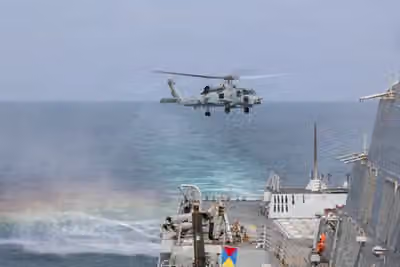
At least 10 US warships are now believed to be operating in the Middle East, including the aircraft carrier USS Abraham Lincoln, BBC Verify reported.
The report said a US guided-missile destroyer, the USS Delbert D. Black, was tracked sailing through the Suez Canal toward the Gulf on Wednesday, citing ship-tracking data from the MarineTraffic website.
A US official confirmed to BBC Verify on Tuesday that the aircraft carrier is in the region, although it has not appeared on public ship-tracking sites for more than a week.
BBC Verify also tracked a US Navy Osprey aircraft early on Thursday flying in the Gulf toward Oman. Ospreys are tiltrotor transport aircraft known to operate from the USS Abraham Lincoln.
Another Osprey was tracked on Tuesday broadcasting its position off the coast of Oman, which BBC Verify said could suggest the carrier is operating in the area.

Iran’s Revolutionary Guards naval forces will carry out live-fire exercises next week in the Strait of Hormuz, Iran’s state-run English-language Press TV reported.
Earlier on Thursday, the Associated Press reported that Iran had warned mariners it planned to conduct naval live-fire drills in the Strait of Hormuz on Sunday and Monday, citing a notice to mariners broadcast by VHF radio.
The report cited two unnamed Pakistani security officials, who confirmed the warning had been issued.