EU parliament president says Europe stands with Iranian protesters
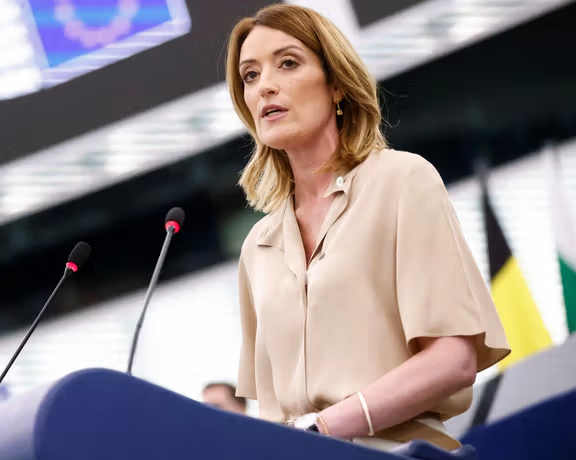

The president of the European Parliament said lawmakers had voted to back the aspirations of the Iranian people and called for what she described as decisive action against Iran’s authorities.
Roberta Metsola said in a post on X that the message from the European Parliament was clear: “Iran must be free. Iran will be free.”
She said the parliament had voted to support measures including an end to the brutal crackdown on protesters, a halt to executions and the release of detained demonstrators and political prisoners.
“We have called for decisive action to stop the violence, halt executions, free the brave and target the oppressors,” Metsola wrote.
She added that the parliament had urged the designation of Iran’s Revolutionary Guards as a terrorist organization.
Addressing Iranians, Metsola wrote: “Even when cables are cut, we hear you. Even when blackouts fall, we see you. You are not alone.”


Australian police have charged a Queensland PhD candidate with preparing a terrorist act after alleging he planned to throw a Molotov cocktail into an Australia Day crowd on the Gold Coast, in an attack authorities say was intended to spark unrest.
A Brisbane Magistrates Court heard on Thursday that Sepehr Saryazdi, 24, discussed leading “riots” on January 26 in online messages and urged others to stockpile alcohol bottles to make incendiary devices.
Prosecutors said he had bought bottles of alcohol and other materials earlier this month, and told the court his comments in a private Facebook Messenger group were “extremely concerning”.
The court heard Saryazdi believed the Australian government was becoming tyrannical and wanted to replace it with what he described as a “cybernetics” system in which society would be guided by artificial intelligence and data analysis. Prosecutors said he expected to die during the alleged attack, and had encouraged group members to learn how to shoot.
His lawyer said Saryazdi had become isolated after moving to Brisbane and was emotionally overwhelmed, arguing he never intended to hurt anyone and sought national attention for his grievances.
Magistrate Penelope Hay denied bail and remanded him in custody. He is due back in court on February 20.
A senior Iranian military commander warned that any attack on Iran would draw a swift and devastating response, saying US interests, bases and what he described as centers of influence would become targets.
Major General Abdollahi, commander of Iran’s Khatam al-Anbiya Central Headquarters, said any strike on Iranian territory, security or interests would be met with immediate retaliation, according to state-linked media.
“Any aggression against Iranian soil will be met with a fast, precise and devastating response,” he was quoted as saying.
He said the United States was fully aware of the consequences of any such move.
“Any attack on the land, security and interests of the Iranian nation will immediately turn all US interests, bases and centers of influence into legitimate and accessible targets for Iran’s armed forces,” he said.
Abdollahi added that Iran would not start a war but would respond forcefully if attacked.
“The Islamic Republic of Iran has never been and will never be the initiator of war,” he said. “But in the face of any aggression, threat or hostile act, it will give a fast, decisive and regret-inducing response.”

More than 90 Iranian artists, writers and cultural figures based abroad issued an urgent statement condemning the widespread killing of protesters in Iran and warning that detainees could face execution.
In the statement, the signatories said independent sources indicated that thousands of people had been killed during the protests that began earlier this month.
“Based on information published by independent sources, thousands of people have lost their lives in these protests,” the statement said, citing reports of the use of lethal force against demonstrators and the violent suppression of peaceful rallies.
The group said thousands of people, mostly young, had been detained, adding that there were serious concerns about their treatment and legal status.
The statement said the main fear was that detainees could face charges such as terrorism, espionage or waging war against God - offenses that can carry the death penalty under Iran’s laws, especially in cases where there is no access to fair trials or transparent legal processes.
The authors said past precedent and recent warnings by judicial officials about “swift and severe” action raised the risk that heavy sentences, including executions, could be carried out quickly.
They described the killing of unarmed protesters and what they called arbitrary arrests as signs of systematic violence and serious violations of basic human rights, including the right to life and freedom of expression.
The signatories urged the international community, human rights groups, international organizations and independent media to respond urgently, warning that the lives of thousands of detainees were at serious risk.
The head of the foreign affairs committee of Estonia’s parliament called on Western countries to support the Iranian people against what he described as mass repression by the country’s rulers.
Marko Mihkelson said in a post on X that the West needed to defend itself not just “in words but also in deeds,” linking support for Iranians with broader global security challenges.
“It is critical that the West defend itself not only in words but also in deeds,” he wrote. “Central to this is the West’s will and capacity… to help the Iranian people resist mass terror perpetrated by an Islamist dictatorship.”
Mihkelson said how Europe responded would shape its role in a changing global order.
“This will determine the role Europeans will play in shaping the renewed world order,” he wrote.
Witnesses told Iran International that elderly women and men were among those killed during a violent crackdown on protests in the city of Malayer, in Iran’s western Hamadan province.
According to the accounts many families were forced to bury their dead quietly and without public funerals.
The source said security forces held at least 35 bodies and demanded large sums of money from families in exchange for returning them.