• العربية
  • فارسی
Brand
  • Iran Insight
  • Politics
  • Economy
  • Analysis
  • Special Report
  • Opinion
  • Podcast
  • Iran Insight
  • Politics
  • Economy
  • Analysis
  • Special Report
  • Opinion
  • Podcast
  • Theme
  • Language
    • العربية
    • فارسی
  • Iran Insight
  • Politics
  • Economy
  • Analysis
  • Special Report
  • Opinion
  • Podcast
All rights reserved for Volant Media UK Limited
volant media logo

Iran protest crackdown toll may top 20,000, UN rapporteur says

Jan 22, 2026, 13:30 GMT+0
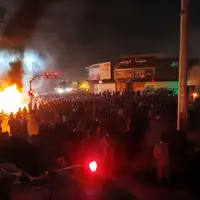
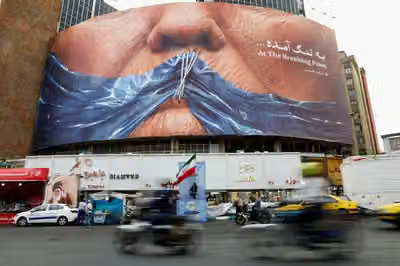
A scene of protests in Arak, Markazi province, on January 8, 2026

The number of civilians killed in Iran’s crackdown on protests may be more than 20,000, the UN special rapporteur on human rights in Iran said, citing reports from doctors inside the country, Bloomberg reported.

Mai Sato said earlier this week that civilian deaths were estimated at 5,000 or more, adding that medical reports suggested the toll could be far higher, at about 20,000 or more.

The US-based Human Rights Activist News Agency (HRANA) said it has verified 4,902 deaths since unrest erupted in late December and is reviewing a further 9,387 suspected fatalities, while more than 26,000 people have been arrested, according to a statement on its website.

Iran’s National Security Council on Wednesday issued its first official toll, reporting 3,117 deaths, including 2,427 described as “innocent,” among them members of the security forces, without providing a civilian breakdown.

Iran International reported earlier this month that more than 12,000 people were killed during the crackdown largely on January 8 and 9.

Most Viewed

Iran negotiators ordered to return after internal rift over Islamabad talks
1
EXCLUSIVE

Iran negotiators ordered to return after internal rift over Islamabad talks

2
ANALYSIS

US blockade enters murky phase as tankers spoof signals and buyers hesitate

3
ANALYSIS

Why the $100 billion Hormuz toll revenue is a myth

4

US tightens financial squeeze on Iran, warns banks over oil money flows

5
ANALYSIS

US blockade targets Iran oil boom amid regional disruption

Banner
Banner

Spotlight

  • Hardliners push Hormuz ‘red line’ as US blockade tests Iran’s leverage
    INSIGHT

    Hardliners push Hormuz ‘red line’ as US blockade tests Iran’s leverage

  • Ideology may be fading in Iran, but not in Kashmir's ‘Mini Iran'
    INSIGHT

    Ideology may be fading in Iran, but not in Kashmir's ‘Mini Iran'

  • War damage amounts to $3,000 per Iranian, with blockade set to add to losses
    INSIGHT

    War damage amounts to $3,000 per Iranian, with blockade set to add to losses

  • Why the $100 billion Hormuz toll revenue is a myth
    ANALYSIS

    Why the $100 billion Hormuz toll revenue is a myth

  • US blockade targets Iran oil boom amid regional disruption
    ANALYSIS

    US blockade targets Iran oil boom amid regional disruption

  • Iran's digital economy battered by prolonged blackout
    INSIGHT

    Iran's digital economy battered by prolonged blackout

  • At least 12,000 killed in Iran crackdown during internet blackout

    At least 12,000 killed in Iran crackdown during internet blackout

  • Iran crackdown left 16,500 dead, 330,000 injured - Sunday Times

    Iran crackdown left 16,500 dead, 330,000 injured - Sunday Times

•
•
•

More Stories

Iran still among world’s worst countries for torture of jailed journalists – CPJ

Jan 22, 2026, 01:00 GMT+0

Iran remains one of the world’s worst countries for abusing detained journalists, with reporters subjected to torture and harsh prison conditions amid intensified repression following nationwide protests, according to a new report by the Committee to Protect Journalists (CPJ).

"Iran held five journalists as of December 1, down from a peak of 55 three years earlier, but has generated the highest number of documented torture and beating cases against imprisoned media workers since records began in 1992," CPJ’s 2025 global prison census published on Wednesday said.

The report said Iran’s record worsened following nationwide protests, with journalists frequently detained for covering demonstrations and dissent.

CPJ links Iran’s earlier spike in journalist jailing to nationwide protests in recent years, and rights groups say reporters have been repeatedly detained for covering demonstrations and dissent.

Rights groups also report that many of those detained have been held in notorious facilities such as Tehran’s Evin Prison under harsh conditions.

Iran has been under a near-total internet and telecommunications blackout since early January amid nationwide protests, severely restricting the flow of information from inside the country.

Internet monitoring groups including NetBlocks recorded sharp drops in connectivity across Iran as authorities sought to limit access to social media, messaging services and independent news coverage.

The Middle East and North Africa remains the region with the third-highest number of jailed journalists worldwide. CPJ said Iran is among several states where authorities routinely treat critical reporting as a security threat, using broadly defined anti-state or terrorism-related accusations to justify arrests.

The report warned that Iran continues to arrest reporters, particularly those covering protests and economic grievances. Detainees face harsh conditions, prolonged pre-trial detention and due-process violations in breach of international law, the organization said.

It said the global trend of jailing and mistreating journalists in countries including Iran not only reflects authoritarian governance but also enables corruption and abuse of power by shielding them from public scrutiny.

More evidence of mass killings surfaces despite Iran internet blackout

Jan 22, 2026, 00:10 GMT+0

Fragments of what has unfolded in Iran over the past two weeks are beginning to emerge from beneath a near-total internet blackout, revealing killings that have largely remained hidden from public view.

Through sporadic messages, rare phone calls and accounts relayed to media outlets operating outside the country, details are surfacing of civilians shot during nationwide protests that erupted earlier this month and were met with what sources describe as one of the deadliest crackdowns in the Islamic Republic in decades.

Among the cases now coming to light is the killing of a shopkeeper in the southern city of Shiraz, according to people familiar with the incident who spoke to Iran International.

Local sources said the man had sheltered protesters inside his business during demonstrations on January 8.

The shop owner, identified as Gholamreza Zareh, ran the Linda flower shop on Qadamgah Street. Witnesses said that after protesters had fled, Zareh later opened his door to assess whether the security presence had subsided. Security forces then shot him in the neck, killing him instantly, according to the accounts.

The fate of the protesters who had sought refuge in the shop remains unclear.

In a separate incident in the southwestern city of Andimeshk, a 19-year-old protester, Shahab Fallahpour, was killed by security forces during demonstrations, people familiar with the case told Iran International.

Sources said Fallahpour, a wrestler from the Shohada neighborhood, was shot on January 9 by sniper fire from a rooftop on Parto Street, without warning. His body was buried three days later, before dawn on January 12, in the presence of his parents and under the supervision of government forces, according to the accounts.

No funeral ceremony was permitted, and the family has since been pressured not to speak publicly, the sources said.

Iran International has reported that at least 12,000 people have been killed since the protests began. CBS News has cited estimates placing the death toll as high as 20,000.

Sources told Iran International on Wednesday that hospitals and morgues are facing shortages of body bags, resulting in bodies being stored in corridors and other areas.

They described heavy security deployments at medical facilities, restrictions on families’ access, and limits on the registration of information related to the dead, which they said appeared aimed at preventing the true scale of the killings from becoming public.

With communications still largely severed, the full extent of what has occurred across Iran may not be known for weeks, if ever.

Tehran ignored warnings of unrest, chose force over reform

Jan 21, 2026, 21:43 GMT+0
•
Behrouz Turani

The protests that erupted across Iran in January 2026 may have appeared sudden to outside observers but inside the country, they were anything but.

For more than a year, Iranian political analysts, sociologists and even establishment insiders had warned that mounting economic pressure and social exhaustion were pushing the country toward a nationwide rupture.

The state, unable or unwilling to pursue reform, appeared to place its faith instead in a familiar instrument: brute force.

When unrest finally broke out, it was met with an exceptionally violent crackdown that claimed thousands of lives. The predictions came true in the worst possible way.

‘Boiling point’

In October 2025, former labor minister and government spokesman Ali Rabiei wrote in the reformist daily Sharq that Iranians were “fed up with the government’s promises.” Without meaningful economic relief, he warned, the country risked sliding into civil unrest.

A month later, sociologist Taghi Azad Armaki described the situation as “critical,” calling for national dialogue rather than denial. Accumulated social dissatisfaction, he told the moderate daily Etemad, had pushed society to its “boiling point.”

Moderate commentator Abbas Abdi went further weeks later, writing in Etemad that Iranian society had reached “the point of no return.”

State-affiliated news agencies — including Revolutionary Guards-linked Fars — did highlight economic grievances, but largely downplayed the likelihood of widespread protest, framing any potential unrest as the work of foreign actors.

A crisis mapped in advance

The clearest articulation of what lay ahead came in late December 2025, just as protests were beginning to spread and foreign-exchange and gold prices were surging.

Writing for the reformist website Rouydad24, analyst Amir Dabiri Mehr argued that Iran’s fate now hinged almost entirely on how the government chose to respond. He outlined four possible scenarios, ranging from de-escalation to catastrophe.

In the first two — economic reform or restraint by security forces — the government would seek to calm public anger without violence. Dabiri Mehr treated both as increasingly unlikely. Events soon confirmed that assessment.

The third scenario, a violent crackdown, did unfold. Security forces suppressed protests across cities including Tehran, Mashhad, Isfahan and Rasht, temporarily silencing dissent through force.

Ignoring it all

Dabiri Mehr’s fourth scenario envisioned escalation: a severe crackdown combined with the portrayal of protesters as “enemies” or “foreign agents,” pushing unrest toward militarization and raising the risk of foreign intervention or broader confrontation.

He cautioned that a social media blackout would not contain anger but displace it — forcing dissent from online spaces into the streets and transforming economic frustration into a wider social movement. Repression alone, he warned at the time, would not resolve the crisis.

The tragedy now unfolding was foreseen not only by contemporary analysts but, metaphorically, by Iran’s own literary tradition.

In Ferdowsi’s Shahnameh, written a millennium ago, a line captures the logic of the present moment: When a man’s fortune darkens, he does everything he should not do.

The warnings were clear. The alternatives were understood. What followed was not inevitability, but choice—and its consequences are now unfolding.

Iran's rulers are betting on the iron fist

Jan 21, 2026, 18:50 GMT+0
•
Ata Mohamed Tabriz

The unprecedented brutal crackdown on recent protests in Iran suggests Tehran's rulers are no longer attempting to govern a discontented society but are in open conflict with it.

The large-scale killing of protesters may look like a panicked security response, but it is better understood as a calculated effort to destroy protest both on the streets and in people’s minds.

By deploying overwhelming force, the state is seeking to reframe protest as an act that guarantees death—so dangerous that it becomes irrational to attempt.

This logic has been reinforced by the nationwide internet shutdown. Cutting communication is not simply about hiding abuses from the outside world; it is about isolating protesters from one another, breaking networks of trust, and leaving individuals to face fear alone.

When information collapses, collective will fractures. The aim is to ensure that even before a demonstration forms, the decision to join it feels like a solitary, suicidal gamble.

The state has effectively pushed society into an impossible position, where enduring daily life is as unpleasant—and as unimaginable—as any attempt to change it. This paralysis is not accidental. It is Tehran’s endgame, and increasingly its only means of survival.

'Us against them'

The violence of January 9 and 10 served another purpose as well: consolidating power from within.

By tying the survival of the political system to the actions of those carrying out repression, the state has produced what might be called forced loyalty. Security forces and affiliated actors are drawn into violence so severe that there is no path back.

Once hands are stained with blood, survival becomes inseparable from the survival of the system itself. This creates a hardened core of enforcers whose only perceived option is to push forward, no matter the cost.

This dynamic encourages a “scorched earth” approach. The conflict is no longer managed or contained; it is framed as a total struggle between “us” and “them,” with protesters cast as enemies rather than citizens.

In such a framework, compromise is not weakness—it is betrayal. Mediation disappears. Violence becomes the only remaining language.

Murky repression

By ignoring collective demands and stripping the public of political relevance, the Islamic Republic has effectively dismantled politics itself. What remains is not governance, but a permanent security posture.

The use of plainclothes forces and paramilitary units fits squarely within this logic. By blurring the boundary between state and society, the authorities have sought to reframe repression as “people against people.”

Protesters are portrayed as violent elements within society, already dehumanized through labels such as “rioters” or “terrorists.” This allows the state to deflect responsibility while deepening social fragmentation.

Slain senior Revolutionary Guard commander Hossein Hamedani once boasted about mobilizing convicts and thugs to suppress protests. “They are not afraid of blood,” he said.

Their role is not only physical repression but also narrative production: muddying responsibility, normalizing brutality, and casting doubt on the moral legitimacy of protest itself. Their unofficial status also provides the state with plausible deniability.

Burned bridges

At the same time, the machinery of repression has become increasingly bureaucratic. Killings are absorbed into routine procedure; violence is carried out as a duty—lawful, necessary, even sacred.

Statements from military and security institutions during this period make clear that the deaths of protesters are not seen as a national loss, but as a means of preserving the political order.

This moment also exposes a deeper vulnerability. A system that securitizes everything produces nothing but control and coercion. Maintaining such a structure requires constant expenditure—of resources, manpower, and legitimacy—both at home and abroad.

A crisis in the domestic security sphere cannot remain contained indefinitely; it will eventually spill outward, generating external pressure and international consequences.

What is unfolding in Iran is therefore not a temporary crackdown. It is the outcome of a long shift from governing society to confronting it as an enemy.

It is almost impossible to predict where Iran is headed, but its rulers appear to have bet on the iron fist—suspending politics for a permanent emergency and burning all bridges back to mediation and consent.

How '800 executions canceled' fits Tehran’s playbook

Jan 21, 2026, 14:50 GMT+0
•
Roozbeh Mirebrahimi

The thank-you note from US President Donald Trump to Iran’s leadership for halting what he described as planned mass executions reveals much about his politics, but more about the rulers in Tehran who have canonised deception as a political instrument.

Trump said last week that he had it “on good authority” that Iran intended to execute 800 prisoners, a claim for which no corresponding evidence has appeared in Iranian official announcements or domestic reporting.

American media reports suggested Iran's foreign minister Abbas Araghchi had been communicating with Trump's Mideast envoy Steve Witkoff and his statements had influenced the president's thinking to relent on a mooted attack.

Trump’s apparent willingness to take the claim at face value may also reflect his own preference, at least momentarily, for de-escalation—or for deferring action he may have judged premature at that stage.

Whether the specific information circulated in this episode was exaggerated, fabricated, or misunderstood remains unclear. But if misleading claims were fed to American officials or intermediaries, such behavior would be entirely consistent with Tehran’s long-standing political logic.

Concealment as expediency

This logic does not arise from classical Islamic jurisprudence as such. In traditional Islamic legal thought, deception is generally condemned in ordinary political and social life and tightly constrained even in wartime.

The Islamic Republic, however, reconfigured this ethical boundary when its first supreme leader, Ruhollah Khomeini, argued that actions normally considered impermissible could be justified under the higher imperative of preserving Islam—and later, preserving the system itself.

Concepts such as maslahat (expediency) and political taqiyya (concealment) were thus transformed from narrowly defined exceptions into governing principles. Deception ceased to be situational and became structural.

This transformation was evident even before the Islamic Republic consolidated power. Khomeini publicly promised political pluralism, civil liberties, and limits on clerical authority. After 1979, these commitments were quietly discarded or retrospectively framed as tactical necessities of the revolutionary struggle.

What occurred was less a political reversal than the institutionalization of a widening gap between public narrative and actual intent. Decisions of lasting consequence were made offstage, while legality and transparency were preserved largely in appearance.

‘Managing’ foes

In later decades, deception became a stable feature of Iran’s foreign policy as well. Negotiations were often used not to resolve disputes but to reduce pressure, fragment opposition, and buy time.

Iran’s best-known diplomat, Mohammad Javad Zarif, boasted several years ago that his team had deliberately “managed” international perceptions. Misrepresentation was not incidental; it was strategic.

Within such a system, misleading a foreign government or manipulating a prominent political figure would be a default option, not merely a necessary evil.

Whether or not the recent execution claims were accurate, their circulation fits a familiar operational pattern: deflect scrutiny, reshape headlines, ease pressure, and gain time.