Iranian teen hid in body bag among slain protestors to survive - rights group
A grieving man embraces the body of a loved one shrouded in a body bag at the Kahrizak Forensic Center south of Tehran
A wounded Iranian protester played dead inside a plastic body bag for three days to hide from security forces and heard what he believed to be fellow protestors being summarily executed, a rights group reported on Thursday.
The IHRDC reported that the teenager, whose name it withheld for his safety, was held among bodies of slain protestors transferred to the Kahrizak Forensic Center south of Tehran where he stayed motionless until his family eventually found him alive.
It added it was not able to independently verify the account as a nationwide internet blackout persists in Iran.
The youth, who is under 18, was in critical condition after suffering gunshot wounds.
“During the three days he was held among the bodies transferred to Kahrizak, he heard the ringing of cell phones among the corpses and smelled the intense stench of decay,” the Iran Human Rights Documentation Center said, citing the teenager’s account.
The group said the young man described hearing gunfire after sounds from wounded detainees, suggesting they were summarily executed.
“The witness reported that whenever groans from the wounded were heard, they were shortly followed by the sound of gunfire and the cessation of the groaning, strongly indicating that security forces delivered fatal shots to wounded individuals who were still alive,” IHRDC said.
“These details raise serious concerns regarding the treatment of the wounded, violations of the right to life, and extrajudicial killings, including of minors, during the suppression of protests,” the rights group added.
Tehran has broadened its attack on dissent after the deadliest crackdown on protests in the Islamic Republic's history by seizing assets of those accused of supporting the unrest, in a tactic first deployed amid the state's chaotic birth.
Judicial authorities in Qom province last week announced the confiscation of all assets and bank accounts belonging to Mohammad Saeedinia, the founder of a popular cafe chain operating in several Iranian cities.
Saeedinia had been arrested a day earlier and officials linked the move to his alleged support for strikes and protests after he temporarily closed his cafés following calls for strikes and work stoppages.
State-affiliated Fars News reported that assets linked to Saeedinia—including cafe chains, a roadside complex and food-industry businesses—were valued at between 25 and 27 trillion rials ($17.5–19 million).
Prosecutors said similar cases had been opened against dozens of other cafes, as well as actors, athletes and signatories of protest statements, adding that some assets had already been seized to compensate for damage to public property.
No violent crime, financial fraud or national-security offense has been publicly substantiated in Saeedinia’s case. Instead, it illustrates how economic pressure has emerged as an element of state repression in a practice with a long pedigree.
The owner of the Saedinia café chain Mohammad Saeedinia attending a public event
Confiscation codified
From the earliest months after the 1979 revolution, confiscation was used not only to dismantle the ancien régime’s economic base, but to restructure ownership and concentrate power within institutions aligned with the new state.
In the chaotic post-revolutionary period, seizures were carried out in what amounted to a legal vacuum. Revolutionary courts and ad hoc committees confiscated property under broad ideological justifications, often before a coherent judicial framework existed.
Decrees issued by Ruhollah Khomeini concerning “ownerless” or “illegitimate” property created elastic categories through which private assets could be absorbed by revolutionary bodies.
Although framed as redistribution, these measures laid the economic foundations of new power centers.
Over time, confiscation was institutionalized through bodies such as the Foundation of the Oppressed and the Execution of Imam Khomeini’s Order, as well as through legal provisions including Article 49 of the constitution, which targets “illegitimate wealth” without defining the term.
Among the early and most consequential targets was Ahmad Khayami, a pioneer of Iran’s modern auto industry and co-founder of Iran National, later Iran Khodro. The seizure of his assets and removal of private control over the company marked a decisive break with Iran’s pre-revolutionary model of industrial entrepreneurship.
Another prominent case was Habib Sabet, an entrepreneur active in media, construction and commerce, and the founder of Iran’s first private television network. His assets were confiscated in the revolution’s aftermath, reflecting how independent capital—even without overt political involvement—was treated as incompatible with the new order.
Private sector hobbled
The execution of Habib Elghanian, a leading industrialist and head of Tehran’s Jewish community, sent a particularly chilling signal. After a summary revolutionary trial in 1979, his assets were seized and he was put to death, accelerating capital flight and underscoring the risks facing private enterprise in the new Islamic Republic.
The impact on Iran’s modern private sector was significant.
Entrepreneurs who had built manufacturing, retail and financial enterprises over decades were removed, their assets transferred to state or quasi-state structures. Many left the country.
Others were sidelined through prosecution or regulatory exclusion.
Habib Elghanian, a prominent leader of Iran's Jewish community, seen during his trial in Iran that led to his 1979 execution.
As revolutionary fervor faded, the practice evolved rather than disappeared. Highly publicized trials and executions gave way to asset freezes, license revocations and selective enforcement. Confiscation became less spectacular but more routine, embedded in administrative and judicial processes.
Recent protest cycles have again brought these mechanisms to the fore. Business closures, account seizures and professional bans have accompanied crackdowns, reinforcing the message that economic activity remains conditional on political compliance.
The seizure of Saeedinia’s assets fits squarely within this longer trajectory. It is not an isolated response to unrest, but part of a system in which control over property has, from the outset, served as a means of political management.
Iran remains one of the world’s worst countries for abusing detained journalists, with reporters subjected to torture and harsh prison conditions amid intensified repression following nationwide protests, according to a new report by the Committee to Protect Journalists (CPJ).
"Iran held five journalists as of December 1, down from a peak of 55 three years earlier, but has generated the highest number of documented torture and beating cases against imprisoned media workers since records began in 1992," CPJ’s 2025 global prison census published on Wednesday said.
The report said Iran’s record worsened following nationwide protests, with journalists frequently detained for covering demonstrations and dissent.
CPJ links Iran’s earlier spike in journalist jailing to nationwide protests in recent years, and rights groups say reporters have been repeatedly detained for covering demonstrations and dissent.
Rights groups also report that many of those detained have been held in notorious facilities such as Tehran’s Evin Prison under harsh conditions.
Iran has been under a near-total internet and telecommunications blackout since early January amid nationwide protests, severely restricting the flow of information from inside the country.
Internet monitoring groups including NetBlocks recorded sharp drops in connectivity across Iran as authorities sought to limit access to social media, messaging services and independent news coverage.
The Middle East and North Africa remains the region with the third-highest number of jailed journalists worldwide. CPJ said Iran is among several states where authorities routinely treat critical reporting as a security threat, using broadly defined anti-state or terrorism-related accusations to justify arrests.
The report warned that Iran continues to arrest reporters, particularly those covering protests and economic grievances. Detainees face harsh conditions, prolonged pre-trial detention and due-process violations in breach of international law, the organization said.
It said the global trend of jailing and mistreating journalists in countries including Iran not only reflects authoritarian governance but also enables corruption and abuse of power by shielding them from public scrutiny.
Fragments of what has unfolded in Iran over the past two weeks are beginning to emerge from beneath a near-total internet blackout, revealing killings that have largely remained hidden from public view.
Through sporadic messages, rare phone calls and accounts relayed to media outlets operating outside the country, details are surfacing of civilians shot during nationwide protests that erupted earlier this month and were met with what sources describe as one of the deadliest crackdowns in the Islamic Republic in decades.
Among the cases now coming to light is the killing of a shopkeeper in the southern city of Shiraz, according to people familiar with the incident who spoke to Iran International.
Local sources said the man had sheltered protesters inside his business during demonstrations on January 8.
The shop owner, identified as Gholamreza Zareh, ran the Linda flower shop on Qadamgah Street. Witnesses said that after protesters had fled, Zareh later opened his door to assess whether the security presence had subsided. Security forces then shot him in the neck, killing him instantly, according to the accounts.
The fate of the protesters who had sought refuge in the shop remains unclear.
In a separate incident in the southwestern city of Andimeshk, a 19-year-old protester, Shahab Fallahpour, was killed by security forces during demonstrations, people familiar with the case told Iran International.
Sources said Fallahpour, a wrestler from the Shohada neighborhood, was shot on January 9 by sniper fire from a rooftop on Parto Street, without warning. His body was buried three days later, before dawn on January 12, in the presence of his parents and under the supervision of government forces, according to the accounts.
No funeral ceremony was permitted, and the family has since been pressured not to speak publicly, the sources said.
Iran International has reported that at least 12,000 people have been killed since the protests began. CBS News has cited estimates placing the death toll as high as 20,000.
Sources told Iran International on Wednesday that hospitals and morgues are facing shortages of body bags, resulting in bodies being stored in corridors and other areas.
They described heavy security deployments at medical facilities, restrictions on families’ access, and limits on the registration of information related to the dead, which they said appeared aimed at preventing the true scale of the killings from becoming public.
With communications still largely severed, the full extent of what has occurred across Iran may not be known for weeks, if ever.
Iran's foreign minister said the country was prepared to show no restraint in retaliating to any military attack and mocked Europe about its standoff with the United States over President Donald Trump's push to control Greenland.
Tensions between Tehran and Washington have flared in the wake of the deadliest crackdown on protests in the history of the Islamic Republic earlier this month.
Trump warned Iran not to kill protestors and vowed in a social media post the "help is on the way," in comments which heartened demonstrators and appeared to signal readiness for a military intervention which has yet to materialize.
"Unlike the restraint Iran showed in June 2025, our powerful armed forces have no qualms about firing back with everything we have if we come under renewed attack," Araghchi said in an editorial in the Wall Street Journal, referring to a 12-day war with Israel and the United States.
At least 12,000 protestors were killed by security forces, according to medics and government sources speaking to Iran International.
The veteran diplomat and strident defender of Tehran's crushing of the nationwide demonstrations had his invitation to the World Economic Forum in Davos, Switzerland revoked this week.
"An all-out confrontation will certainly be ferocious and drag on far, far longer than the fantasy timelines that Israel and its proxies are trying to peddle to the White House," he added. "It will certainly engulf the wider region and have an impact on ordinary people around the globe."
Trump is weighing "decisive" military options toward Iran in the wake of the mass killing of demonstrators, the same newspaper reported on Tuesday, as a US carrier strike group steams toward the region.
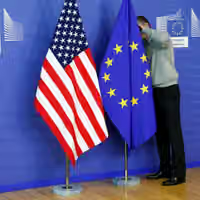
Meanwhile the United States has ramped up its bid to lay claim to Greenland, a part of Denmark, citing Arctic and world security in a diplomatic drama which is opposed by the European Union and is straining the nearly 80-year-old NATO alliance.
Araghchi cited what he called Europe's support for Trump's move to exit an international deal over Iran's disputed nuclear program in his first term, saying the United States was behaving in a unilateral way which challenged global order.
"Sadly for Europe, its current conundrum is the very definition of 'blowback'. The E3/EU faithfully obeyed and even abetted President Trump when he unilaterally abrogated the Iran Nuclear Deal," he wrote on X.
"Mr. Trump's threat to take over Greenland by any means—unlawful as it is under any conception of international law or even a 'rules-based order'—could not happen to a more deserving continent," he added.
Iran is ramping up its control of domestic cyberspace with a closed new state-run intranet, according to a US-based advocacy group, after a nationwide internet blackout cloaked the deadliest crackdown on protests in nearly half a century.
“Like North Korea, the Islamic Republic has been working to build an intranet, and it is scary. It will be blocking off Iran," said Neda Bolourchi, the executive director of the Public Affairs Alliance of Iranian Americans.
The Washington-based PAAIA works to amplify Iranian American voices and advocate for policy solutions on Capitol Hill.
Iran's internet blackout began on January 8 as the uprisings spread nationwide and security forces launched a sweeping crackdown.
At least 12,000 people were killed, most of them over January 8 and 9 according to medics and government sources who spoke to Iran International.
Iran’s Supreme Leader Ali Khamenei has since acknowledged that “several thousands” were killed, while doctors say most deaths occurred over just two days during what they describe as the most violent phase of repression in the Islamic Republic’s 47-year history.
With near-total internet and phone shutdowns in place, independent verification remains extremely difficult, and medical sources warn the true toll could be higher.
Where does the blackout stand now?
Bolourchi said the shutdown remains severe but not absolute, and that the small openings are not born of restraint but aim to support a bare minimum of business activity especially in the banking sector.
“We’re getting reports that landlines are sporadically available and that some of the throttling has been reduced,” she said.
A limited number of calls and messages are still getting out through platforms such as WhatsApp, though at dramatically reduced levels.
The Islamic Republic, she explained, cannot fully cut connectivity without paralyzing its own systems. Banks, hospitals and parts of the economy still depend on the internet to function, forcing authorities to allow just enough access to keep the state running while the broader population remains largely cut off.
Satellite internet, once a critical lifeline, has also come under heavy pressure. Bolourchi said authorities are using jamming equipment to disrupt Starlink connections while simultaneously confiscating receivers, which are visible and easy to locate.
She warned that possession of such tools has become increasingly dangerous, as the clerical establishment expands the use of severe charges traditionally reserved for enemies of the state.
The length of the blackout itself, Bolourchi said, points to something more permanent taking shape.
Unlike previous shutdowns that proved economically unsustainable after a few days, this current outage has persisted, suggesting the Islamic Republic has made significant progress in separating government infrastructure from public access.
That shift, she warned, could leave ordinary Iranians trapped inside a sealed digital ecosystem, unable to communicate freely with the outside world even after protests subside.
Bolourchi argued that the United States still has leverage if it chooses to use it, pointing to legislation already passed by Congress that was intended to fund internet circumvention tools for Iran, including support for satellite connectivity and VPNs.
Congress, she said, went further than requested by approving $15 million annually for these efforts.
“A lot could have been done over the past year that would be helping the people of Iran right now,” Bolourchi said, citing bureaucratic and funding delays. “Instead, we’re always in a reactive position.”