Iran lawmaker calls for more legal and welfare support for police
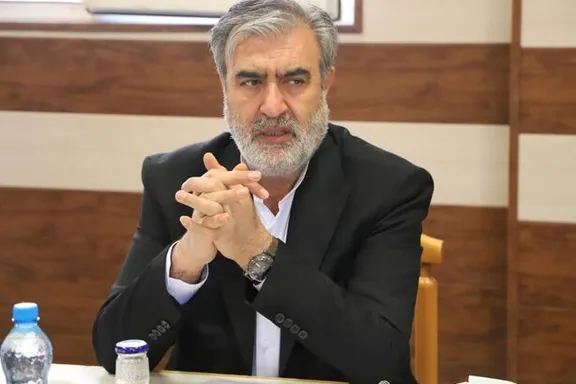
A senior Iranian lawmaker said parliament should pass more effective laws to support the country’s police, including legal backing, better equipment and improved living conditions for officers, after security forces used heavy violence against protesters.
Ebrahim Azizi, head of the national security committee in Iran’s parliament, said parliament saw it as its duty to support the police force of the Islamic Republic through legal, logistical and welfare measures.
“Legal support for police missions, stronger equipment, and attention to livelihoods, housing and welfare services for personnel are among parliament’s priorities,” Azizi said.









A 37-year-old physiotherapist and clinic founder was shot dead during protests in Iran earlier this month, and his family was later forced to pay money to retrieve his body, a source familiar with the matter told Iran International.
The source identified him as Masoud Bolourchi, a Tehran-based physiotherapist and founder of Rush Physiotherapy Clinic, and said he was shot from behind on Jan. 8.
According to the source, his family later located his body in Kahrizak, south of Tehran, and were pressured by security officials into paying what was described as a “bullet fee” before it was released.
Bolourchi had studied in Budapest, Hungary, and had returned to Iran several years ago, the source said.
The public rancor between US President Donald Trump and Iranian Supreme Leader Ali Khamenei has gotten increasingly personal, suggesting that a standoff once mediated through proxies and carefully coded threats may be approaching a finale.
That escalation was on display last week when Trump openly questioned Khamenei’s right to rule and called him a “sick man” who kills his own people.
“It’s time to look for new leadership in Iran,” the president was quoted as saying by Politico. His blistering rhetorical intervention came after one of Khamenei's most strident speeches yet in which he, uncharacteristically, acknowledged thousands had been killed in the state's crackdown on protests this month.
"We consider the US president criminal for the casualties, damages and slander he inflicted on the Iranian nation," Khamenei said.
Iranian officials denounced Trump’s language as “offensive” and “unacceptable,” with president Masoud Pezeshkian warning that any move against Khamenei would trigger an all-out war.
The latest public spat followed widespread protests inside Iran, which were quelled through the unprecedented use of force. Speaking about the unrest last week, Khamenei once again blamed Israel and the United States for incitement, accusing Washington of fomenting terrorism and sabotage.
'The most wretched of humankind'
While the language has grown sharper, the confrontation itself is not new.
The personal animosity between Trump and Khamenei reached a decisive turning point in January 2020, when a US drone strike in Baghdad ordered by Trump killed Qassem Soleimani, the commander of Iran’s Quds Force and one of the most powerful figures in the Islamic Republic.
Khamenei described those responsible as “the most wretched of humankind” and vowed revenge. The killing transformed what had been a strategic rivalry into a deeply personal feud—one infused with symbolism, grievance, and a sense of irreversibility.
In the years that followed, Khamenei increasingly personalized his attacks on Trump. He portrayed the US president as the embodiment of American arrogance and decay, at one point calling him a “clown.”
Still, the veteran theocrat most abstained from uttering the name of his nemesis, out of contempt. Trump has done largely likewise.
'Ultimately responsible'
Even before Soleimani’s death, the two leaders had traded insults during Trump’s first term.
In June 2019, Trump imposed sanctions on Khamenei, calling him “ultimately responsible” for Tehran’s conduct. Iran’s then president, Hassan Rouhani, responded by calling the White House “mentally disabled,” a remark later endorsed by Khamenei’s office.
Trump dismissed the response as “ignorant and insulting,” saying Iran’s leaders “do not understand reality.”
A year later, when Japan’s then prime minister Shinzo Abe attempted to deliver a message from Trump to Khamenei, the Iranian leader publicly refused to accept it, telling Abe that he did not believe Trump was “worthy” of receiving a message.
Footage later showed Abe awkwardly folding the envelope away—an episode widely read as a calculated public snub.
One last dance?
Since Trump’s return to office, the exchanges have become more frequent and more explicit, often coinciding with moments of heightened tension, not least the June war between Iran and Israel.
On June 17, Trump took to social media for a rare direct attack.
“We know exactly where the so-called ‘Supreme Leader’ is hiding,” he wrote. “He is an easy target, but is safe there—we are not going to take him out, at least not for now.”
In October 2025, Khamenei described the United States under Trump as “a true manifestation of terrorism.” He compared Trump to figures such as Pharaoh and Nimrod, warning that “tyrants fall at the height of their arrogance.”
What distinguishes the current phase of their feud is not merely its volume, but its direction.
Earlier exchanges left room for ambiguity, intermediaries, or eventual de-escalation. The present rhetoric increasingly dispenses with those buffers, with Trump now speaking openly of replacement.
Whether this marks the final chapter of the confrontation remains uncertain. What is clear is that the US-Iran conflict now includes a personal clash between two leaders loath to compromise, despite the asymmetry of power between them.
More than 300 hours have passed since Iran imposed a nationwide internet blackout, an internet monitoring group said, adding that the restrictions are aimed at concealing abuses and controlling information as protests continues.
“Attempts to obscure the truth will be documented in real time: The world is watching,” NetBlocks said.
It added that Iran’s authorities are keeping most of the country offline while allowing limited access through “whitelisted” networks, and the government is also seeking to influence views abroad by placing opinion pieces.
Iran is ramping up its control of domestic cyberspace with a closed new state-run intranet, according to a US-based advocacy group, after a nationwide internet blackout cloaked the deadliest crackdown on protests in nearly half a century.
“Like North Korea, the Islamic Republic has been working to build an intranet, and it is scary. It will be blocking off Iran," said Neda Bolourchi, the executive director of the Public Affairs Alliance of Iranian Americans.
The Washington-based PAAIA works to amplify Iranian American voices and advocate for policy solutions on Capitol Hill.
Iran's internet blackout began on January 8 as the uprisings spread nationwide and security forces launched a sweeping crackdown.
At least 12,000 people were killed, most of them over January 8 and 9 according to medics and government sources who spoke to Iran International.
Iran’s Supreme Leader Ali Khamenei has since acknowledged that “several thousands” were killed, while doctors say most deaths occurred over just two days during what they describe as the most violent phase of repression in the Islamic Republic’s 47-year history.
With near-total internet and phone shutdowns in place, independent verification remains extremely difficult, and medical sources warn the true toll could be higher.
Where does the blackout stand now?
Bolourchi said the shutdown remains severe but not absolute, and that the small openings are not born of restraint but aim to support a bare minimum of business activity especially in the banking sector.
“We’re getting reports that landlines are sporadically available and that some of the throttling has been reduced,” she said.
A limited number of calls and messages are still getting out through platforms such as WhatsApp, though at dramatically reduced levels.
The Islamic Republic, she explained, cannot fully cut connectivity without paralyzing its own systems. Banks, hospitals and parts of the economy still depend on the internet to function, forcing authorities to allow just enough access to keep the state running while the broader population remains largely cut off.
Satellite internet, once a critical lifeline, has also come under heavy pressure. Bolourchi said authorities are using jamming equipment to disrupt Starlink connections while simultaneously confiscating receivers, which are visible and easy to locate.
She warned that possession of such tools has become increasingly dangerous, as the clerical establishment expands the use of severe charges traditionally reserved for enemies of the state.
The length of the blackout itself, Bolourchi said, points to something more permanent taking shape.
Unlike previous shutdowns that proved economically unsustainable after a few days, this current outage has persisted, suggesting the Islamic Republic has made significant progress in separating government infrastructure from public access.
That shift, she warned, could leave ordinary Iranians trapped inside a sealed digital ecosystem, unable to communicate freely with the outside world even after protests subside.
Bolourchi argued that the United States still has leverage if it chooses to use it, pointing to legislation already passed by Congress that was intended to fund internet circumvention tools for Iran, including support for satellite connectivity and VPNs.
Congress, she said, went further than requested by approving $15 million annually for these efforts.
“A lot could have been done over the past year that would be helping the people of Iran right now,” Bolourchi said, citing bureaucratic and funding delays. “Instead, we’re always in a reactive position.”
US Republican Representative Joe Wilson on Tuesday condemned Iran’s authorities over mass killings of civilians and accused Russia’s president of waging destructive wars, drawing parallels between the two leaders.
“Courageous Iranians are being slaughtered in streets, homes, and hospitals by the tens of thousands,” he wrote on X. “The deranged terrorist regime that pledges death to America and Israel must be stopped.”
In the same post, Wilson criticized Russian President Vladimir Putin over the war in Ukraine, accusing him of attacking infrastructure and civilians.
“For 25 years, Putin has cried ‘poor Russia’ as he invades sovereign countries,” Wilson wrote, referring to strikes on energy infrastructure during winter and the use of drones against civilians.
Wilson described Putin and Iran’s Supreme Leader Ali Khamenei as “a cancer to the civilized world,” and said international action could stop what he called the threat posed by both leaders.