Iranian teenage champion swimmer killed by security forces


A 19-year-old Iranian athlete, Arnika Dabbagh, was killed by security forces in the northern city of Gorgan during the nationwide protests, people familiar with the matter told Iran International.
Dabbagh was a student and a competitive swimmer who had won national titles in swimming competitions in Iran, the sources said.

The IT and cybersecurity teams of Iran's Sepah Bank are currently reviewing the scope and details of the reports that the bank has been hacked, state-run Mehr News Agency reported on Tuesday.
Sepah Bank, which is responsible for processing the payments of military personnel, was earlier targeted by hackers during Israel's June war on Iran.
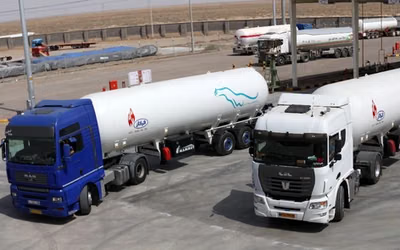
The pro-Israel hacker group Predatory Sparrow, known for prior cyberattacks on Iran’s fuel infrastructure, claimed responsibility for "paralyzing" Sepah Bank.
Iran’s security forces killed a family member of a victim of Ukraine International Airlines Flight PS752, which was shot down by the Revolutionary Guards in 2020, during nationwide protests in Tehran, the Association of Families of Flight PS752 Victims said on Tuesday.
The association said Alireza Javaheri-Pey, the cousin of Ali Javaheri-Pey, who was among those killed in the missile strike on the Ukrainian passenger jet, was killed on the evening of Jan. 8 in the Ariashahr area of the Iranian capital.
Javaheri-Pey was shot directly in the head at close range at around 8 p.m. by Iran’s security forces, according to the association.
“Alireza Javahari-Pey was 25 years old and had only been married for six months,” the association said.

Iranians calling Iran International’s phone-in said security forces killed and removed bodies; some reported families pressured into quiet burials and Arabic-speaking forces on the streets, as the crackdown pushed protests to window chants and fueled calls for foreign backing.
Monday night’s call-in program unfolded through broken connections, Starlink links, and brief windows of limited access.
From Tehran, Mashhad, Shiraz, and smaller cities, callers described nights shaped by gunfire, bodies taken away, families disappearing after hospital notifications, and what several people called an urgent need for outside backing as the crackdown intensifies.
Many callers placed their accounts around Thursday and Friday, January 8 and 9, when a public call for protests gave way in the following days to chants from windows and rooftops as streets became harder to enter.
‘We need help’
Several callers said protests have reached a point where they do not believe people inside Iran can sustain the pressure alone, especially with widespread violence and a continuing near-blackout online.
Ali, calling from Tehran, put it bluntly. “We are 90 million prisoners in Iran, and we need support,” he said.
He pointed to foreign involvement in Iran’s past and argued that outside powers should play a direct role again. “Even the 1979 revolution did not happen only by the people, and the United States and European countries helped shape it,” Ali said.
From Shiraz, Shiva voiced a similar fear that if the moment passes without outside action, the aftermath will be even harsher.
“If no foreign force helps us and everything becomes normal again, what comes next will be arrests, heavy sentences, and executions,” she said.
She described a level of exhaustion that has turned into desperation. “People are empty-handed, and we cannot do more than this alone.”
Houman, calling from Mashhad, addressed US President Donald Trump directly and tied the question of foreign help to what he said he had witnessed on the streets.
“We did not come out for Trump, we came out for freedom and for our children’s future,” he said.
He then framed outside action as decisive for whether this ends in even more bloodshed. “Trump should do something,” Houman said.
'Proxy forces brought in'
Another theme running through the calls was descriptions of Arabic-speaking forces operating alongside Iranian security units.
Masoud, calling from Tehran, said people around him were hearing and seeing signs that some forces deployed were not local. “I do not understand who these people are who speak Arabic,” he said.
He also described what he said was an effort to document them while avoiding exposure. “My friends recorded them, and some of it is on CCTV cameras, but they cannot publish it for security reasons,” Masoud said.
The suggestion, repeated in different forms, was that Iran is drawing on proxy networks and allied forces from the region.
US officials have also said they are concerned by reports that Hezbollah members and Iraqi militias are being used against protesters, after Iran International and CNN cited sources describing Iraqi Shi’ite fighters crossing into Iran under the cover of religious pilgrimages.
'A city of blood'
Callers repeatedly described shootings they said were indiscriminate, close-range, or intended to kill rather than disperse.
Masoud described what he said he saw the morning after a protest night in Tehran. “I saw intestines on the street, and I saw what they did to our young people,” he said.
He described bodies being dragged through blood and said streets had been washed while traces remained.
Elen, calling from Turkey after spending days in Shahinshahr near Isfahan, said she saw an injured person reach a side street and then be shot again.
“I saw a wounded person reach the alley, and the officers came over, shot him, and then put his body in the trunk and took him away,” she said.
Houman described what he called sniper fire and shooting from elevated positions in Mashhad, and said people were hit as they tried to flee. “They were shooting people from the rooftops, and many were shot from behind while they were running.”
He described Friday as a night when he said arrests were not even the point. “On Friday, they were not even arresting people, and they were just shooting,” Houman said.
Danial, who called from Iran without naming his city, challenged official narratives about who is responsible for the dead, and said the violence was the story.
“They say people were killed by terrorists, but I ask why nothing happened during the rallies they organized for their own supporters,” he said.
He then offered a line that became the moral center of his call.
“The terrorist was the Islamic Republic that stood in front of the people and opened fire,” Danial said.
Bodies taken, buried quietly, or never returned
A large share of the testimony focused not only on killings, but on what happens afterward.
Masoud described what he said was the forced removal of a body and a secret burial.
“On Thursday night, they snatched the body and buried her stealthily in a nearby village,” he said.
He also described what he said is becoming a pattern: families burying people at home to avoid pressure.
Masoud said he was seeing many cases of people being buried at home to avoid official procedures and pressure. “We have a lot of cases like this; people being buried at home.”
Elen described families burying without paperwork or formal steps, and said she heard of demands for money in exchange for returning bodies.
“They buried the young man quietly, without papers, and the family said, ‘I know he is dead and that is enough,’” she said.
Nima, calling from Texas, said he had received information from a hospital worker in Tehran who managed to connect briefly. He read out a list of names and ages, including a nine-year-old.
He said the hospital account suggested an unusually high concentration of lethal shots. “They said not one person had been hit in the legs, and the injuries were to the head, neck, and chest.”
He also said the hospital worker described security pressure inside the facility, including what he said were detentions of families.
“Every family that was told their loved one had died disappeared within 10 to 15 minutes,” Nima said.
He described what he said were vans arriving to remove bodies, and claimed some people taken away were still alive. “I saw people who were still breathing, and they took them away together with the dead."
A protest evolving under shutdown
With internet access still largely down inside Iran, callers said the blackout is not only an information barrier but a tactical weapon, forcing protests to evolve.
Ali in Tehran described a shift away from mass street gatherings toward nighttime chants from homes following the call by exiled Prince Reza Pahlavi. “People are still shouting the slogans from their windows and rooftops,” he said.
He said the sense of isolation is growing. “In this situation when the internet is not there, we cannot even connect with our loved ones outside Iran,” Ali said.
Kian, calling from Ahvaz, argued that the country has entered a different phase, with older methods of control losing impact even as violence escalates.
“Iran has entered a new stage where the old tools of repression and official storytelling do not work,” he said.
He described the shutdown and the use of force as signs of fear by the authorities, not strength.
“Cutting the internet and bringing forces into civilian spaces and widespread killing are not signs of power, and they are signs of fear,” Kian said.
Callers repeatedly returned to two immediate questions: whether outside governments will take steps beyond statements, and whether the escalating violence and the handling of bodies will push even more people into open defiance despite the fear.
“The history is written with the voice of the people,” Kian said.
Israeli Foreign Minister Gideon Sa’ar on Tuesday called on the European Union to designate Islamic Revolutionary Guard Corps as a terrorist organization, citing the its role in repressing protests in Iran and destabilizing the region.
Speaking at a joint press conference with his Czech counterpart, Sa’ar said Iran’s authorities were continuing their crackdown despite restricting internet access.
“Behind the internet shutdown, the repression of Iran continues,” he said. “The ayatollah regime in Iran is brutally butchering its own people as they struggle for their freedom.”
Sa’ar urged the EU to act in response to calls from Iranians protesting the Islamic Republic.
“I call on the European Union: Rise to the moment. Answer the call of the Iranian people. Designate the Revolutionary Guards as a terrorist organization,” he said.
He also warned of a broader threat posed by Tehran, pointing to Iran’s nuclear ambitions.
“The world’s most dangerous and extreme regime, which funds and cultivates a network of terror organizations and states, wants to get its hands on the world’s most dangerous weapon,” Sa’ar said, adding that such a development would threaten not only Israel and the Middle East, but also Europe.
Omid Nouripour, vice president of Germany’s federal parliament, said Western governments had failed to apply enough pressure on Iran’s authorities and called for greater unity and solidarity with the Iranian people.
In a video posted on X, Nouripour said European governments had not done enough to break what he described as their silence, and that the United States had failed to live up to promises it had made to Iranians.
“We were not able to put enough pressure on the European governments to break their silence,” he said. “We could not put enough pressure on the US government to fulfill the promises it made to the Iranian people.”
“No one should have to risk being shot,” Nouripour said, adding that the authorities’ response to rising costs and lack of freedom had been “killing and oppression.”