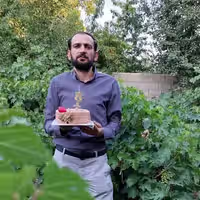
“The regime right now is on its last leg. It's on the verge of collapse. It's going to attempt every other means to yet again survive,” Iran’s exiled Prince Reza Pahlavi said in an interview with Fox News on Monday.
“That's why a definitive strike is going to completely reverse the odds in favour of the nation and defenseless people. That's what we need in terms of actual support,” he added.
Asked whether he meant American strikes, Pahlavi said: “It could be an American strike. It could be an Israeli strike. It could be whatever the Iranian people now are looking at the cavalry coming, because we can only hold the fort up to a point.”
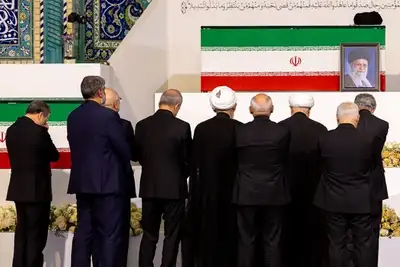
European Parliament President Roberta Metsola said lawmakers honored those killed in Iran with a moment of applause during the Parliament's first plenary session in 2026.
“The people of Iran don’t need silence. They have been kept forcefully silent for 47 years. They deserve to be free,” Metsola posted on X on Monday.
Iran’s foreign minister Abbas Araghchi said on Monday the World Economic Forum cancelled his planned appearance at its annual meeting in Davos due to what he described as political pressure from Israel and its "proxies" in the United States.
“The World Economic Forum cancelled my appearance in Davos on the basis of lies and political pressure from Israel and its United States-based proxies and apologists,” he said in a post on X.
“There is one fundamental truth to the recent violence in Iran: We had to defend our people against armed terrorists and ISIS-style killings openly backed by Mossad,” Araghchi added.


The latest wave of protests in Iran once more demonstrated both the depth of popular opposition to the Islamic Republic and the limits of mass mobilization in the absence of a decisive breakdown in the regime’s coercive capacity.
As observed by numerous scholars of revolution, opposition forces are almost never in a strong position to defeat a regime’s armed forces. Revolutions occur when, for whatever reason, those armed forces stop suppressing the opposition.
This can happen for different reasons. One is that personnel within the armed forces simply refuse to carry out orders to suppress the opposition, as occurred in the democratic revolutions in much of Eastern Europe in 1989 and in subsequent “color revolutions” elsewhere.
The Islamic Republic’s armed forces, however, have so far proven quite willing to suppress Iranian citizens.
Another possibility is that the regime is more frightened of its armed forces than of its opponents, and therefore does not allow them to act forcefully for fear that they might seize power after suppressing the opposition.
This is what happened in Iran in 1979. But while Shah Mohammad Reza Pahlavi was unwilling to use force effectively against his opponents, the Islamic Republic has shown no such hesitation.
Yet another scenario is that a split develops within the ranks of an authoritarian regime’s armed forces, with significant elements defecting to the opposition.
A defection by a key commander can quickly cascade, as occurred over just a few days in the Philippines in 1986. When such a defection occurs, the remaining security forces are confronted not merely with suppressing unarmed civilians, but with fighting armed men like themselves—a prospect they often wish to avoid.
This has not yet occurred in Iran, but in my view it remains the likeliest path to bringing down the Islamic Republic.
What would it take for this to happen? Most probably, it would require officers to feel confident that their institution would survive the regime’s downfall and remain intact under a new political order.
The commanders of the Islamic Revolutionary Guard Corps (IRGC) are less likely to feel such confidence than Iran’s regular armed forces. But even if elements of the regular military were willing to defect to the opposition, they would likely still have to fight the IRGC—unless the latter collapsed when faced with the prospect of confronting the regular army.
These are the fraught calculations confronting those within Iran’s armed forces who share the population’s opposition to the regime.
The Trump administration might be able to affect this calculus through attacks that degrade the IRGC, but not Iran’s regular armed forces.
In other words, for the regular military to risk turning against the regime, it would have to believe both that it could defeat the IRGC and its Basij allies, and that it would itself survive the fall of the Islamic Republic.
Alternatively, some kind of deal would have to be made with IRGC commanders, assuring them of integration into a new regime’s armed forces.
On its face, of course, such an idea is utterly repugnant.
There is also the hope that rank-and-file members of the regime’s armed forces might refuse orders to fire on demonstrators and instead turn their weapons against their commanders and the regime. This, however, does not appear likely.
That being the case, the only viable path to bringing down the regime may be some form of accommodation with key elements of its armed forces.
The Trump administration’s transactional approach to foreign policy might make it more open to attempting this. But America’s authoritarian Arab allies may be even more fearful of a democratic Iran than of a weakened Islamic Republic. The mere existence of a democratic Iran could inspire democratic movements in Arab countries—something their rulers are keen to avoid.
Conservative Israeli governments, too, have long taken a dim view of democratic movements in Muslim countries, which they do not expect to be as accommodating as certain authoritarian Arab governments that have signed the Abraham Accords.
Israel and Iran’s Arab neighbors, in particular, can therefore be expected to lobby the Trump administration about the dangers and unpredictability of political change in Iran.
Unfortunately, all this suggests that without key defections from within Iran’s armed forces—or efforts by the United States or other outside powers to encourage them—the Islamic Republic is more likely than not to remain in power.
The best hope for Iran’s democratic opposition is to secure an accommodation with key elements of the armed forces that would trigger the kind of security-force defections seen in successful democratic revolutions elsewhere.
This is far easier said than done. But where it has happened, it has often come suddenly and unexpectedly.
I sincerely hope this will happen in Iran.
Iran's intelligence agents detained and questioned Omid Ravankhah, head coach of Iran’s national under-23 football team, for several hours on Monday after he arrived in Tehran from Dubai, people familiar with the matter told Iran International.
Intelligence agents confiscated Ravankhah’s passport before allowing him to leave the airport. He was instructed to report to a security body on Tuesday, the people said.
According to the people, Reza Naghipour, the caretaker manager of the national under-23 team, has threatened Ravankhah over his public support for the people of Iran. Naghipour had previously threatened former footballer Ali Karimi with death, they said.
Speaking at a press conference following Iran’s match against Lebanon at the Asian Championship, last Tuesday, Ravankhah voiced explicit support for what he described as the Iranian people’s national revolution against the Islamic Republic.
“It is my social duty, in these circumstances, to stand alongside my people, and no matter what consequences it may have for me, I hope their voices are heard,” he said.
“Unfortunately, for years now in my country, the management of many issues has taken place at the lowest possible level, and people have no right to any form of protest. From here, I want to be the voice of my people, who have endured many hardships in these days,” he added.
“Violence in Iran” ranked by a wide margin as the top concern among respondents in a poll published on the European Parliament’s official account on X.
As of Monday evening, the poll had recorded 34,270 votes, with 98.4% of participants selecting “violence in Iran” as the issue that interested them most.
By comparison, 1.3% chose Greenland’s integrity, while illegal AI deepfakes and medicine shortages received 0.2% and 0.1% respectively.
The poll is set to remain open for another 17 hours, according to the post.