Guards-linked outlets defend Iran internet shutdown
Iran’s internet shutdown is “in line with common international practices,” Tasnim, a news agency affiliated with the Revolutionary Guards, said without specifying which standards justify a nationwide blackout.
Fars News, another IRGC-linked outlet, also reported that private chats and group activity online will only be available on domestic messaging platforms.
Reza Eskandarpour, 37, was killed by direct gunfire during protests on January 8 in the Ariashahr neighborhood of Tehran, sources confirmed to Iran International.
Eskandarpour, born in October 1988 and a resident of, was shot dead by security forces, according to reports received by Iran International.
Eskandarpour was protesting with five friends when one of them was shot by security agents, sources said. He returned to help his wounded friend, at which point a sniper linked to security forces opened fire from a rooftop.
He was hit by six live rounds and killed at the scene. Two other people accompanying him were also killed at the same time.
Eskandarpour owned a cabinet-making workshop in Ariashahr and was preparing to get married, according to people close to him.
As the security crackdown intensifies in cities across Iran, reports received by Iran International indicate a sharp rise in the number of people killed, with sources saying that in some areas nearly every family has lost someone or has at least one detained or injured relative.
One source said at least five people, including a 15-year-old girl, were killed in Izeh, south of Iran, on the evening of January 8 during protests. Residents described conditions resembling martial law from around 5 p.m., with snipers positioned on rooftops and armed forces wearing masks deployed in streets and residential alleys.
In Khorramabad, Lorestan province, security forces have been stationed in large halls and schools, while reports point to the widespread transfer of bodies to medical centers. In Borujerd, residents described a severe security lockdown alongside raids on homes and reports of killings and arrests.
A source told Iran International that in Bam, Kerman province, more than 100 people were detained and around 10 killed during protests on January 8 and 9. Families have not been informed of detainees’ whereabouts, and one family was told they would have to bury the body of their slain relative themselves.
In Arak, Markazi province, eyewitnesses said the number of deaths was so high that the morgue ran out of capacity to store bodies. Witnesses in Qazvin also reported protesters being shot from rooftops.
Arshia Ahmadpour, an 18-year-old boxer from Baharestan in Isfahan, was killed by security forces during protests in the city on January 9, according to information received by Iran International.
Ahmadpour, a relative said, was originally from Izeh in southern Iran, worked as a hairdresser in Isfahan, and was an athlete who practiced boxing.
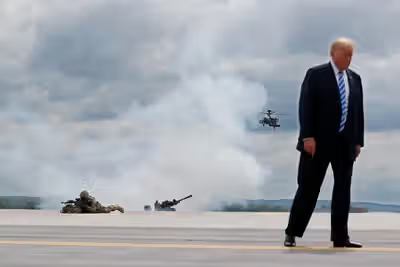
Tehran's chief prosecutor on Saturday vowed "firm" action against detained protesters, responding to a Truth Social post by US President Donald Trump in which he said Iran's leadership had "cancelled the executions" of 800 protesters.
"Trump always talks a lot of nonsense. The hell he does," Tehran's chief prosecutor Ali Salehi said on Saturday, when asked about Trump's statement.
"Our response is firm, deterrent, and swift, and a large number of our cases have now resulted in indictments being issued and have been sent to court," he said.
President Donald Trump said Friday he decided against striking Iran after Tehran, he said, halted the execution of 800 protesters who were on death row.
“They canceled the hangings. That had a big impact,” Trump told reporters.
No Iranian officials have publicly confirmed the existence of the 800 death-row cases Trump referenced.
Iran’s supreme leader accused the US president of orchestrating unrest and committing crimes against the Iranian nation, escalating his rhetoric against Washington as authorities continue to frame recent protests as a foreign-backed plot.
Ali Khamenei in his Saturday speech blamed the United States for casualties, damage and what he described as slander against Iran, directly targeting President Donald Trump for encouraging unrest and promising support to protesters.
“We consider the US president a criminal for the casualties, damages, and the slander he inflicted on the Iranian nation,” Khamenei said. He further described the recent protests as “an American plot” and accused Washington of seeking to “devour Iran.”
Supreme leader links unrest to Washington
Trump, Khamenei said, had personally intervened, accusing him of making statements that emboldened demonstrators and pledging military backing. “Trump himself intervened in this unrest, made statements, encouraged the rioters, and said we will provide military support,” he added.
The events, he said, were planned by Americans with the aim of asserting control over Iran, repeating a long-standing narrative that external forces are behind domestic dissent. He also accused the US president of misrepresenting those involved in the unrest, saying Trump portrayed “vandals” as the Iranian nation.
At least 12,000 people have been killed in Iran in the largest killing in the country's contemporary history, much of it carried out on January 8 and 9 during an ongoing internet shutdown, according to senior government and security sources speaking to Iran International.
The killing was carried out on the direct order of Supreme Leader Ali Khamenei, with the explicit knowledge and approval of the heads of all three branches of government, and with an order for live fire issued by the Supreme National Security Council, Iran International has learned.
Warning to protesters and alleged backers
Khamenei issued a warning that extended beyond street protests to those he described as "instigators" at home and abroad.
The leader of the Islamic Republic said he does not intend to steer the country toward war but will not let "domestic criminals" go, while also acknowledging that “several thousand people” were killed during widespread protests across Iran.
“The Iranian nation, just as it broke the back of the riot, must also break the back of those who instigated it.”
Authorities and society, he added, would not relent in pursuing those blamed for the unrest. “The Iranian nation will not let go of the domestic and international criminals behind this unrest,” Khamenei said.