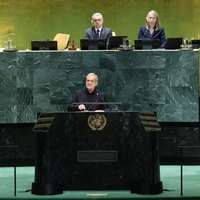
Iran’s deputy permanent representative to the United Nations denied reports that security forces have killed protesters, telling an emergency session of the UN Security Council on Thursday that such accusations are “fabricated narratives” promoted by the United States and its allies.
Gholamhossein Darzi said Iranian security forces were confronting armed “ISIS-style terrorist cells” and violent separatist groups, which he claimed were funded and armed by foreign actors, including Israel.
Darzi also rejected accusations that authorities imposed internet restrictions to conceal harm to civilians. He said the measures were temporary and necessary to counter cyberattacks, protect national infrastructure and disrupt what he described as “communications among terrorist networks” operating inside Iran.
Iran’s mission said Tehran does not seek escalation or confrontation but warned that any act of aggression would be met with a “decisive, proportionate and lawful response” under Article 51 of the UN Charter, adding that this was “a statement of legal reality, not a threat.”
"This regime ... cannot be reformed. Let me be very clear, the Islamic Republic behaves like ISIS, and the Islamic Republic must be treated like ISIS," exiled Iranian activist Masih Alinejad told the United Nations Security Council, referring to Islamic State.
She was invited to address the world body, which included a representative from Iran, by the United States.
"This is how you can save lives," added Alinejad, whom a jury in a federal case last year found had been targeted by assassins directed by the Islamic Republic.
US lawmakers issued a bipartisan letter on Thursday urging the Trump administration to take immediate action to support protesters in Iran amid an intensified internet blackout and security crackdown by the authorities.
Representatives Claudia Tenney, a Republican from New York, and Dave Min, a Democrat from California, on Thursday co-authored the pleas for the administration to help Iranians maintain access to communications tools as protests continue across the country amid an internet blackout.
The lawmakers said Iranian authorities have restricted mobile data, disrupted cellular networks and sought to block access to satellite-based services in an effort to suppress dissent. They warned that internet shutdowns are being used alongside mass arrests and deadly force against protesters.

A review of public statements by Iran’s senior officials since late December suggests a marked hardening of tone as protests escalated, a shift that coincided with a sharp intensification of the state’s security response.
The protests began on December 28 amid soaring inflation. It initially drew a more measured response from the government.
But following a surge in demonstrations on January 8, and especially after a Supreme Leader speech the following day, officials reverted to a familiar framing: unrest portrayed as a foreign-backed security threat demanding a forceful response.
In an interview with Al Jazeera broadcast between January 9 and 12, Foreign Minister Abbas Araghchi said protests had been peaceful from December 28 through January 7, but claimed that “armed terrorist elements linked to Israel and the United States” had subsequently turned them violent.
The judiciary soon echoed that framing.
Speaking to bazaar merchants on January 10, Chief Justice Gholamhossein Mohseni Ejei said protesters had initially “demanded the country’s progress,” avoiding direct reference to the violent response.
Three days later, he called for the immediate trial of detainees, and in a January 14 post on X announced plans to televise the trials of what he called the “main culprits” in order to expose their alleged foreign ties.
Around the same time, footage of Ejei interrogating a detainee on state television circulated on social media.
‘No peace, only war’
The rhetorical shift became unmistakable on January 9, when Khamenei delivered a speech that many observers viewed as pivotal. He described protesters as “rioters under foreign influence” and urged security forces to confront them sternly.
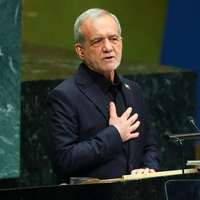
President Masoud Pezeshkian, who until then had acknowledged protesters’ grievances and expressed openness to dialogue, followed suit.
“(They are) violent terrorists and rioters brought from abroad to attack mosques and civilians,” he said, urging the public “to stop the terrorists.”
Other senior figures reinforced the message. Security Chief Ali Larijani said on January 11 that forces were “controlling the protests with minimal damage,” despite emerging videos of a bloody crackdown.
“There will be no peace and no ceasefire, only war,” he warned protesters.
‘Conspiracy’
Some civilian officials sought to strike a more conciliatory tone, though without challenging the core narrative. Government spokesperson Fatemeh Mohajerani condemned violence in general terms and said the internet blackout—entering its eighth day on Thursday—was a “temporary measure.”
Parliament Speaker Mohammad Bagher Ghalibaf said on January 13 that “protesting is the people’s legitimate right” and promised to address economic grievances, while also accusing protesters of “seeking violence.”
Military commanders, meanwhile, were more explicit. From January 8 through 14, senior officers repeatedly characterized the unrest as a “conspiracy” orchestrated by Israel and unnamed terrorist groups.
Army Commander Abdolrahim Mousavi praised the Basij domestic enforcement militia and police for “controlling the riots,” warned of possible direct military involvement, and described the protests as “a malicious conspiracy.”
Police Commander Ahmadreza Radan said “the level of confrontation has been raised,” warned that attacks on police stations “will not be tolerated,” and described police conduct as “mild” despite reports of mounting casualties.
Taken together, the statements reflect a rapid convergence among Iran’s political, judicial and security elites around a securitized narrative after January 8—one that recast the protests as an externally driven threat that can only be thwarted with bullets.
An open petition signed by more than 3,400 US-based Iranian technology professionals issued on Thursday called for the end of the Islamic Republic and urged the United States and other democratic countries to provide urgent support to protesters in Iran.
The petition was shared on X on Thursday by Kooshiar Azimian, an Iranian technology entrepreneur and investor, who invited others in the tech community to join and sign the statement.
According to the petition, the signatories include founders, engineers, investors and scientists working at major technology companies and institutions, including Google, Meta, Apple, Nvidia, Tesla, Amazon, Microsoft, MIT and Harvard.
The statement also endorses Reza Pahlavi, Iran’s exiled prince, as a "unifying transition figure", adding that opposition forces need coordinated leadership as protests continue inside Iran.
“Trump has said his hand is on the trigger. We will cut off his hand and his finger,” senior IRGC general and member of Iran’s Expediency Council, Mohsen Rezaei, said on Thursday, issuing a direct threat against US President Donald Trump.
Rezaei added hat Iran would no longer accept a ceasefire if the country is attacked. “If we move forward, there will be no talk of a ceasefire anymore,” he said.
“You do not pay attention to the restraint and strategic patience we have shown. Stop right now. Step back, otherwise none of your bases in the region will be safe.”