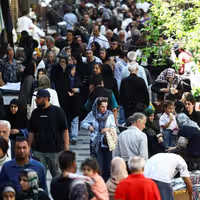
Iran has extended a temporary closure of its airspace to most flights, according to an aviation notice issued early Thursday amid fears of a US attack.
The NOTAM (Note to Airmen) shows the airspace will remain closed until 03:30 (UTC).

President Donald Trump wants any potential US military action against Iran to be “swift” and “decisive,” according to people familiar with internal discussions cited by NBC News, as uncertainty grows over Washington’s response to unrest inside the country.
The report said Trump and senior advisers have been weighing military options while closely monitoring developments in Iran, where protests and a heavy security response have raised fears of wider instability. Sources told NBC News that any operation, if ordered, would be designed to avoid a prolonged conflict.
The White House has not publicly confirmed plans for military action. Trump has repeatedly warned Iranian authorities over their handling of protests but has also said he is adopting a wait-and-see approach.
Iranian officials have accused the United States and Israel of fueling unrest and warned of consequences if foreign powers intervene.

Israel’s apparent inaction amid Iran’s widespread unrest may look counterintuitive, but it reflects a long-standing strategic calculation rather than hesitation.
The wave of protests arrived at a sensitive moment for Israeli Prime Minister Benjamin Netanyahu: as he was pressing US President Donald Trump to nod ahead another round of Israeli strikes against Iran, especially its missile program.
For years, Netanyahu has argued in Washington that Tehran’s challenge cannot be resolved through containment or diplomacy alone, but only through the collapse of the Islamic Republic.
Against that backdrop, one might have expected Israel to seize on Iran’s internal instability and move decisively against its strategic assets. Instead, restraint has become policy.
Netanyahu is aware that any visible Israeli role could serve the interests of Iran’s rulers—by discrediting protesters as foreign-backed agents or by giving Tehran justification to escalate militarily against Israel.
Cautious calculation
Several considerations reinforce Netanyahu’s caution.
Israel is still emerging from a recent military campaign and has little appetite for being drawn into another direct confrontation with Iran. At the same time, Netanyahu continues to prefer US leadership on the Iran file, a long-standing strategic priority.
From his perspective, the most effective—and legitimate—pressure on Iran, including any potential military action, must come from the United States rather than Israel.
There is also a deeper calculation at play. Netanyahu may believe the Islamic Republic is closer than at any point in decades to a breaking point, and that overt Israeli involvement could delay or derail that process.
From this view, Israel’s most effective contribution to regime destabilization is to avoid becoming the focal point of Iranian nationalism or regime propaganda.
Restraint: pros and cons
Yet restraint carries risks of its own.
Iran’s theocratic rule may survive the current unrest and seek to exploit its vulnerability by pursuing a renewed nuclear agreement with the West. For Israel, this is a deeply troubling scenario as it could ease economic pressure on Tehran and extend the life of the Islamic Republic without addressing Israel’s core security concerns.
Nor would every political transformation in Iran necessarily serve Israeli or American interests.
A pro-Western restoration, such as the return of the Shah’s son, is far from certain. Other outcomes could include further radicalization of the regime or a decision to accelerate its nuclear program, moving more decisively toward a nuclear weapon.
In short, Israel is not rushing to exploit Iran’s internal crisis. Despite longstanding fears over Iran’s military buildup and a fundamental desire for regime change, Netanyahu is pursuing a policy of restraint shaped by caution, timing, and deference to US leadership.
Even so, restraint does not guarantee insulation. Israel could still be drawn into a broader conflict—particularly if the United States launches a military strike and Iran chooses to retaliate against Israeli targets.
For now, Israel’s posture reflects a familiar strategic logic: hoping for the best, while preparing for the worst.

Iran’s foreign minister Abbas Araghchi blamed Israel and foreign “terrorist elements” for unrest inside the country and rejected reports that Iranian security forces carried out mass killings of protesters, during a contentious interview with Fox News host Brett Baier.
Araghchi said violence during the unrest was not the result of state repression but clashes between security forces and foreign-backed groups seeking to provoke the United States into war with Iran. “It was a fighting between our security forces and terrorist elements,” he said, describing the events as “a full-scale internal war.”
Baier repeatedly pushed back, citing witness accounts from inside Iran describing snipers firing into crowds, high numbers of casualties and videos showing bodies being removed from the streets, saying such reports contradicted Tehran’s account.
Araghchi dismissed those accounts as false, saying: “The footages that you mentioned have not been seen in Iran and it was a misinformation campaign is going on at the same time.”
On the death toll, Araghchi rejected figures cited by opposition figures and exiled Prince Pahlavi or more that 12,000, saying fatalities were “only hundreds” and that higher numbers were exaggerated.
When asked will be there any hanging in any days to follow, Araghchi said: "there is no plan for hanging at all."
A US carrier strike group is being relocated from the South China Sea to the CENTCOM area of responsibility, according to reporting from News Nation.
Wall Street Journal Journalist Laurence Norman shared the latest findings from Amnesty International regarding security forces' response to anti-government protests in Iran.
"According to evidence gathered by Amnesty International, security forces positioned on the streets and rooftops, including of residential buildings, mosques and police stations, have repeatedly fired rifles and shotguns loaded with…" the post said, referencing a larger Amnesty report on the crackdown.
“At least two videos show security forces chasing and directly firing at fleeing protesters who appear to pose no threat warranting the use of force, let alone firearms or other prohibited weapons," the post said.