Germany has issued a new directive cautioning the country’s airlines against entering Iranian airspace, Flightradar24 said on Wednesday, as European carriers adjust operations amid escalating tensions in the Middle East.
The move came shortly after Lufthansa said it would bypass Iranian and Iraqi airspace until further notice.
The airline added that it would operate only daytime flights to Tel Aviv and Amman from Wednesday through Monday next week, warning that some services could be canceled as a result.

Iranian authorities have significantly expanded the presence of security forces across multiple cities, tightening control to prevent further protests in what some residents inside Iran described as a 'de facto curfew.'
Multiple sources told Iran International that patrols and checkpoints were ubiquitous, with increased police and military deployments across urban centers, particularly in major cities.
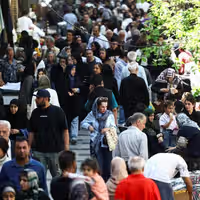
In Tehran, daily life has slowed markedly, with many shops closed and streets quieter than usual.
Residents said movement, communications, healthcare activity, and access to educational institutions are under tight government control, describing the capital as subdued and tense, with people avoiding unnecessary travel or gatherings.
"It's like a de facto curfew," one Tehran resident said.
In Karaj, residents said that because of the dense presence of security forces, people cannot even speak comfortably with one another. Similar conditions have been reported in multiple parts of the country.
The expanded security footprint follows what rights groups and media outlets describe as a bloody crackdown on the protests.
Iran International reported on Tuesday that at least 12,000 people have been killed nationwide since the unrest began, while CBS News, citing an Iranian official, said the death toll could be as high as 20,000.
Tehran rejected those figures on Wednesday, dismissing them as claims spread by what it called “Mossad-backed” media.
‘Help on the way’
On Tuesday, US President Donald Trump urged Iranians to remain in the streets and take over state institutions, telling protesters that “help is on the way,” while exiled prince Reza Pahlavi has also called on Iranians to continue demonstrations.
The calls from abroad for sustained protest appear to be colliding with a harsher reality on the ground—at least for now.
In Shiraz, sources said security conditions intensified earlier this week, with additional military units deployed and new restrictions imposed on movement. Local notices outlining the presence of armed forces and limits on traffic circulated in the city, though no nationwide emergency measures have been formally announced.
In Sanandaj, residents reported an expanded security presence beginning earlier this week, including personnel they described as speaking Arabic rather than Persian.
Similar observations have been reported by sources in other western regions, though the identities and affiliations of the forces could not be independently verified.
Some protesters and observers alleged that forces affiliated with the Islamic Revolutionary Guard Corps, including Afghan and Iraqi recruits, have been mobilized and organized at specific locations, including a mosque in Tehran’s Gholhak district.
Iranian authorities have not commented on these claims.
US President Donald Trump said he's been informed that the killing has stopped in Iran.
"They're not going to have an execution, which a lot of people were talking about for the last couple of days, today was going to be the day of execution," he told reporters.
“We've been told that the killing in Iran is stopping, stopped, and stopping. And there's no plan for executions or an execution or execution. So I've been told that in good authority,” Trump said.
“But that's just gotten to me from information that the killing has stopped, that the executions have stopped,” he added.
Asked whether military action against Iran was now off the table, Trump said: “We’ll watch and see what the process is, but we’ve been given a very good statement by people that are aware of what’s going on.”
G7 nations on Wednesday said they were “gravely concerned” by developments surrounding the ongoing protests in Iran, warning that further sanctions could follow if the authorities continue their violent crackdown.
In a joint statement, the foreign ministers of Canada, France, Germany, Italy, Japan, the United Kingdom and the United States, along with the European Union’s high representative, said they were “deeply alarmed at the high level of reported deaths and injuries” linked to the unrest.
The G7 urged Iranian authorities to “exercise full restraint, refrain from violence, and uphold the human rights and fundamental freedoms of Iran’s citizens.”
“The members of the G7 remain prepared to impose additional restrictive measures if Iran continues to crack down on protests and dissent in violation of international human rights obligations,” the statement said.

A 25 percent tariff on US imports from any country that trades with Iran appears aimed at punishing third countries, but it is likely to hit Tehran far harder.
The proposed secondary tariffs were announced by President Donald Trump earlier this week in response to a violent crackdown on protesters in Iran.
Some commentators have questioned whether such measures could be enforced, pointing to Iran’s trade links with more than 140 countries. Others have focused on China’s open opposition, noting that Beijing is Iran’s largest trading partner.
Yet recent experience suggests that secondary tariffs can be far more damaging to the sanctioned country than to those doing business with it.
What past examples say?
A telling precedent is the United States’ action against India over its imports of Russian oil in late August last year. Although the mechanics differed, the effect became clear within months.
By late 2025, Russian crude was selling at discounts of up to $20 to $30 per barrel compared to discounts of around $3 per barrel in summer and $10 in autumn. Even at a discounted price, Russia’s oil exports to India fell by 29 percent in December compared with the previous month.
The pain, in short, was absorbed primarily by Russia, not India.
US Census Bureau data show that despite the imposition of 25 percent tariffs on Indian goods, India’s exports to the United States did not decline significantly. Cheap Russian oil helped Indian refiners remain competitive.
China’s experience tells a similar story. While Chinese exports to the United States fell by about 20 percent in 2025 under US tariffs, China’s total global exports grew by 5.5 percent. Supported by discounted Russian oil and gas, Beijing posted a record $1.2 trillion trade surplus.
Taken together, these cases suggest that secondary tariffs tend to extract concessions from the sanctioned exporter rather than meaningfully penalizing its trading partners.
How secondary tariffs on Iran would work?
Washington has yet to publish detailed guidance on how the proposed 25 percent tariff would be applied. Still, Trump’s public statements indicate that the measure would not be limited to countries purchasing Iranian crude oil.
As with its oil exports to China, Tehran would likely be forced to lower prices across a wide range of goods so that buyers can offset the cost of tariffs imposed on their exports to the United States.
Even if secondary tariffs were applied only to buyers of Iranian energy and petrochemical products, the impact would be severe.
According to data from the commodity intelligence firm Kpler, seen by Iran International, Iran currently exports around 1.3 million barrels per day of crude oil—almost all to China.
It also exports more than half that volume in refined petroleum products, primarily to the United Arab Emirates, Turkey, Iraq, India, and Pakistan.
Annual revenues from liquefied petroleum gas exceed $10 billion, fuel oil generates roughly $7 billion, and gas exports about $5 billion. When petrochemical shipments are included, income from these products roughly matches Iran’s crude oil earnings.
Here, too, vulnerabilities are mounting.
Iran’s 25-year gas supply contract with Turkey is set to expire in five months, with no indication that Ankara intends to renew it. Gas deliveries to Iraq have also been halted because of domestic shortages, prompting Baghdad to seek alternative suppliers.
Tehran shouldering the costs
The United Arab Emirates—the largest buyer of Iranian fuel oil and a major importer of Iranian LPG—maintains extensive economic ties with the United States, making it unlikely to risk exposure to secondary tariffs.
Other Asian buyers, including India, Singapore, Malaysia, and Pakistan, import Iranian products in volumes too small to justify jeopardizing access to the US market.
The most likely outcome is that Iran will once again be pushed to rely overwhelmingly on China, offering steep discounts to preserve market share.
If implemented, secondary tariffs would not isolate Iran’s trading partners so much as narrow Iran’s options, deepen its dependence on a single buyer, and erode its earnings at a moment of acute domestic and fiscal strain.
In that sense, the policy may prove more damaging than conventional sanctions—by forcing Iran itself to absorb the cost of maintaining its already limited presence in the global economy.

The United States and its regional partners have established a new air and missile defense coordination cell at Al Udeid Air Base in Qatar to strengthen integrated defenses across the Middle East, US Central Command said on Wednesday.
The Middle Eastern Air Defense – Combined Defense Operations Cell is based within the Combined Air Operations Center at Al Udeid and is staffed by US personnel and regional partners.
“This is a significant step forward in strengthening regional defense cooperation,” CENTCOM commander Navy Admiral Brad Cooper said, adding that the new cell would improve coordination and information-sharing on air and missile defense responsibilities.