The widely circulated video appears to show an elderly cleric who identifies himself as Ali Kashani. Responding to a question from a woman filming him on a busy street that appears to be in Tehran, he says he opposes what he calls a “criminal and murderer” government as shoppers and passersby move through the scene.
In the footage, he denounces Ruhollah Khomeini, founder of the Islamic Republic, and what he describes as “his sedition,” saying it has harmed the people, the country and religion, and calls on people to rise up against it. A woman off camera is heard chanting “Death to Khamenei” and insulting Khomeini, while the cleric signals approval.
A notable feature of the current wave of protests has been the visible turnout in Mashhad, Iran’s second-largest city, and Qom, a center of Shi’ite seminaries. Both cities have long been seen as bastions of hardline clerics who wield influence over local governance, including the appointment and removal of officials.
During recent demonstrations, protesters in several cities chanted slogans such as “Clerics must go and get lost” and “Until clerics are in shrouds, the homeland will not be free.”
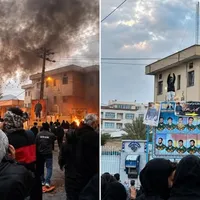
In several cities, protesters have used anti-clerical slogans, and some have targeted religious sites, with reports that a seminary in Mashhad and a mosque at Kaj Square in Tehran were set on fire.
During the earlier “Woman, Life, Freedom” protests, videos of people knocking off clerics’ turbans also spread widely, becoming a symbol of opposition to the religious establishment.
Secularization of Iranian society
The Iranian government has long sought to present public religious rituals – such as Ashura commemorations, which many Iranians continue to observe annually – as evidence of popular support for the Islamic Republic. However, many analysts argue that Iranian society has moved closer to secularism in recent years than at any time since the 1979 revolution.
Even among those who maintain religious beliefs, hostility toward religious governance has grown. For most Iranians, religion is increasingly seen as a personal matter rather than a political system.
In February 2024, the results of a confidential research report commissioned by state institutions were leaked. The study was based on face-to-face interviews with more than 15,000 randomly selected individuals aged over 15 across Iran. According to the findings, over 70% of respondents supported the separation of religion and politics, while only slightly more than 20% opposed it.
The same survey found that 85% of respondents believed religious observance among the population had declined compared with five years earlier, and more than 80% expected society to become even less religious over the following five years.
Online reactions
Within a short time of being posted, the video was viewed hundreds of thousands of times and drew strong reactions before internet access was fully shut down.
Many users accused the cleric of opportunism, arguing he had shifted his position because he believed the Islamic Republic’s collapse was imminent.
One user wrote: “Why the rush now? He could have waited another 46 years to testify to these Islamic crimes and plunder.” Another wrote: “A good cleric is a dead cleric… die and make a nation happy.”
Another commenter wrote: “Don’t be fooled by clerics. Anyone who still gets excited by these words after 47 years of humiliation under clerical rule is nothing but a traitorous fool.
A good cleric is a dead cleric.” Another wrote: “If there were any honorable clerics, they would have abandoned this robe and turban – symbols of oppression – long ago.”
A few users sought to distinguish between ideology and appearance. One wrote: “When I say ‘death to clerics,’ I mean death to that outdated political and ideological system – not the person’s clothing.” Some users, however, expressed cautious agreement with the cleric’s remarks. One wrote: “I don’t care about his clothes or his profession, but he’s telling the truth. No one has harmed religion the way they have.”
A pro-government user reacted angrily, writing: “This cleric is an infidel who thinks religion is nothing but myths and stories. Imam Khomeini and Imam Khamenei are no less than prophets and divinely appointed imams, like Imam Ali and Imam Hussein.”