As protests spread in Iran, official denial deepens
State media in Iran are portraying the country as calm, even as rights groups and videos emerging from streets point to expanding protests and intensifying repression.
State media in Iran are portraying the country as calm, even as rights groups and videos emerging from streets point to expanding protests and intensifying repression.



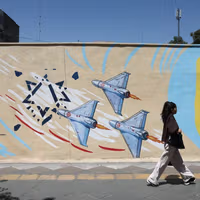
Tehran appears to be placing growing emphasis on its ballistic missile program amid continued domestic unrest and the looming possibility of US intervention in support of protesters in Iran.
That assessment was underscored on Tuesday by a statement from Iran’s Defense Council, formed after the June war with Israel, which warned that the country could respond before an attack if it detected clear signs of a threat.
In remarks carried by state media, the council said Iran did not consider itself restricted to responding only after an action had taken place and would treat “tangible signs of a threat” as part of its security calculus.
The warning came amid an escalating war of words between Tehran and Washington, with President Donald Trump recently cautioning that the United States would act if Iranian security forces continued killing protesters.
Signaling deterrence
Against that backdrop, Iranian officials have sought to project readiness while downplaying the likelihood of immediate war.
“We will not launch a pre-emptive strike unless our military commanders deem it necessary,” Abolfazl Zohrevand, a member of parliament’s national security committee, said on Tuesday—suggesting that while escalation is not inevitable, the option of striking first remains firmly on the table.
Since late December, reports from international outlets such as Euronews, alongside eyewitness accounts shared online, have pointed to sightings of missile trails over several cities, including Tehran, Mashhad and Kermanshah.
Iranian authorities have not commented publicly on the reports, but they have reinforced the sense that missiles have become the most visible pillar of Iran’s deterrence posture.
The moderate outlet Khabar Online wrote on Monday that the reported missile activity suggested “a shift in Iran’s strategy against Israel,” arguing that Tehran was now prioritizing the restoration of its missile capabilities while keeping its nuclear program in the background.
Gearing for conflict?
Other state-aligned media have been more explicit.
In a January 6 commentary, the Asia News website argued that recent missile and air-defense drills were intended to test and showcase Iran’s capabilities, improve coordination among the Islamic Revolutionary Guards Corps, the regular army and air-defense units, and send a deterrent signal to Israel and the United States.
It added that nighttime operations were designed to enhance combat readiness under low-visibility conditions.
Given that Asia News is primarily an economic outlet with no military specialization, analysts say such commentary may reflect messaging prepared by military sources rather than independent assessment.
Analysts also caution that the quieter nuclear posture may reflect financial constraints and a desire to avoid drawing US attention at a moment of intense scrutiny of Iran’s nuclear facilities, rather than a fundamental change in long-term strategy.
As Khabar Online itself noted with thinly veiled irony, “this shift in Iran’s strategy is likely to pave the way for more complex security competition rather than reducing tensions.”
State media in Iran are portraying the country as calm, even as rights groups and videos emerging from streets point to expanding protests and intensifying repression.
As the tenth day of unrest wraps up, Tehran appears to be pursuing a dual control strategy: widespread arrests of individuals described as riot leaders, alongside intensified news censorship and tighter restrictions on internet access.
The website Asr-e Iran reported on Tuesday that not a single reporter or photographer from non-state outlets is currently permitted to conduct field coverage of demonstrations.
During the early days of the unrest, state media—including the national broadcaster—unexpectedly aired limited and heavily censored coverage of protests.
Some appeared to validate people’s right to protest, signaling a brief opening toward a more conciliatory stance.
Khamenei intervention
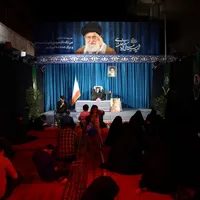
That tone shifted sharply after Supreme Leader Ali Khamenei’s speech on Saturday, in which he rejected any accommodation with those he described as “rioters.”
Since then, official rhetoric has again turned confrontational, even as protests and strikes have continued to spread.
On Monday night, large crowds took to the streets in eastern Tehran, an area traditionally regarded as a conservative stronghold.
On Tuesday, bazaar merchants once again closed their shops and took to surrounding streets in numbers not previously seen in online videos since the protests began.
Footage circulating on social media appears to show a noticeable increase in the number of demonstrators in several other cities as well.
It also points to the spread of strikes to Kurdish regions, where political parties have called on residents to join work stoppages starting Thursday.
‘Enemy conspiracy’
Despite this, official and semi-official outlets have insisted that the unrest is fading.
The Revolutionary Guards-affiliated Fars News Agency claimed on Tuesday that “riotous movements” had declined sharply since Monday night and were limited to a few locations.
“People, despite having grievances about living conditions and high prices, have shown no support for these riots or even street protests,” Fars asserted.
Hossein Shariatmadari, the editor of the hardline Kayhan, which is funded by the office of the Supreme Leader, went further, claiming that a planned “enemy conspiracy” had been neutralized thanks to the “vigilance, faith and devotion” of bazaar merchants and the public.
Feeble administration
The administration of President Masoud Pezeshkian, by contrast, has sought to strike a more restrained tone—though with limited influence over events unfolding on the streets.
On Tuesday, Mehdi Tabatabei, one of the president’s deputies, wrote on X that it was the government’s duty to hear protesters’ voices and respond to their “reasonable” demands, arguing that the line between protest and “riot” lay in avoiding violence.
The administration has also tasked a committee with probing security forces’ attack on a hospital in Ilam where protesters had sought refuge.
Writing in the daily Ham-Mihan, moderate pundit Abbas Abdi warned that officials were mistaken to believe the unrest could simply be “wrapped up” without addressing its underlying causes.
A society protesting for multiple reasons, he wrote, including economic hardship, retains a high potential for renewed unrest even after periods of enforced silence.
One defining feature of the current wave of protests has been its expansion into smaller towns grappling with poverty and unemployment.
Another, more telling—and ignored characteristically by pundits who address Pezeshkian and not Khamenei—is the growing irrelevance of the civilian administration at moments like this, when the confrontation crystalises into protesters against the security apparatus.
Tehran’s plan to distribute cash handouts to nearly the entire population appears aimed at calming protests driven by relentless price increases. Whether it will work remains an open question.
Officials say the payments are meant to offset the elimination of a subsidized exchange rate previously used to import essential goods, a policy shift that has already pushed prices higher.
Under the plan, the government would issue monthly coupons worth one million tomans—about $7 at the open-market rate—to every Iranian.
Some economists have questioned whether the measure can achieve its stated aim.
In an editorial published on January 5, the daily Setareh Sobh described the policy as an “economic gamble,” warning that similar efforts in the past had failed to stabilize prices or restore public confidence.
The paper noted that Iran’s currency has lost roughly 20,000 percent of its value since the 1979 revolution, when the dollar traded at seven tomans.
“This devaluation,” the daily wrote, “is the result of policies such as hostage-taking, hostility toward the West and Israel, mismanagement and the exclusion of experts from parliament and government.”
Questions of feasibility
Mahmoud Jamsaz, a leading Iranian economist, went further, arguing that the handouts risk aggravating the very pressures they are meant to relieve.
“Under current conditions,” he wrote, “the president knows very well he lacks the executive power even to pay government employees’ salaries.”
The government has acknowledged inflationary risks. Fatemeh Mohajerani, a government spokeswoman, told reporters on Sunday that the policy could raise prices of some essential goods by 20 to 30 percent.
Labor Minister Ahmad Maydari said the payments would be issued as coupons redeemable for basic commodities, rather than cash transfers, in an effort to limit price pressures.
Still, critics question whether the state has the fiscal capacity to sustain such a program, particularly as tax revenues are already under strain.
A broader breaking point
Public reaction has been largely dismissive.
On social media, many pointed to continued protests despite the announcement, stressing that rising prices were only one factor behind demonstrations that have spread across more than 200 cities and towns.
Sociologist Taghi Azad Armaki told the Shargh newspaper that the unrest reflected “accumulated, unresolved social and political challenges,” adding that economic hardship had exposed deep divides within Iranian society.
“These gaps,” he said, “have eroded the government’s social capital and heightened concerns about the country’s future.”
Reformist commentator Abbas Abdi echoed that concern in Etemad, warning that Iranian society had reached a critical threshold. “Society has a breaking point,” he said, “and Iran is rapidly approaching it.”
Even Iran’s tightly controlled press has increasingly described the demonstrations as political in character, reflecting broader dissatisfaction with governance rather than price levels alone.
For now, the government appears to be betting that targeted relief can buy time. Whether it can ease public anger—or instead accelerate inflation while leaving deeper grievances unresolved—remains uncertain.
The seizing of Venezuela’s Nicolas Maduro by US forces over the weekend has sharpened debates in Tehran about President Donald Trump’s endgame in Iran, as anti-government protests across the country enter a second week.
The episode has prompted comparisons—sometimes uneasy, sometimes fiercely rejected—between Venezuela’s trajectory and Iran’s own.
Strikes and protests have spread to dozens of Iranian cities in recent days, sharpening questions about economic exhaustion and public legitimacy.
Former Iranian diplomat Fereydoun Majlesi told the Shargh newspaper that Maduro’s detention reflected Washington’s current logic: maximal displays of power and deterrence. “Maduro’s arrest was not just a political act but a deterrent message to other players,” he said.
Foreign policy analyst Ali Bigdeli also told Shargh that while a direct U.S. attack on Iran would require congressional approval, the Venezuela episode showed that covert actions or security pretexts remained possible.
“Without a serious revision of foreign policy and adaptation to new global conditions, continuing the old path will not only fail but impose greater costs,” he warned.
‘Erosion of trust’
Even sources close to the establishment reflected unease, albeit more subtly.
Khabar Online, a moderate outlet close to security chief Ali Larijani, highlighted US sanctions on Venezuela while also pointing to mismanagement and corruption.
“Maduro’s fall was not the product of a single factor, but the outcome of accumulated crises long ignored,” the commentary argued, landing on a phrase widely used in reference to Iran’s own condition: “erosion of public trust.”
Political analyst Sadegh Maleki was more direct.
“Maduro, like (Syria’s) Assad, ruled without heartfelt popular backing,” he told Shargh. “Governments that create distance between themselves and the people are more vulnerable to external operations.”
‘Not comparable’
Conservative voices, however, moved quickly to dismiss any analogy. Gholamreza Sadeghian, editor-in-chief of the Revolutionary Guards-affiliated Javan daily, was blunt in his assessment. “Iran Is Not Comparable—Don’t Waste Your Time,” he headlined his Sunday editorial.
Washington’s threats, Sadeghian wrote, were not a sign of strength but part of a “repetitive and failed spectacle,” adding that “America neither has the capacity for final victory nor the ability to reshape the global order in its favor.”
Hardline newspapers denounced the US action as an “open kidnapping,” a “violation of the UN Charter,” and a “raid on Venezuela’s oil.”
Commentators argued that Washington’s aim was to gain leverage over global energy markets and consolidate geopolitical influence by controlling the country’s vast reserves.
The lesson, hardliners argued, was that Iran should never engage in talks with the United States, noting that Maduro was detained shortly after he signaled readiness to negotiate with Trump.
‘Military power not enough’
Kayhan newspaper, which is funded by the office of Iran’s Supreme Leader, claimed that Venezuelans had taken to the streets in support of Maduro and declared they would not allow their country to be occupied.
Ultraconservative lawmaker Javad Karimi-Ghodousi went further, predicting that Maduro would return to Venezuela “as a hero.” Trump, he added on X, would “be slapped by America’s revolutionary youth and fall into the dustbin of history.”
A more measured assessment came from the moderate outlet Rouydad24.
An editorial argued that the two countries’ situations were fundamentally different and rejected “fear of collapse,” while still suggesting that Maduro’s fate offered a lesson for Tehran on the need to address economic and social demands.
“Venezuela showed that even military structures cannot endure without sustainable social backing,” the site wrote.
As protests once again ripple across Iran, the country’s political establishment is moving quickly to revive an economic reform agenda that many Iranians say no longer speaks to the core of their anger.
While demonstrators chant against the entire system, the government of President Masoud Pezeshkian has focused its response on reshuffling economic managers and pressing ahead with long-delayed currency reforms, betting that technical fixes can still defuse a crisis that has increasingly become political.
The renewed unrest was triggered by a sharp bout of currency volatility that briefly pushed the U.S. dollar to around 1.45 million rials on the open market, intensifying already high inflation and accelerating the erosion of purchasing power.
“Protesting the dollar is protesting instability; protesting a life that cannot be planned,” wrote journalist Mustafa Danandeh in the daily Ettelaat. “People who do not know whether six months from now their rent will double, medicine will be available, or their job will survive.”
A new old face
In response, Pezeshkian reshuffled the leadership of the Central Bank of Iran, reappointing Abdolnaser Hemmati and reviving a controversial push toward a single exchange rate—an idea long advocated by economists but repeatedly stalled by politics, sanctions and entrenched interests.
Hemmati, a prominent centrist figure, had been forced out less than seven months into his tenure as economy minister after parliament impeached him over exchange-rate volatility.
His return—this time to a post that does not require parliamentary approval—has infuriated hardline lawmakers and highlighted widening rifts within the political elite.
“This explicitly ignores parliament’s vote and shows disregard for the will of representatives,” said Zeynab Gheisari, an ultra-hardline lawmaker from Tehran. Another hardline legislator, Amir-Hossein Sabeti, said the move demonstrated the government’s “disregard for the people and the country’s economy.”
In his first public remarks after the appointment, Hemmati laid out familiar priorities: controlling inflation, managing the foreign exchange market and tightening oversight of banks.
It’s the economy—or is it?
The reform effort centers on dismantling Iran’s multi-rate currency regime, a system dating back to the Iran–Iraq war of the 1980s, when preferential exchange rates were introduced to subsidize essential imports. Over time, the widening gap between official and market rates turned the system into a major source of rent-seeking, corruption and uncertainty.
As the business news outlet Tejarat News noted, the policy “failed to provide sustainable support for domestic producers and created severe uncertainty for investment and production planning.”
The Entekhab news site cautioned that in an economy burdened by sanctions, fiscal shortfalls and political distrust, inflationary expectations tend to regenerate quickly once short-term interventions fade.
On Thursday, the president announced the immediate elimination of the subsidized exchange rate of 285,000 rials per dollar for basic goods and animal feed imports, saying the subsidy would instead be transferred directly to consumers to eliminate “rent, bribery and corruption.”
In unusually blunt remarks, Pezeshkian acknowledged that public anger was directed at the state itself. Dissatisfaction, he said, was the government’s responsibility, adding that “there is no need to look for America to blame.”
Many protesters appear keenly aware that Pezeshkian’s authority is tightly constrained by entrenched power centers, a reality reflected in slogans that target the theocratic system itself and its supreme leader rather than the exchange rate.