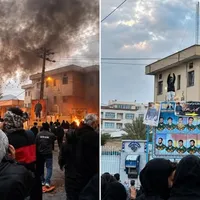
German Green MEP Hannah Neumann said on Monday that eight days of nationwide protests and student strikes across more than 78 cities show Iranians have reached a “breaking point.”
“For eight days, people in Iran are protesting because daily life has become impossible. Protests and student strikes have continued across more than 78 cities. Despite intimidation, violence and death, people keep showing up. It’s not about a moment, it’s about a breaking point,” Neumann posted on X.
Neumann, who chairs the European Parliament’s Delegation for Relations with Iran, also addressed the violence in the streets against protesters.
“There are growing reports of live ammunition, pellet guns, mass arrests and targeted internet disruptions, cutting people off from each other and from the world. This is a regime afraid of its own people, turning fear into violence,” she said.
“At its core, it’s simple: Iranians are asking for dignity, for safety, for the right to speak without being shot. Europe has a responsibility to stand clearly with people who are asking for rights that should never require courage, and to insist on accountability when those rights are denied,” Neumann said.
Former US ambassador to the UN Nikki Haley said on Monday that the Iranian people have endured decades under a “corrupt and extremist” system and praised their courage as “powerful,” voicing support for the latest protest wave in a post on X.
“The Iranian people have suffered tremendously under a corrupt and extremist regime for nearly fifty years. Their voices and their courage are powerful.”

The US capture of Nicolas Maduro, a staunch ally of Iran's theocratic rulers, has cast doubt on whether Venezuela will ever pay its reported two-billion debt to Tehran should Caracas flip into an ally of Washington.
Following a US attack on Venezuela on January 3 and the arrest of Maduro, its economic muddle is unchanged. Unpaid debts, legal claims and arbitration rulings total between $150 billion and $170 billion.
The scale of liabilities far exceeds the capacity of Venezuela’s collapsed economy, casting doubt on whether creditors will recover their losses.
Iran is among the countries exposed to the fallout. Analysts say the Islamic Republic is not just a conventional creditor but potentially one of the main financial losers of any transformational change in Caracas, especially as it is sanctioned by the United States.
Over nearly two decades, Tehran spent around 2 billion of dollars in Venezuela according to Iranian media.
The economic projects ranged from joint automobile production projects launched in 2007, housing schemes estimated at about 23,000 units, banking cooperation and oil and logistical exchanges carried out under sanctions.
Iran also used Venezuela as a political and logistical base to bypass international sanctions and advance regional objectives.
According to Heshmatollah Falahatpisheh, a former head of Iran’s parliamentary national security commission, Venezuela's debts to Iran reflect only officially recorded investments and assistance.
No estimates exist for the value of undeclared financial flows linked to what the US calls smuggling networks or military and security cooperation between the two allies, due to their classified nature.
Venezuela’s debt crisis dates back to large-scale nationalizations carried out between 2007 and 2012 under Hugo Chávez and the early years of Maduro’s rule, when foreign oil, mining and industrial assets were seized. Western companies later secured arbitration rulings, which Venezuela failed to pay.
From 2018 onward, US courts recognized those rulings as enforceable debt, allowing creditors to pursue Venezuelan assets abroad. Venezuela’s first bond default in 2017 accelerated the crisis, with unpaid principal and interest accumulating into tens of billions of dollars.
The International Monetary Fund estimated Venezuela’s nominal GDP at about $82.8 billion in 2025, far below its total external debt. Creditors have since focused on foreign assets, particularly Citgo Petroleum in the United States, whose ownership has been contested in US courts since 2019.
With Maduro removed from power, Venezuela’s debt case has moved out of political limbo. However, it is unlikely that losses tied to Iran’s investments in Venezuela will be recovered through US courts, given Iran’s own sanctioned status and the scale of competing claims.
At least 1,000 people have been arrested in connection with the ongoing protests in Iran, Norway-based human rights organization Hengaw reported on Monday citing documents and information it has obtained.
So far, Hengaw has verified the identities of 400 individuals. Of those whose identities have been confirmed, 41 are children and 33 are women.
At least 170 Kurdish citizens are also among the detainees whose identities have been verified, the report said.

The seizing of Venezuela’s Nicolas Maduro by US forces over the weekend has sharpened debates in Tehran about President Donald Trump’s endgame in Iran, as anti-government protests across the country enter a second week.
The episode has prompted comparisons—sometimes uneasy, sometimes fiercely rejected—between Venezuela’s trajectory and Iran’s own.
Strikes and protests have spread to dozens of Iranian cities in recent days, sharpening questions about economic exhaustion and public legitimacy.
Former Iranian diplomat Fereydoun Majlesi told the Shargh newspaper that Maduro’s detention reflected Washington’s current logic: maximal displays of power and deterrence. “Maduro’s arrest was not just a political act but a deterrent message to other players,” he said.
Foreign policy analyst Ali Bigdeli also told Shargh that while a direct U.S. attack on Iran would require congressional approval, the Venezuela episode showed that covert actions or security pretexts remained possible.
“Without a serious revision of foreign policy and adaptation to new global conditions, continuing the old path will not only fail but impose greater costs,” he warned.
‘Erosion of trust’
Even sources close to the establishment reflected unease, albeit more subtly.
Khabar Online, a moderate outlet close to security chief Ali Larijani, highlighted US sanctions on Venezuela while also pointing to mismanagement and corruption.
“Maduro’s fall was not the product of a single factor, but the outcome of accumulated crises long ignored,” the commentary argued, landing on a phrase widely used in reference to Iran’s own condition: “erosion of public trust.”
Political analyst Sadegh Maleki was more direct.
“Maduro, like (Syria’s) Assad, ruled without heartfelt popular backing,” he told Shargh. “Governments that create distance between themselves and the people are more vulnerable to external operations.”
‘Not comparable’
Conservative voices, however, moved quickly to dismiss any analogy. Gholamreza Sadeghian, editor-in-chief of the Revolutionary Guards-affiliated Javan daily, was blunt in his assessment. “Iran Is Not Comparable—Don’t Waste Your Time,” he headlined his Sunday editorial.
Washington’s threats, Sadeghian wrote, were not a sign of strength but part of a “repetitive and failed spectacle,” adding that “America neither has the capacity for final victory nor the ability to reshape the global order in its favor.”
Hardline newspapers denounced the US action as an “open kidnapping,” a “violation of the UN Charter,” and a “raid on Venezuela’s oil.”
Commentators argued that Washington’s aim was to gain leverage over global energy markets and consolidate geopolitical influence by controlling the country’s vast reserves.
The lesson, hardliners argued, was that Iran should never engage in talks with the United States, noting that Maduro was detained shortly after he signaled readiness to negotiate with Trump.
‘Military power not enough’
Kayhan newspaper, which is funded by the office of Iran’s Supreme Leader, claimed that Venezuelans had taken to the streets in support of Maduro and declared they would not allow their country to be occupied.
Ultraconservative lawmaker Javad Karimi-Ghodousi went further, predicting that Maduro would return to Venezuela “as a hero.” Trump, he added on X, would “be slapped by America’s revolutionary youth and fall into the dustbin of history.”
A more measured assessment came from the moderate outlet Rouydad24.
An editorial argued that the two countries’ situations were fundamentally different and rejected “fear of collapse,” while still suggesting that Maduro’s fate offered a lesson for Tehran on the need to address economic and social demands.
“Venezuela showed that even military structures cannot endure without sustainable social backing,” the site wrote.

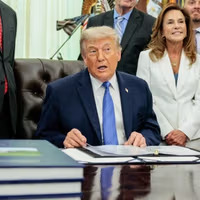
US President Donald Trump is seen holding a signed “Make Iran Great Again” cap in a photo alongside Republican Senator Lindsey Graham.
"God bless and protect the brave people of Iran who are standing up to tyranny," Graham said in a post sharing the photo.